
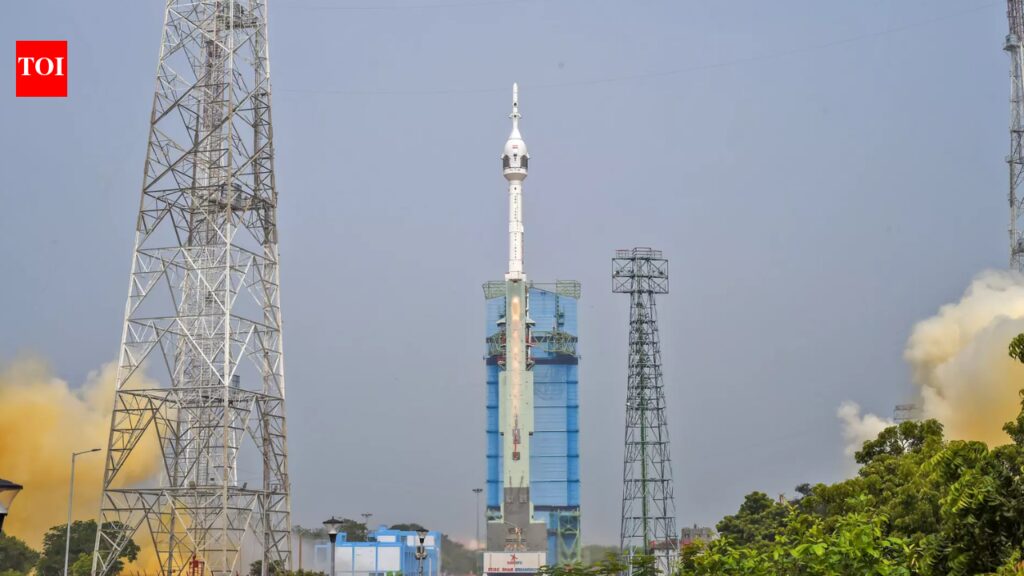
 BENGALURU: India and the US are set to deepen their space partnership with an ambitious agenda that includes demonstrating uncrewed docking capabilities with the International Space Station (ISS) under India’s Gaganyaan programme.According to a presentation by Isro chairman V Narayanan reviewed by TOI, the future cooperation areas span three key areas of collaboration between the two nations’ space agencies.The first involves comprehensive training of Isro personnel, including astronauts, at NAsa facilities across multiple domains, including robotics systems, extravehicular activity (EVA), extravehicular mobility unit (EMU) systems, resource management, space medicine and spaceflight operations, LEO and lunar mission control operations, rendezvous and docking procedures, and payload and science operations.An important initiative outlined is the uncrewed docking demonstration of India’s Gaganyaan Orbital Module with the US Orbital Segment of the ISS — this would mark a significant technological milestone for India’s human spaceflight programme. The third area focuses on cooperation in docking, berthing, and inter-operability systems. These developments will be discussed at the 9th meeting of the India-USA Civil Space Joint Working Group (CSJWG), scheduled to be hosted by India in Bengaluru during April-May 2026.On the civil space front, Narayanan highlighted India’s engagement with the Artemis Accords. India signed the Accords on June 21, 2023, and has since taken part in annual workshops and principals’ meetings. In 2025, India led discussions on science data-sharing at the Artemis workshop in Abu Dhabi. Isro was also present at the Artemis Accords principals’ meeting held on the margins of the International Astronautical Congress (IAC) in Sydney in Oct 2025.Beyond human spaceflight and lunar frameworks, the partnership extends to operational data exchange. Isro and the US Geological Survey share data between India’s Resourcesat-2 and the US Landsat-8 satellites for natural resources assessment and environmental studies. With the US National Oceanic and Atmospheric Administration (NOAA), India exchanges Earth observation data, particularly from the EOS-6 satellite, for weather forecasting and ground station use.Under an agreement with US Space Command, Isro receives high-accuracy data and alerts related to space situational awareness. Academic links also feature, with students from the Indian Institute of Space Science and Technology pursuing higher studies at Caltech under the Satish Dhawan Endowed Fellowship.Lunar missions remain an area of cooperation. Chandrayaan-1 carried Nasa’s MiniSAR and Moon Mineralogy Mapper payloads, contributing to the discovery of water molecules on the Moon. Nasa’s Laser Retro Reflector Array flew on Chandrayaan-2 and Chandrayaan-3, and high-resolution images from Chandrayaan-2 have supported Nasa’s Viper mission planning.Narayanan traced the relationship back to 1963, when Nasa’s Nike-Apache sounding rocket was launched from India. The 1975 Satellite Instructional Television Experiment using Nasa’s ATS-6 satellite, remote sensing studies in the 1970s, and joint agricultural and hydrology experiments laid the groundwork for a partnership that now spans low-Earth orbit to the lunar surface.
Capt Shubhanshu Shares What India Can Learn from ISS Successes