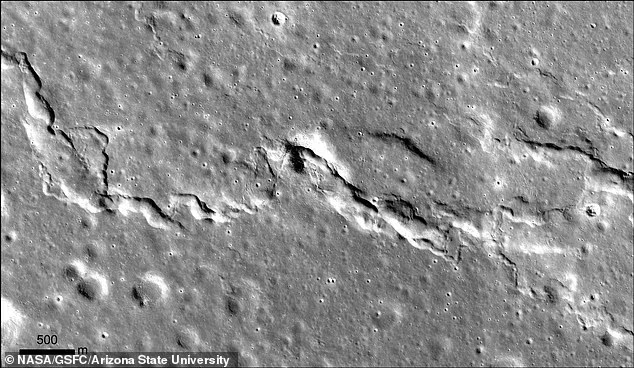
Researchers have uncovered more than a thousand previously unknown tectonic ridges across the Moon’s dark plains, showing the Moon is still contracting and reshaping itself. These features are among the youngest geological structures on the lunar surface. Because they form through the same forces linked to past moonquakes, they could signal new seismic hotspots The findings, published in *The Planetary Science Journal*, come from scientists at the National Air and Space Museum’s Center for Earth and Planetary Studies and their collaborators
For the first time, scientists show that these ridges are relatively young and spread widely across the lunar maria, the broad, dark plains visible from Earth. By determining how SMRs form, the team has also identified new potential sources of moonquakes that could influence where future lunar missions choose to land.
The Moon does not have plate tectonics. Instead, stress builds up within its single, continuous crust. That stress produces distinctive landforms. One well known example is lobate scarps, ridges created when the crust compresses and one section is pushed up and over another along a fault. These scarps are common in the lunar highlands and formed within the last billion years, about the most recent 20% of the Moon’s history. In 2010, co author Tom Watters, a senior scientist emeritus at the Center for Earth and Planetary Studies, found evidence that the Moon is gradually shrinking. As the interior cools, the surface contracts, creating the compressional forces that formed lobate scarps in the highlands

1 Comment
Researchers have uncovered more than a thousand previously unknown tectonic ridges across the Moon’s dark plains, showing the Moon is still contracting and reshaping itself. These features are among the youngest geological structures on the lunar surface. Because they form through the same forces linked to past moonquakes, they could signal new seismic hotspots The findings, published in *The Planetary Science Journal*, come from scientists at the National Air and Space Museum’s Center for Earth and Planetary Studies and their collaborators
For the first time, scientists show that these ridges are relatively young and spread widely across the lunar maria, the broad, dark plains visible from Earth. By determining how SMRs form, the team has also identified new potential sources of moonquakes that could influence where future lunar missions choose to land.
The Moon does not have plate tectonics. Instead, stress builds up within its single, continuous crust. That stress produces distinctive landforms. One well known example is lobate scarps, ridges created when the crust compresses and one section is pushed up and over another along a fault. These scarps are common in the lunar highlands and formed within the last billion years, about the most recent 20% of the Moon’s history. In 2010, co author Tom Watters, a senior scientist emeritus at the Center for Earth and Planetary Studies, found evidence that the Moon is gradually shrinking. As the interior cools, the surface contracts, creating the compressional forces that formed lobate scarps in the highlands