
 Credit: SSC Space
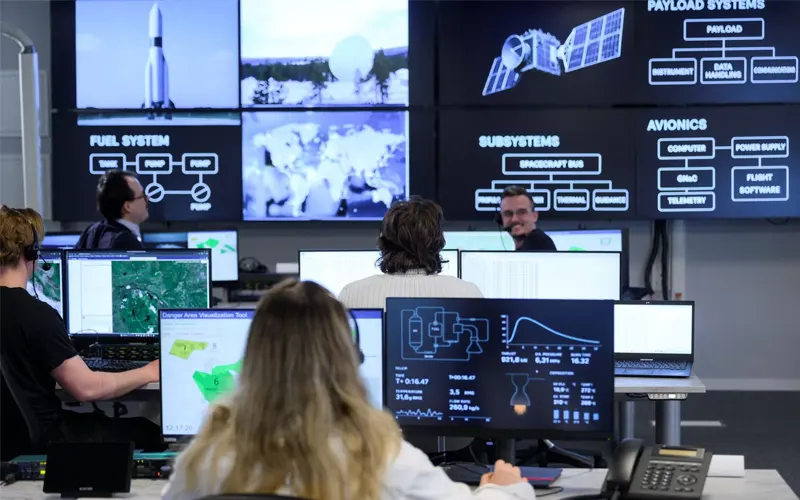
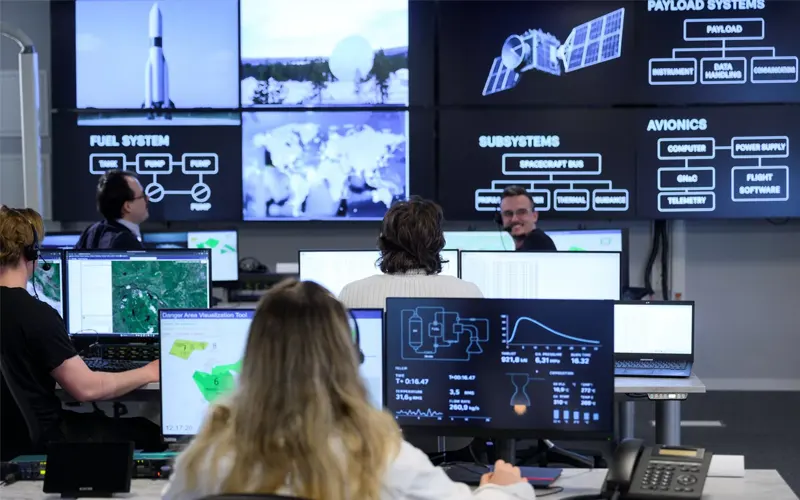
SSC Space has officially opened the Esrange Space Center’s new Orbital Launch Control Center, which will be used to manage future rocket launches from the facility.
The Esrange Space Center in northern Sweden has hosted suborbital rocket launches since the 1960s. In October 2020, the Swedish government and the Swedish Space Corporation (SSC), now known as SSC Space, which operates the facility, announced plans to establish an orbital launch capability at Esrange. Just over two years later, in January 2023, the site was officially inaugurated.
On 18 February 2026, three years after the facility was officially inaugurated, SSC Space announced the establishment of the facility’s new Orbital Launch Control Center (OLCC). The OLCC will be used to oversee launch operations for orbital missions from Esrange, including vehicle monitoring, countdown procedures, and coordination with range safety and airspace authorities.
“It’s always a challenge to work on a project that interfaces so many different systems and aspects of an orbital launch,” says Leo Helmersson Hobbs, OLCC Project Manager. “It involves a wide range of people across our own organization as well as our launch vehicle partners, all learning from each other in the process.”
While the establishment of the OLCC is a significant milestone, Hobbs admits that it is just one “among many others required to establish a spaceport with orbital launch capability.” The 18 February SSC Space announcement likewise admitted that the first orbital launch from the facility “may still be some way off.”
The launch manifest
The first vehicle to utilise the new facility will be the European Space Agency’s Themis reusable rocket demonstrator, conducting suborbital flights. As part of the European Commission’s SALTO programme, Esrange will host the demonstrator’s initial low-altitude hop tests, a campaign expected to begin imminently after ESA announced in late 2025 that it was waiting for spring conditions to commence testing.
In addition to low-altitude test flights, an upgraded variant of the demonstrator known as Themis T1E will conduct medium-altitude test flights from Esrange. ESA announced this additional testing phase with an award of €230 million to ArianeGroup across two contracts in November 2024.
Over and above Themis, Esrange has secured commitments from two international rocket builders interested in conducting launches from the orbital launch facility.
In May 2024, South Korea’s Perigee Aerospace signed an agreement to become the facility’s first orbital launch partner, with plans to conduct flights of its Blue Whale 1 rocket from Esrange. At the time, SSC Space said the first Blue Whale 1 flight from the site was expected no earlier than 2025, following a successful inaugural launch of the rocket from a facility in South Korea. However, with that inaugural flight yet to take place, it is unclear when a mission from the Swedish launch site will occur.
In June 2024, Firefly Aerospace signed an agreement with SSC Space to launch its Alpha rocket from Esrange. The companies revealed at the time that an initial launch from the site was expected in 2026. However, as Firefly works to return Alpha to flight following an April 2025 failure, that schedule has likely been pushed back, though by how much remains unclear.
The competition
Esrange is one of several sites aiming to host orbital launches from mainland Europe, with SaxaVord Spaceport in the UK and Andøya Space in Norway being the most prominent.
SaxaVord Spaceport is located on the island of Unst off the northern coast of Scotland. The facility is expected to host its first launch this year, with Germany’s Rocket Factory Augsburg preparing to reattempt the inaugural flight of its RFA ONE rocket. The facility currently has one completed launch pad with two others in various stages of development.
In Norway, Andøya Space has already hosted its first orbital launch attempt, with Isar Aerospace launching its Spectrum rocket from the site in March 2025. However, the flight lasted less than a minute before the vehicle splashed down into the sea metres from the launch pad, exploding on impact. The company is currently preparing for the rocket’s second flight from the spaceport, which is expected no earlier than 19 March.
With both SaxaVord and Andøya hosting launch providers that regard those sites as primary bases, the outlook for Esrange’s orbital launch facility appears less certain, as its partners see Sweden as only one option within broader global launch strategies.
Keep European Spaceflight Independent
Your donation will help European Spaceflight to continue digging into the stories others miss. Every euro keeps our reporting alive.