
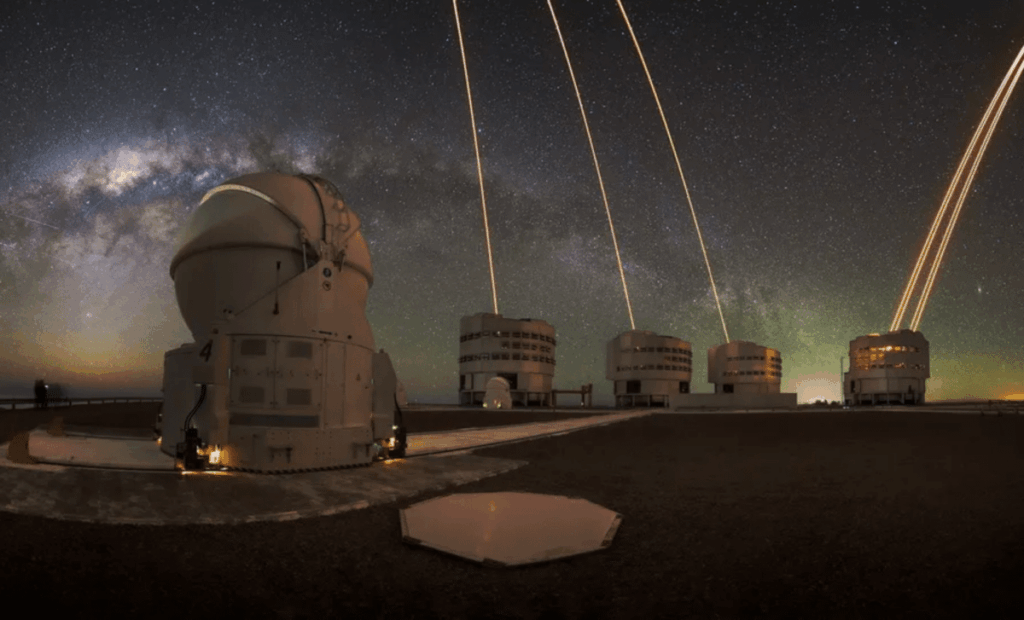
Above the Paranal Observatory in Chile, a mesmerizing scene unfolds, Chilean astrophotographer Alexis Trigo captured the Milky Way stretching across the night sky, while beams of light cut through the darkness. These beams, coming from the European Southern Observatory’s (ESO) Very Large Telescope (VLT), don’t just add to the visual drama; they’re part of a clever technology that creates artificial stars. By firing lasers into the upper atmosphere, the VLT can produce “guide stars” that help astronomers correct for the blur caused by Earth’s atmosphere.
The Role of Lasers in Creating Artificial Stars
At first glance, the lasers in the image might seem like something out of a science fiction film. However, they are essential tools for astronomical research. These lasers, which fire from the VLT’s Unit Telescopes, are designed to penetrate 56 miles into Earth’s upper atmosphere. There, they interact with sodium atoms, causing them to glow and create artificial stars. This process is crucial for astronomers because it enables them to account for the blurring effects caused by Earth’s atmosphere. In essence, the lasers act as guide stars, providing a reference point that helps the VLT’s adaptive optics system correct for any distortion.
The use of artificial stars marks a major advancement in observational astronomy. Without them, telescopes would struggle to obtain sharp images due to the turbulent air above Earth. By emitting lasers into the upper atmosphere, astronomers can create a more stable reference, allowing for clearer and more detailed observations of distant galaxies, stars, and exoplanets. This technology is not just for visual appeal; it’s vital for understanding the structure of the universe with high precision.
How Alexis Trigo Captured the Stunning Image
The awe-inspiring photograph that accompanies this article was taken by Chilean astrophotographer Alexis Trigo, who captured the beauty of the Milky Way over the Paranal Observatory. Trigo’s skillful photography highlights not only the wonder of the night sky but also the cutting-edge technology employed by the ESO to make astronomical observations possible.
In his image, Trigo beautifully captured the laser beams shooting up from the observatory’s Unit Telescopes, creating artificial stars in the upper atmosphere. This stunning visual representation brings to life the incredible technology that enables astronomers to peer deep into the universe and unlock its mysteries. Trigo’s work exemplifies the powerful combination of art and science, showcasing the beauty of both the cosmos and the tools we use to explore it.
The Very Large Telescope (VLT) and Its Instruments
The Paranal Observatory, home to the VLT, is one of the most advanced astronomical research centers in the world. The observatory houses four Unit Telescopes (UTs), each equipped with 8.2-meter primary mirrors. These massive mirrors, along with the VLT’s cutting-edge instruments, allow astronomers to study distant objects in unparalleled detail. The VLT has been used to observe everything from far-off exoplanets to deep-space phenomena, enabling scientists to unlock new insights into the cosmos.
In addition to the Unit Telescopes, the VLT is also supported by a smaller 1.8-meter auxiliary telescope, which can be repositioned on rails. This auxiliary telescope helps bolster the light-gathering capabilities of the larger UTs, making the VLT even more powerful. By combining the power of these telescopes, the VLT can achieve remarkable results, producing images that reveal intricate details of objects billions of light-years away.
Why Atmospheric Distortion Is a Problem for Telescopes
The Earth’s atmosphere, while essential for life, is a significant challenge for astronomers. As light from distant stars and galaxies passes through the atmosphere, it is distorted by turbulence caused by variations in temperature, humidity, and pressure. This distortion causes stars to appear as if they are twinkling, and it blurs the images of distant objects.
To counteract this problem, astronomers developed adaptive optics, a technology that uses lasers and mirrors to adjust for the atmospheric distortion in real time. By tracking the artificial stars created by the lasers, the VLT’s adaptive optics system can make precise adjustments to the telescope’s mirrors, ensuring that the images captured are as sharp and clear as possible. This technology has revolutionized astronomy, allowing for more detailed and accurate observations of the universe.
Advancements in Astronomical Technology: The Impact of Lasers and Adaptive Optics
The installation of guide star lasers on the VLT’s telescopes represents a significant leap forward in astronomical technology. These lasers have been in use on one of the Unit Telescopes, Melipal, since 2016, but in December 2025, all four of the VLT’s UTs were equipped with their own lasers. This update enhances the observatory’s ability to correct for atmospheric distortion, improving the quality of the data collected by the VLT.
The impact of these advancements cannot be overstated. With improved atmospheric correction, astronomers can now study distant objects in far greater detail than ever before. This includes everything from searching for exoplanets in distant solar systems to observing the most distant galaxies in the universe. The VLT’s ability to gather clear, high-resolution data opens new doors for scientific discovery, and it has already led to a deeper understanding of the cosmos.