
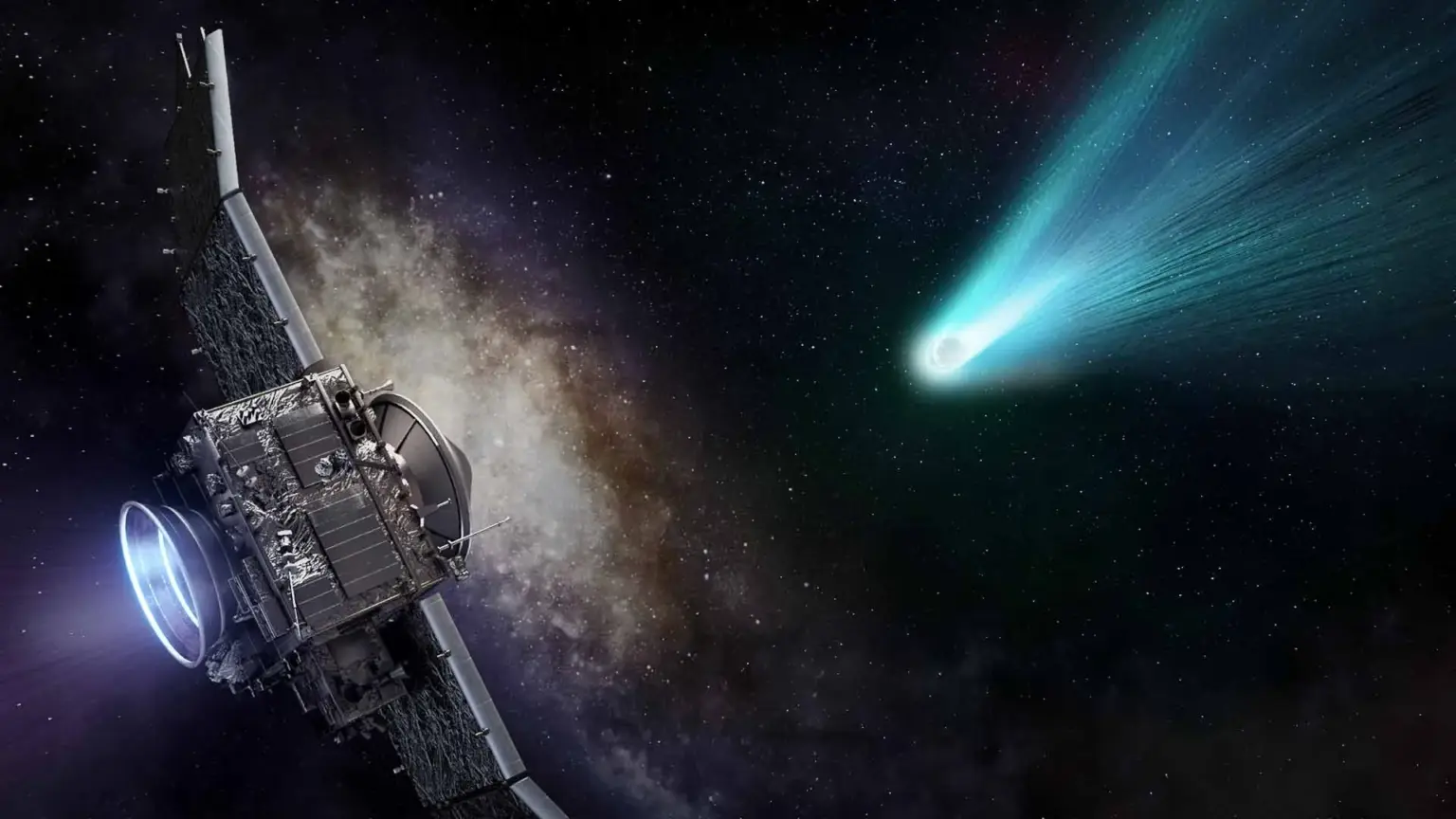
The visit of interstellar comet 3I/ATLAS was one of the most important astronomical events of 2025. This raised a logical question: could we send any device to it that would be able to catch up with it?
A 50-year journey
In an article published on the arXiv preprint website, a team of engineers and scientists explored the possibility of organizing such a mission. Its main difficulties are related to the celestial mechanics of 3I/ATLAS, its exceptionally high heliocentric velocity (58 km/s), and its late discovery. The first factor effectively rules out a rendezvous mission, which relies on an onboard propulsion system to reach the comet’s speed, allowing it to be studied for an extended period of time.
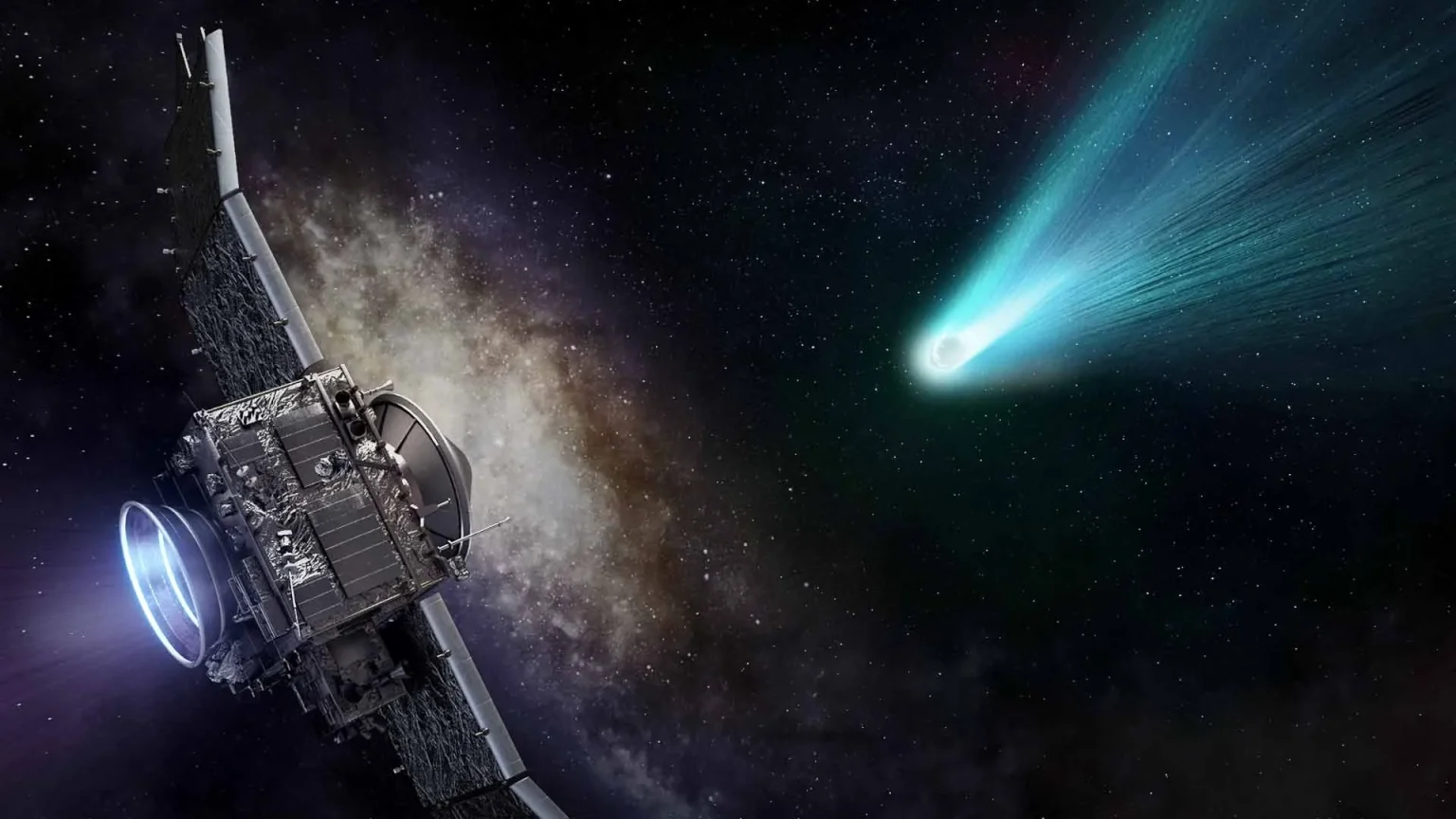 Interception of a comet by a spacecraft (concept). Source: Nicholas Forder/Future
As a result, the only possible option is a flyby mission. However, the second and third factors rule out a direct launch from Earth, because the date for that has long passed (the comet has already left the inner part of the Solar System), and existing rockets are not capable of reaching the speed necessary to catch up with it.
Therefore, researchers proposed an alternative option: launching the spacecraft toward the Sun and performing an Obert maneuver. The idea is to use the star’s gravity for acceleration. At the moment of passing perigee, the probe activates its engines, allowing it to reach maximum speed. After that, it will head towards Jupiter and use its gravity for additional acceleration. According to researchers’ calculations, if launched in 2035, the spacecraft will be able to intercept the comet after approximately 50 years of flight.
Technical problems with intercepting the interstellar comet
It should be emphasized that this is a purely theoretical study demonstrating the fundamental feasibility of such a mission. However, its practical implementation would encounter a number of obvious problems.
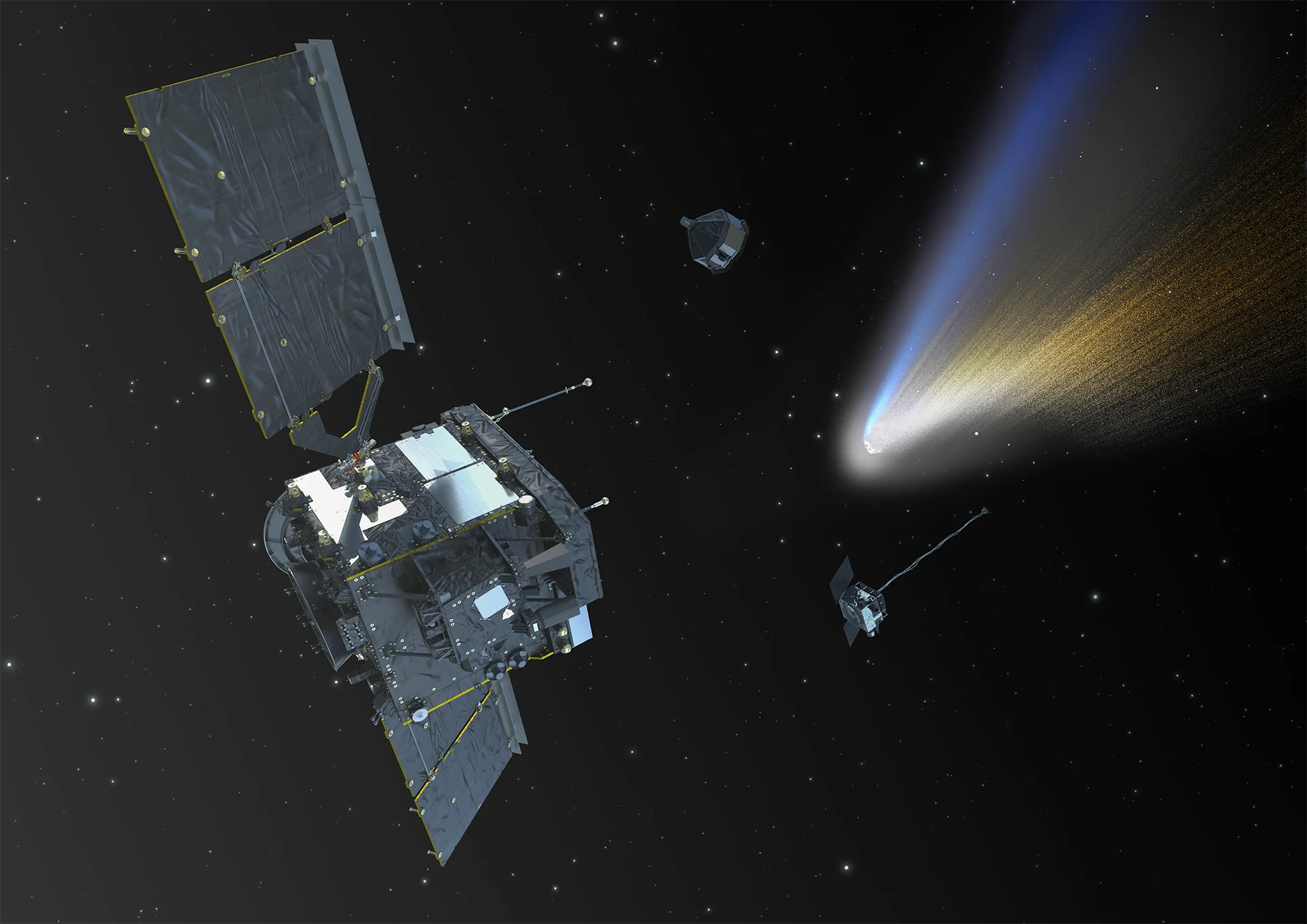 Interception of a comet by a spacecraft (concept). Source: ESA
First, such a mission would require the use of the super-heavy Starship rocket (with refueling in low Earth orbit), which is currently still in the testing phase. Secondly, in order to accelerate to the required speed, the spacecraft will have to approach the surface of the Sun at a distance of only 1.5 million km, which will require equipping it with a heavy heat shield (and this significantly reduces the payload mass).
Thirdly, the comet will be intercepted at a distance of 732 AU from the Sun (for comparison, the legendary Voyager 1 is located at a distance of 170 AU from the Sun). In order to maintain communication with the device at such a vast distance, it will need to be equipped with a powerful nuclear power source, and new communication complexes will have to be built on Earth to pick up the signals it emits.
There is also the question of reliability: the device will have to operate without failure for at least 50 years. And finally, even when using Starship, the interceptor’s mass will be limited to approximately 500 kg. This figure will have to somehow accommodate a heat shield, a nuclear power source, and scientific instruments.
Thus, although in theory the mission to intercept the interstellar comet 3I/ATLAS is possible, it is extremely complex and costly to implement in practice at this time. A far more optimal approach is to commission new powerful telescopes. They will be able to detect interstellar objects at a great distance in advance, which will enable the Comet Interceptor mission currently being designed to be sent to them.