

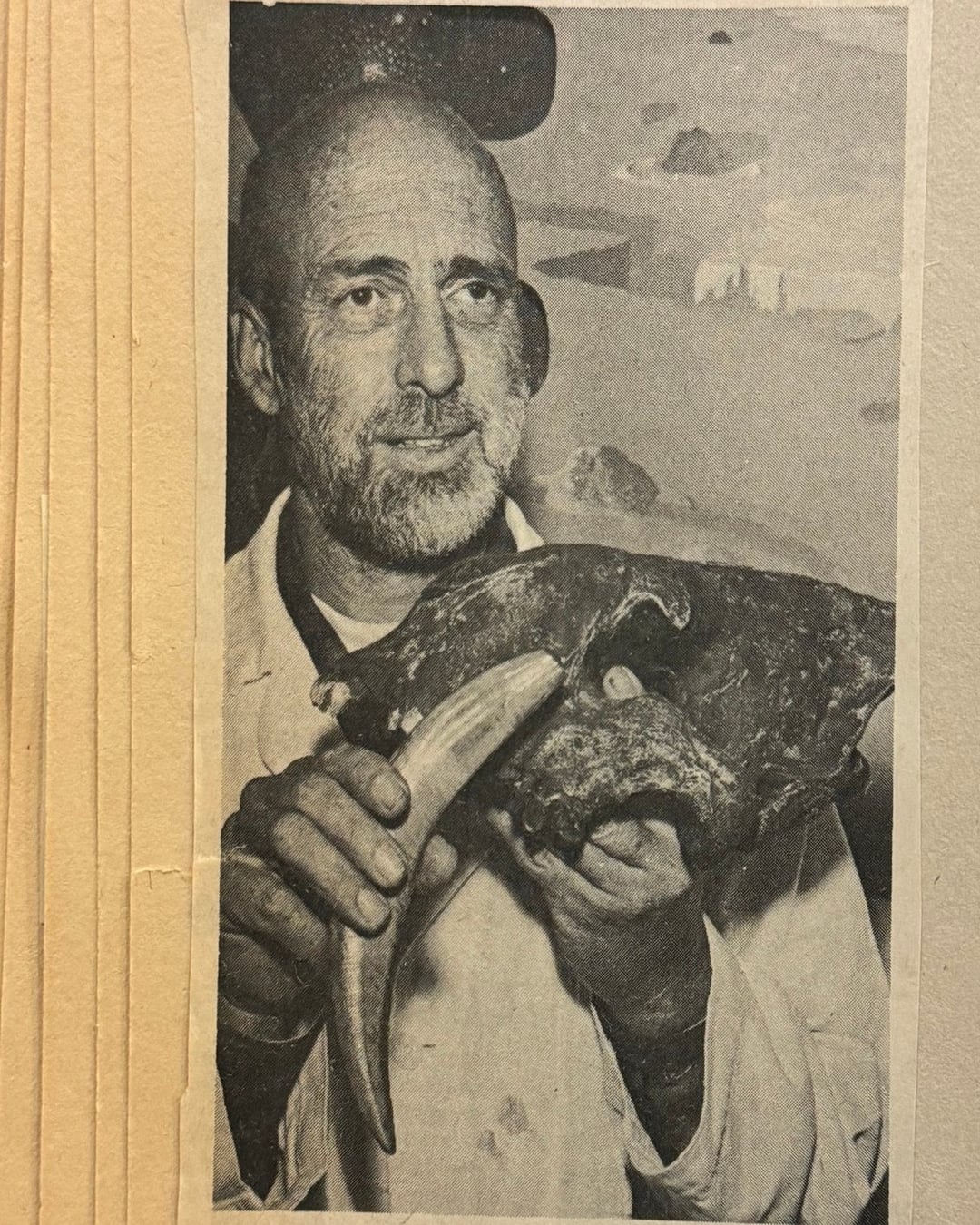
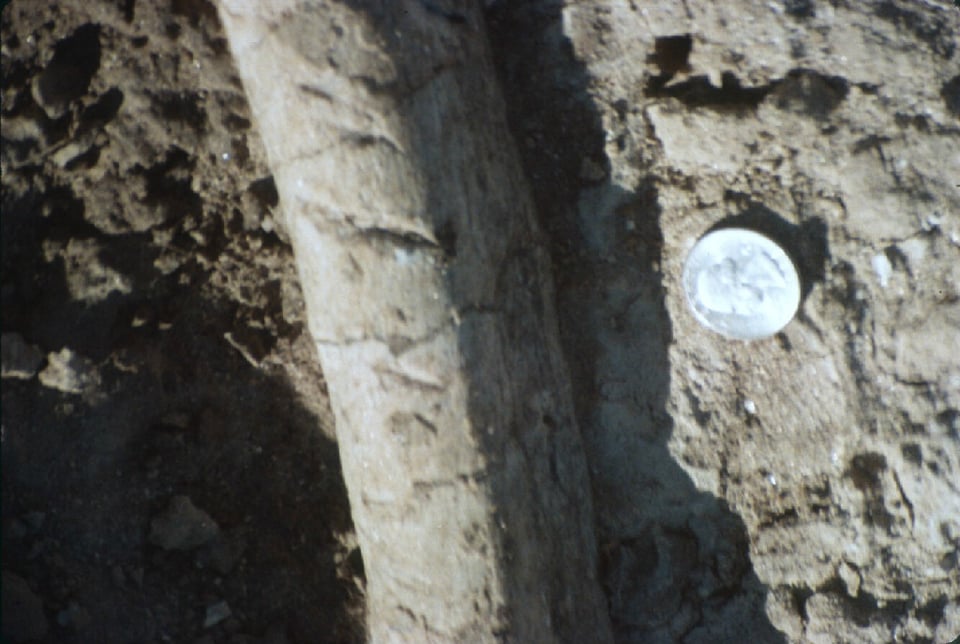
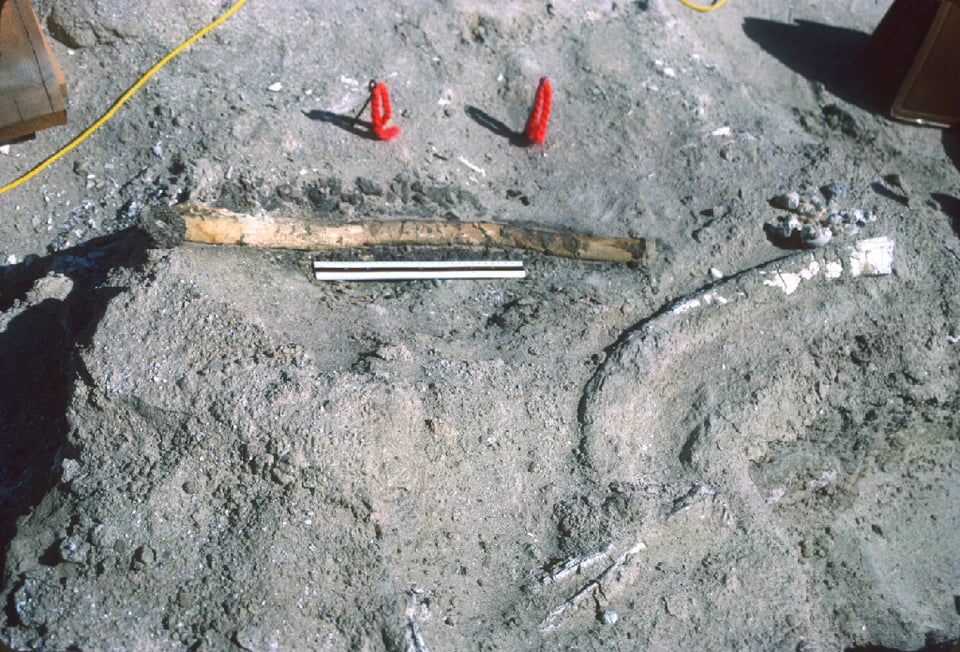
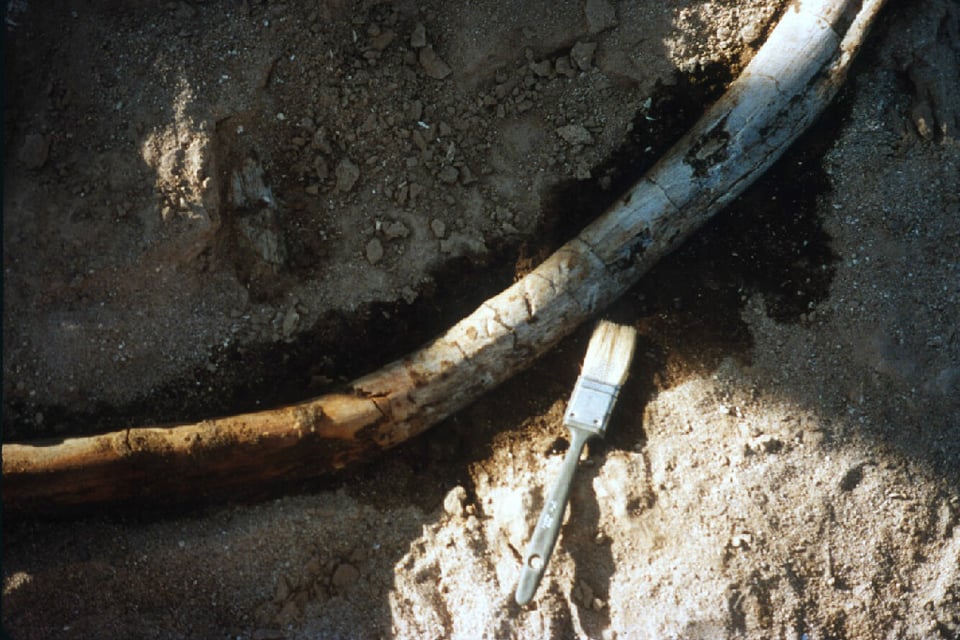
One established scholar said that Miller's claim is "as reasonable as the Loch Ness Monster or a living mammoth in Siberia," while Miller countered that "these people don't want to see man here because their careers would go down the drain." The incised mammoth bones from the Anza-Borrego Desert came up in a conversation we had with Thomas Demere, a paleontologist at the San Diego Natural History Museum (May 31, 1990). Demere said he was by nature skeptical of claims such as those made by Miller. He called into question the professionalism with which the bones had been excavated, and pointed out that no stone tools had been found along with the fossils. Furthermore, Demere suggested that it was very unlikely that anything about the find would ever be published in a scientific journal, because the referees who review articles probably would not pass it. We later learned from Julie Parks, the curator of George Miller's specimens, that Demere had never inspected the fossils or visited the site of discovery, although he had been invited to do so. Parks said that one incision apparently continues from one of the fossil bones to another bone that would have been located next to it when the mammoth skeleton was intact. This is suggestive of a butchering mark. Accidental marks resulting from movement of the bones in the earth after the skeleton had broken up probably would not continue from one bone to another in this fashion.
by PristineHearing5955
7 Comments
Miller, G. J., Remeika, P., Parks, J. D., Stout, B., & Waters, V. (1991). *A preliminary report on half-a-million year-old cutmarks on mammoth bones from the Anza-Borrego Desert Irvingtonian*. Imperial Valley College Museum Society, Occasional Paper No. 8.
The age of the site, about 500,000 YBP, was estimated by Miller’s team from a Uranium-Thorium date on bone samples of the mammoth (>300,000 YBP) and a magnetic polarity stratigraphy (paleomag) date of 720,000 YBP of a local sedimentary layer, plus supposed associations with a volcanic ash layer (>600,000 YBP) and other nearby fossils known from a particular time period (1.9 million YBP to 500,000 YBP). The team postulated that the marks were made by early human hunters, possibly Homo erectus, using the ribs as “chopping blocks,” with a primitive stone chopper or hand axe. This would place humans or their immediate ancestors at this site in North America nearly 500,000 years ago.
Markings on bone include; cuts, grooves, breakage, and other scars made by animals, roots, and natural weathering processes, plus intentional modification by humans for tools, ornaments, or other purposes. Professor Miller had previous experience studying marks on bones during several years working for the Los Angeles County Museum. During the recovery of this Mammoth, he observed five “V” shaped cut-marks on the inside surface of one of the ribs. The marks were not consistent with either weathering or natural scarring of the bone or accidental damage done by paleontologists during the site excavation. Miller and his team were unable to identify any carnivore that could have cut those sharp “V”s, leaving human modification as a distinct possible cause.
We are a species with amnesia. -Graham Hancock
My dumb ass read the title 4 times trying to figure out how bears managed to scratch the mammoth bones with stone tools
Well that’s old enough to be unlikely to be modern homosapiens (of course 300k years old is right at the edge and that number keeps getting pushed back). This is quite a bit older than the ceruti site too.
Why couldn’t a smallish population of some cousin of ours have simply walked in through from beringia before the last ice age closed the route? It’s not like we can trust the fossil record to tell the whole story, less than one tenth of one percent of all species that ever existed managed to be fossilized for us to find at all. Hominin fossils are particularly rare and fragile, for a long time all we had to show for denisovans were a couple knuckle bones and teeth.
I’d be interested to know the current academic view of this evidence. Back in the 90s these ideas were decidedly unpopular as far as I understand things (I’m not that sort of Dr). But it seems like more recently there has been a fair amount of evidence pushing back both the timeline for cognitively and anatomically modern humans, and their global migration.