
Space science!
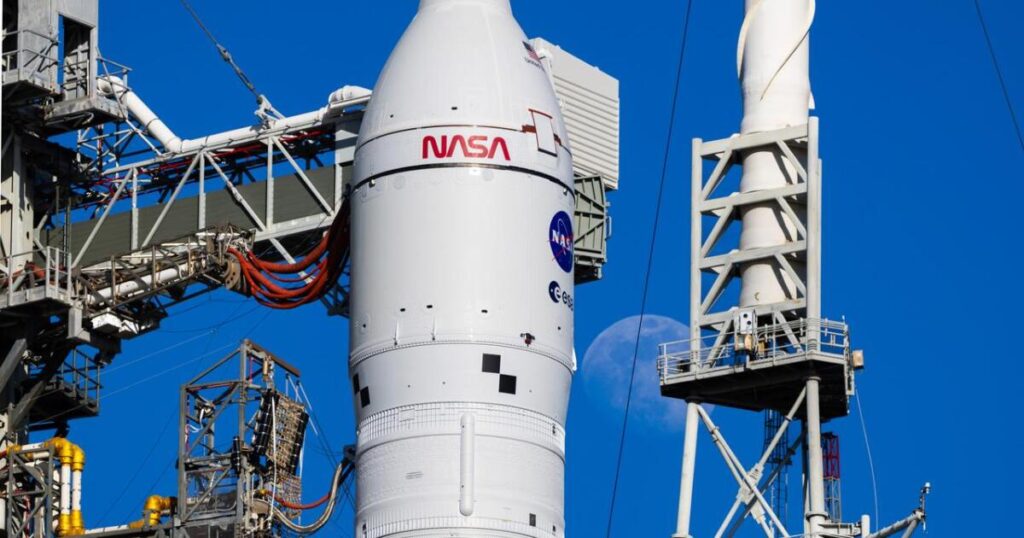
Artemis II is set to launch on NASA’s Space Launch Systems rocket no earlier than March and will send a crew of four on a flyby around the moon. It’s the first time NASA is sending humans back to the moon in over fifty years.
This isn’t just a simple flyby. During their ten-day mission, the crew of four will be participating in science and research so NASA and partners can better understand how this mission to space will have impact on the human body.
In our Story Feedback Form here on CFPublic.org, someone wanted to know “What things will the astronauts do on their way to the moon and back?” Nicky Fox, the Associate Administrator for the Science Mission Directorate at NASA said the astronauts are serving a huge purpose in several science investigations.
Fox said there will be a science officer in the mission control room and a team of scientists that are able to communicate with the crew during their mission. Plus, several experiments are studying the effects of deep space on the crew.
“The other science that I’m particularly excited about that we have actually in the Orion capsule with the astronauts is called Avatar,” Fox said. “That is to study the effects of deep, deep space, both microgravity and radiation –how they are affecting human health. So, these are little, they’re on chips about the size of the tip of your thumb drive, and they are sort of like little replicas of human tissue.”
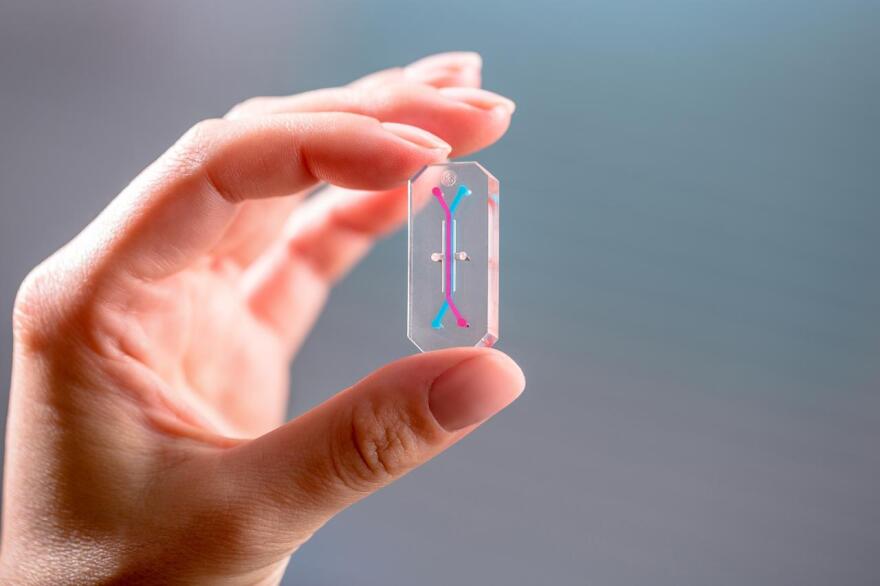
The AVATAR (A Virtual Astronaut Tissue Analog Response) investigation will use organ-on-a-chip devices, or organ chips, to study a effects of increased radiation and microgravity on human health. Artemis II AVATAR is a small experiment flying aboard Artemis II that could lead to big impacts in healthcare, both for astronauts in space and citizens on Earth. For more information on AVATAR: go.nasa.gov/4m5dGH9
Aside from experiments and testing, Fox said the other science happening on board the mission is simple: observation
“To really be able to hear the astronauts and interact with them about just what they’re seeing and what features they find particularly interesting,” Fox said. “I mean, really, what is it like? What’s it like on the far side of the Moon? People talk about science being on this mission, but exploration is science. I mean, when you go on a trip, go somewhere you haven’t been before, what’s the first thing you do? You look around, you decide where looks interesting, and you go visit. That is what we do. We’re naturally curious as humans, and so everything we do is scientific exploration. So many questions that will be answered.”
Aside from Artemis, this year will be a huge year for NASA science with new telescope launching, like the giant Nancy Grace Roman Space Telescope, and the Neo Surveyor Mission that’s looking at near Earth objects. Plus, with the excitement of going back to the moon for the first time in over fifty years, Fox said the energy around NASA and space exploration is incredible.
“It’s almost like we’re standing in the time before you just know the next decade is going to be mined blowing, and we are just standing here waiting for the next greatest things and building on everything that we do today,” Fox said. “You know what’s impossible today is delivered tomorrow, NASA Science, 24/7 so you know that is what we do, and it’s just a really, really exciting time to be doing it.”
Lunar latrine!
Joining the Artemis II crew will be a special delivery –the first toilet to travel to the moon.
Compared to the Apollo program, where there were no toilets, this commode is a testament to how NASA technology and missions have advanced. Amy foster, a professor of history at the University of Central Florida, said during the Apollo days, the methods used were more primitive since NASA was trying to get to the moon first during the Cold War.
“Those first three programs in the 1960s, they really were all designed to get to the moon on a deadline,” Foster said. “Toilets are not easy contraptions to build for space flight. They’re fairly complex because we have the benefit of gravity on toilets on the surface of the Earth. That has to be replicated, and it’s done, usually through systems of vacuums. And they’re complicated pieces of technology.”
With this toilet being used for the Artemis missions, Foster said it gives the astronauts privacy, and its technology is very advanced. She said space toilets are the most complicated toilets out there.
“You need to make sure that the astronauts can evacuate their systems effectively,” Foster said. “The last thing you want is for somebody to end up with a urinary tract infection on the backside of the moon. So, we need to make sure that this is a system that works, and that it works well. The additional thing you know having making sure that these toilets have vacuum systems that are going to function well and function for the whole mission is also important.”
While on the Orion spacecraft, if any urine or fecal material spread throughout the spacecraft it could endanger equipment on board. Aside from the technicalities of a toilet in space, Foster pointed out that it must be easy for the crew to use since it will be a part of their daily routine. Plus, a toilet in space operates differently than the toilets we have here on Earth.
“It can be a truly a disastrous thing if you know, you have feeble material getting into switches and things like that,” Foster said. You simply can’t have it…they need to know how to make the system work well, and it is a little it’s a different process. Like I said, all urine is collected through a hose. Each astronaut has their own funnel that they attach to the end of the hose, and so that’s separate from fecal collection. So, it literally is two different processes, and getting used to how those systems are set up is one of those things they also have to practice.”