
Hey r/astronomy!
I've been learning to analyze astronomical data and just completed my first systematic quasar analysis. I wanted to share what I found!
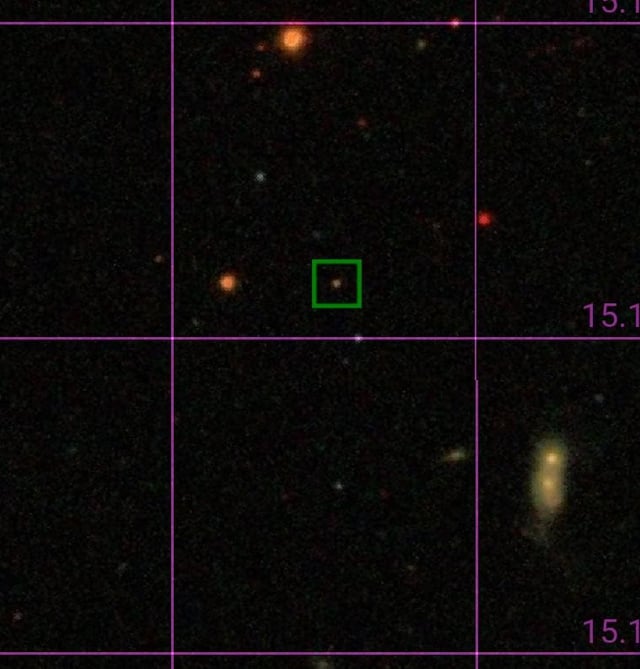
The Object: SDSS J150513.83+151010.4
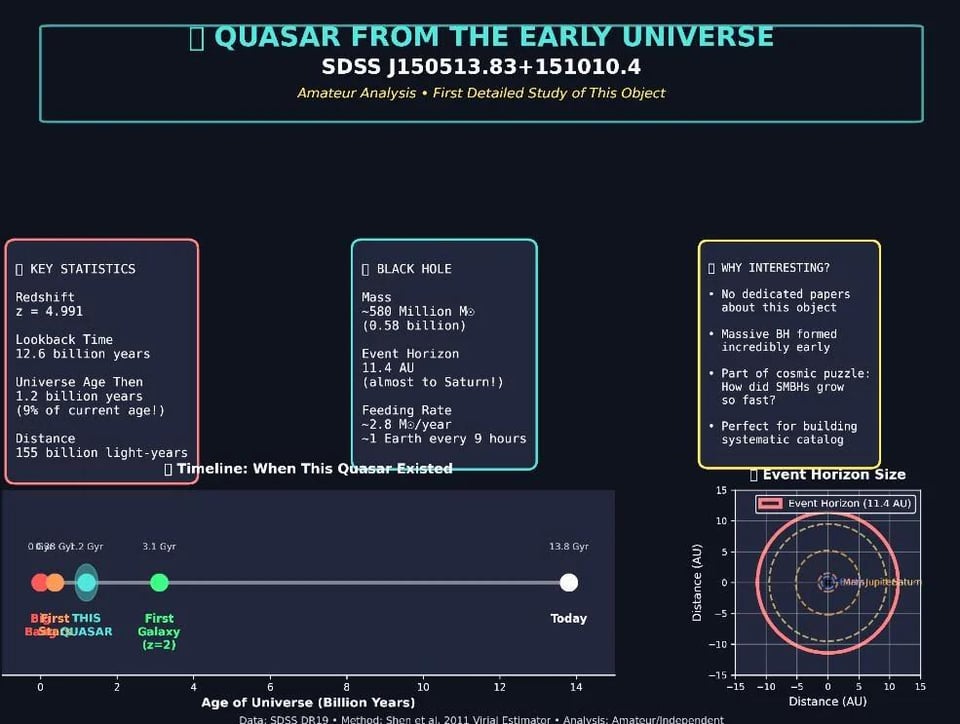
Redshift: z = 4.991
Lookback time: 12.6 billion years (Universe was only 1.2 Gyr old!)
Distance: ~155 billion light-years (comoving)
What I found:
Using the SDSS DR19 spectrum and photometry, I estimated the central supermassive black hole mass using the Shen et al. (2011) virial method:
Black hole mass: ~580 million M☉ (0.58 billion solar masses)
Schwarzschild radius: ~11.4 AU (would engulf most of our inner solar system!)
Eddington ratio: ~0.22 (actively accreting)
Accretion rate: ~2.8 M☉/year
Why this is interesting:
This is a relatively massive black hole existing when the Universe was incredibly young. The big question in astrophysics is: How did supermassive black holes grow so massive so quickly after the Big Bang?
I checked NASA ADS and SIMBAD – while the object is catalogued, there are no dedicated papers studying it. So this might be one of the first detailed analyses of this particular quasar!
My methodology:
- Used SDSS SQL search to find high-z quasars (z > 3.5)
- Downloaded spectrum and photometry data
- Applied virial black hole mass estimator (CIV-based for z~5)
- Calculated physical properties using standard cosmology (Planck 2018)
For comparison, I previously analyzed a z=2.003 quasar with a ~217 million M☉ black hole. This z=5 quasar is 2.7× more massive but formed 1.9 billion years earlier in cosmic history!
I'm planning to analyze 4 more z~5 quasars I found to build a small comparative sample. Open to feedback and suggestions!
Tools used: SDSS DR19, Python (matplotlib, numpy), standard virial BH mass relations
Any astrophysicists here – am I doing this right? 😅
by AutomaticBlueMonster
1 Comment
[https://ned.ipac.caltech.edu/byname?objname=SDSS+J150513.83%2B151010.4&hconst=67.8&omegam=0.308&omegav=0.692&wmap=4&corr_z=1](https://ned.ipac.caltech.edu/byname?objname=SDSS+J150513.83%2B151010.4&hconst=67.8&omegam=0.308&omegav=0.692&wmap=4&corr_z=1)
here are the data about it on NED. Maybe you find it useful