
Applications
16/02/2026
108 views
2 likes
In December last year, teams from the European Space Agency (ESA) and industry completed the system Preliminary Design Review (PDR) for ESA’s Genesis mission, which will measure Earth down to the millimetre. The improved measurement of Earth will benefit fields as diverse as navigation, sea level monitoring and infrastructure development.
Genesis will work at the foundation of navigation, improving the International Terrestrial Reference Frame (ITRF) that underpins not only accurate navigation but also Earth sciences.
“When you navigate, it’s not enough to know where you are, you need to know where you are in reference to something,” says Sara Gidlund, Head of the Genesis Project. “The same goes for Earth science – you need to have a reference for where your data is located. The ITRF is this reference.”
The Genesis mission was first approved during ESA’s Ministerial Council in 2022 and fully subscribed at the Ministerial Council in 2025. Development is led by OHB Italia S.p.A. The successful completion of PDR in December is a significant milestone for the mission.
Genesis taking shape
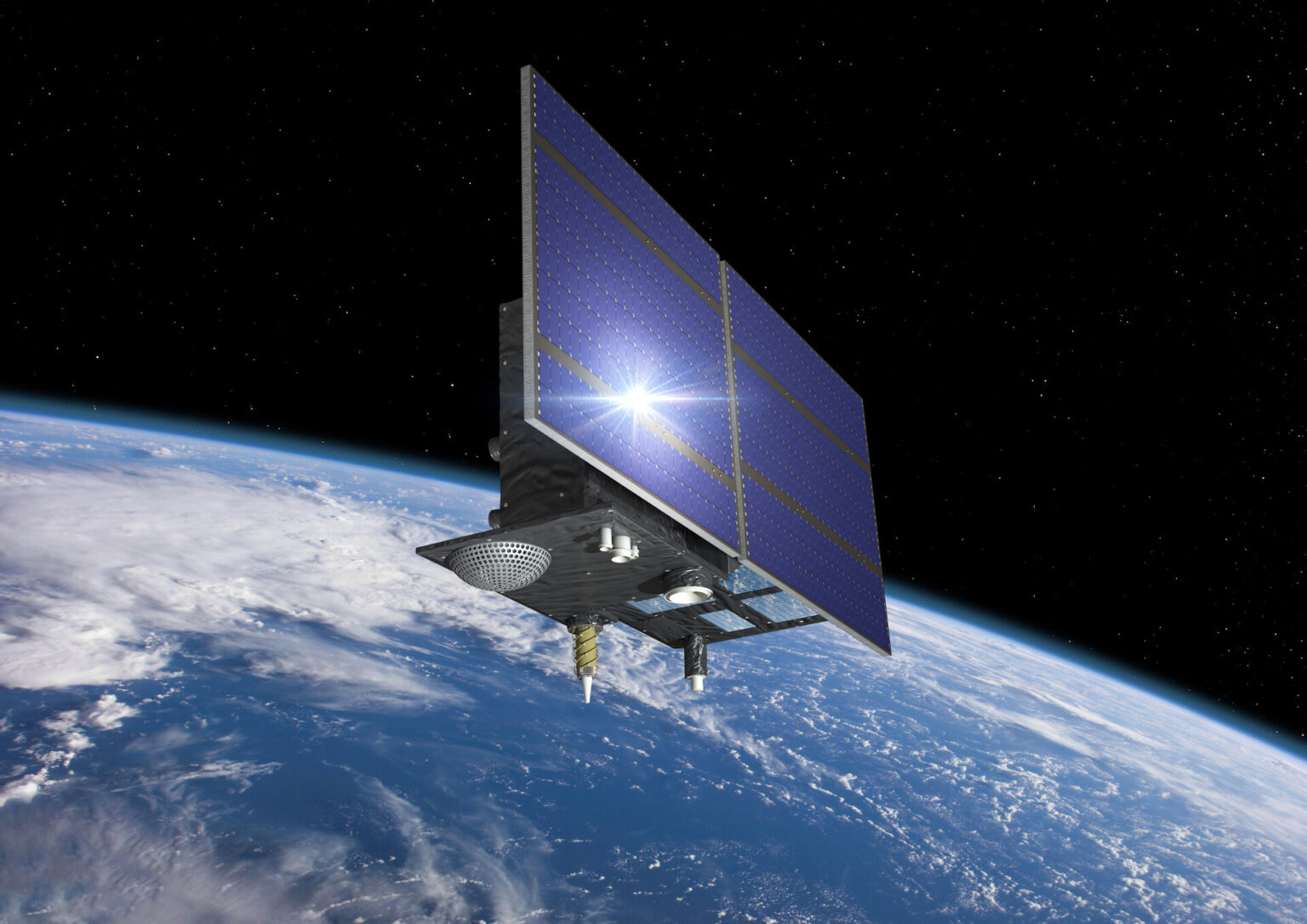
PDR is the first of two major design steps for developing a satellite. During PDR, the high-level design of the satellite and the ground segment is completed. This involves identifying the satellite subsystems (such as the communication or power subsystems) and payloads. In the case of Genesis, the payloads are four Earth-measuring instruments, otherwise known as geodetic techniques, and an Ultra-Stable Oscillator (USO) to synchronise the measurements.
For PDR, the technical details of the satellite are verified by preliminary analyses and the configuration of the various components is set, giving a sneak peek to what the satellites will look like. This ensures that the satellite can achieve the mission objectives.
Throughout the design process, the configuration of Genesis has evolved. Most obviously, the solar panels have moved from being placed at an angle, to vertically, to now covering one side of the satellite (like a power-generating shield).
With the PDR complete, the basic design of Genesis is now frozen. The overall configuration and shape of the satellite is set, and the instruments and their locations on the satellite are established. This means that Genesis is now ready to move towards the final detailed phase of design, concluding with the Critical Design Review (CDR).
Down to the nuts and bolts
As teams work towards CDR for Genesis, they are building models to test the design set by PDR. This testing will ensure the satellite can withstand the stress of launch and operate in the harsh environment of space.
Alongside building and testing models of Genesis, teams are also refining their analysis of the satellite’s performance with detailed computer models. To ensure Genesis can provide measurements of Earth with 1 mm accuracy, these models account for the impact of solar radiation pressure and other non-gravitational forces on the satellite.
This testing and modelling will culminate in the Critical Design Review (CDR), expected to start towards the end of this year. At this point, the placement and the performance of each element will be specified, down to the individual nuts and bolts.
A collaborative effort
In parallel with the satellite’s development, ESA is closely collaborating with the international scientific community to test and calibrate Genesis and to develop data tools to process and utilise Genesis’ data.
This is necessary because the ITRF is a complex product generated by international services under the International Association of Geodesy, including one service for each of the four geodetic (Earth measuring) techniques that Genesis will carry. These services currently use data collected on the ground, so updates are needed to ensure the space-based data from Genesis can be seamlessly incorporated into these techniques, and ultimately into the ITRF.
To facilitate collaboration, ESA has established and regularly cooperates with a Genesis Science Exploitation Team (GSET), which includes representatives from the scientific community and all the geodetic services. ESA also organises an annual Genesis Science Workshop. During this workshop, the ESA Genesis team, scientists working on the generation of the ITRF and experts on geodetic techniques come together to make sure the scientific community is ready to use Genesis’ data. This year’s edition of the workshop will take place in Brussels in March, in collaboration with the Belgian Science Policy Office.
Benefits beyond navigation
The millimetre-level measurement of Earth will strengthen the backbone of navigation and benefit Earth sciences by improving the ITRF.
Accurately measuring Earth is key for satellite navigation and Earth sciences because Earth is not a static place. Tectonic plates shift, volcanoes erupt and ice melts. Some parts of Earth are rising due to glacial rebound while others sink. Genesis will contribute to measuring these changes with unprecedented accuracy.
The improved reference frame generated by Genesis’ measurements will be used to ensure accurate satellite navigation, Earth observation and Earth sciences.
Even as the development of Genesis progresses, ESA and the scientific community are already thinking ahead, beyond Genesis. Because accurate measurement of Earth underpins so many important services and applications, they are already preparing for the next step in reference frame missions.
About Genesis
Genesis is a mission of the FutureNAV programme, an optional ESA Navigation programme with support from Italy, Belgium, Germany, France, Switzerland, Hungary, Finland and the UK. Genesis was approved at ESA’s Ministerial Council in 2022, and at ESA’s Ministerial Council in 2025 the deployment and exploitation of Genesis was subscribed.
The goal of Genesis is to significantly contribute to improving the accuracy and stability of the International Terrestrial Reference Frame (ITRF). The ITRF serves as a reference for all space- and ground-based observations for navigation and Earth sciences. Improving the ITRF will impact high accuracy navigation applications with benefits in aviation, autonomous vehicle driving and traffic management, for example. In Earth sciences it will help refine models used for climate and environmental monitoring and much more. Additionally, by contributing to the improvement and consistency of the Earth reference frame, Genesis addresses the United Nations General Assembly resolution calling for a ‘global geodetic reference frame for sustainable development.’
Genesis’s extreme accuracy is achieved by co-locating the four geodetic (Earth-measuring) techniques (satellite navigation, very-long-baseline interferometry, satellite laser ranging and DORIS) onboard one well calibrated satellite that acts as a flying observatory. The instruments will be synchronized by an ultra-stable oscillator (USO).
For more information, visit www.esa.int/Genesis
Like