
Hello r/space!
Where gold comes from and why we're obsessed with it is something I've been thinking about for almost a decade. I finally sat down and wrote a deep dive on it, covering 5 billion years. Got the Caltech astrophysicist whose team first observed gold being forged in a neutron star collision to give it a quick read.
———–
Where does gold actually come from?
Gold is the single most valuable asset on the planet.
If you combined all of the gold we've pulled out of the ground, it would fit comfortably inside a football stadium, and be valued at $35 trillion.
But do you know where it actually comes from?
It starts in space. And the story of how it got here is my favorite rabbit hole of all-time.
A quick primer on stars
Take the sun. It's the giant ball of gas that our planet revolves around.
To us, it's a big deal. But from a cosmic perspective, it's a dime a dozen. There are more stars in the universe than there are grains of sand on Earth.
And inside of these billions of stars, is where the building blocks of our material world get made.
The life and death of a star
To understand this next part, we have to revisit the lightest element on your high school periodic table: hydrogen. It's the origin point for everything that exists.
Stars, like our sun, are made up mostly of hydrogen gas. They're so massive that gravity creates enormous pressure at the core. This pressure causes hydrogen atoms to collide. When they do, they fuse into helium, which is slightly heavier. Each collision creates energy, which is what keeps the star hot, shiny, and alive.
Once enough helium builds up, it starts fusing into carbon, which is heavier still. Then comes oxygen. Then iron. Each one heavier than the last. The carbon in your bones. The oxygen in your air. The iron in your blood. This is where it all came from, forged inside stars over millions of years.
But when a star starts creating iron, it runs into trouble. For some reason, iron fusion doesn't create new energy. Without the constant creation of new energy keeping gravity at bay, the star collapses on itself and dies in a spectacular explosion.
A supernova.
And what a supernova leaves behind is one of the most extreme objects in the universe, that ultimately produces gold.
The origin of heavy metal
The supernova blows away everything but the iron core. The collapsing force of gravity crushes the iron core down into what's called a neutron star. It contains the mass of the sun compressed into an object the size of Manhattan. A single teaspoon of it would weigh a billion tons.
Since supernovae have been happening across the universe for billions of years, neutron stars are scattered everywhere. When two get tangled in each other's orbits, they spiral closer and closer for millions of years until they finally collide. The violence of this collision forges gold and every other heavy metal in seconds. Silver, platinum, palladium, all born in a natural event almost too extreme to fathom.
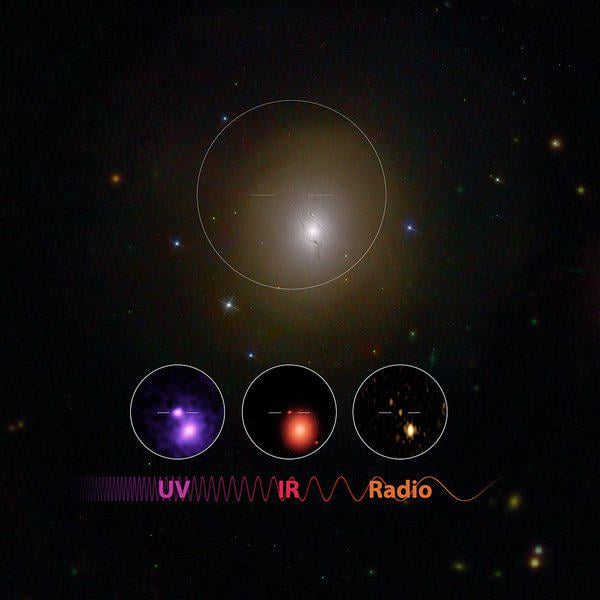
In 2017, scientists at Caltech observed this happen for the first time. They spotted a pair of neutron stars collide 130 million light-years away. This single collision produced an estimated 10 Earths worth of gold and platinum. In seconds.
So there you have it. The ring on your finger was produced by the collision of dead stars in space.
But how did it get here?
From space to Earth
All of this happened before the Earth even existed. Those collisions scattered gold across the universe. Eventually, gravity pulled it together with gas and rock, forming planets. About 4.5 billion years ago, Earth was one of them.
When Earth was young, it was a ball of molten rock. Gold is heavy, so as the planet formed, it sank to the core, where 99.99% of Earth's gold supply remains today. Enough to coat all of Earth's surface a meter thick. Completely out of reach.
So where did the available supply come from? Asteroids. About 4 billion years ago, Earth was pummeled by asteroids carrying their own gold, forged by the same cosmic process. That thin dusting yielded everything we've ever mined.
From rock to riches
For billions of years, it just sat there. Life emerged in the oceans, and eventually crawled onto land. Dinosaurs ruled the planet for over 150 million years. But since you can't eat gold or have sex with it, they never paid it much mind.
Then, 66 million years ago, one last asteroid wiped the dinosaurs off the face of the Earth. In their absence, mammals rose. But it took another 66 million years before one of them did something no creature in Earth's history had ever done.
It picked up a shiny rock and decided it was valuable.
Why? Because it was yellow and beautiful. It was soft enough to shape into jewelry, crowns, and coins. It didn't rust, corrode, or decay. And it was incredibly dense, making it almost impossible to fake.
From then on, through 7,000 years of civilization, gold has been at the center of everything.
It built the first civilizations in Mesopotamia and Egypt. The Romans backstopped the largest army the world had ever seen with it. The Spanish conquered the Americas in pursuit of it. The British built an empire on it. And America became the world's superpower by ending World War II owning most of it.
Today, we still exchange rings made of it when we get married. But most of it sits in bank vaults underground, guarded by men with guns, while trillions in paper claims on it trade over the internet, on devices that themselves contain trace amounts of it.
And it's been on a hell of a run. After trading at $0 for most of the last 5 billion years, humans have now run it up to $5,000.
All of it. Every ounce, every crown, every coin, every ring. Forged in seconds by the collision of dead stars, delivered to Earth by asteroids, and obsessed over by a species that showed up 4.5 billion years after the fact.
The whole thing is pretty weird when you think about it.
by CryptigoVespucci
1 Comment
How do we know how much gold is inside the Earth? How do we know there’s enough to cover the Earth a meter thick?