
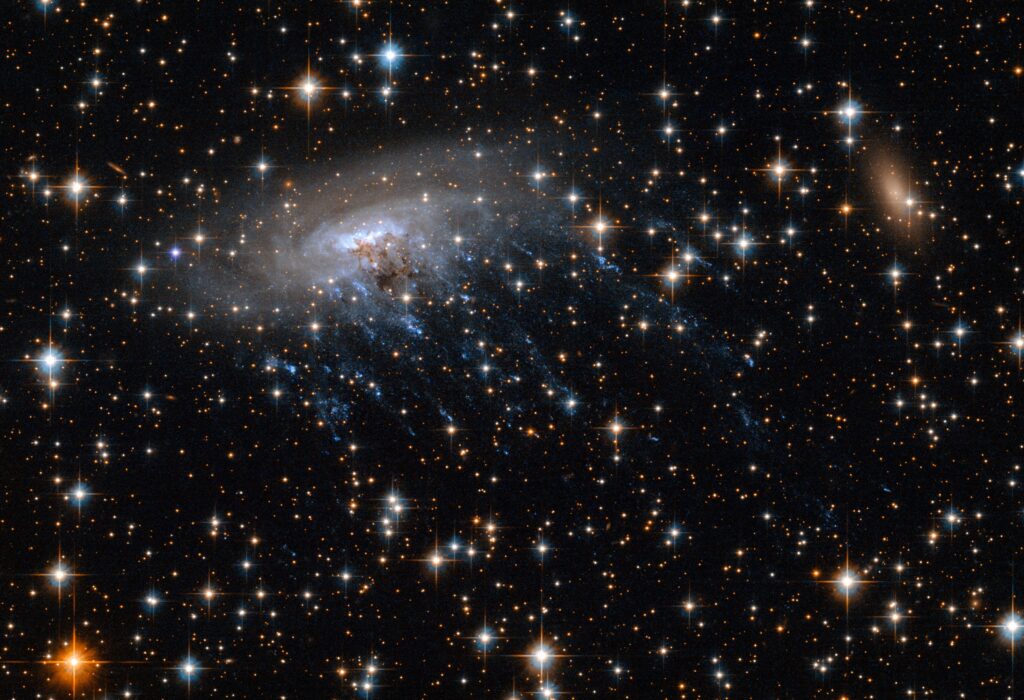
Astrophysicists from the University of Waterloo have observed a new jellyfish galaxy, the most distant one of its kind ever captured.
Jellyfish galaxies are named for the long, tentacle-like streams that trail behind them. They move quickly through their hot, dense galaxy cluster, and the gas within the cluster acts like a strong wind pushing the jellyfish galaxy’s own gas out the back, forming trails. The technical term for this process is ram-pressure stripping. The Waterloo scientists found this galaxy in deep space data captured by the James Webb Space Telescope (JWST). It is at z = 1.156, meaning we’re seeing it as it was 8.5 billion years ago, when the universe was much younger.
The data provides a rare insight into how galaxies were transformed in the early universe and challenges conceptions of what the universe would have been like 8.5 billion years ago.
The team made the discovery while examining the COSMOS field – Cosmic Evolution Survey Deep field – a particular patch of the sky that many telescopes have observed to study distant galaxies. Astronomers chose this patch because it is far from the plane of our own galaxy, and so there is little contamination from stars and dust in the Milky Way. It lies in a region of the sky visible from both the northern and southern hemispheres and free of bright foreground objects, giving astronomers an unobstructed view of the distant universe.
 “We were looking through a large amount of data from this well-studied region in the sky with the hopes of spotting jellyfish galaxies that haven’t been studied before,” said Dr. Ian Roberts, Banting Postdoctoral Fellow at the Waterloo Centre for Astrophysics in the Faculty of Science. “Early on in our search of the JWST data, we spotted a distant, undocumented jellyfish galaxy that sparked immediate interest.”
This jellyfish galaxy had a normal-looking galaxy disk and bright blue knots in its trails, which are very young stars. The age of the stars suggests that they were formed outside of the main galaxy in the trails of stripped gas, which is expected in a galaxy of this nature.
Information gathered from studying this galaxy has challenged some previously held beliefs about what was happening in deep space at that time. Scientists believed that galaxy clusters were still forming and that ram-pressure stripping was uncommon. Roberts and the team made three additional discoveries that could change how we understand the universe.
“The first is that cluster environments were already harsh enough to strip galaxies, and the second is that galaxy clusters may strongly alter galaxy properties earlier than expected,” Roberts said. “Another is that all the challenges listed might have played a part in building the large population of dead galaxies we see in galaxy clusters today. This data provides us with rare insight into how galaxies were transformed in the early universe.”
To learn more about this jellyfish galaxy, Roberts and the team have requested additional time on the JWST to delve deeper into its mysteries.
The paper, JWST Reveals a Candidate Jellyfish Galaxy at z = 1.156, appears in The Astrophysical Journal.
(Feature photo: ESO 137-001, a jellyfish galaxy like the one recently observed by astrophysicists at the University of Waterloo. Credit: NASA, ESA.)
/Public Release. This material from the originating organization/author(s) might be of the point-in-time nature, and edited for clarity, style and length. Mirage.News does not take institutional positions or sides, and all views, positions, and conclusions expressed herein are solely those of the author(s).View in full here.