
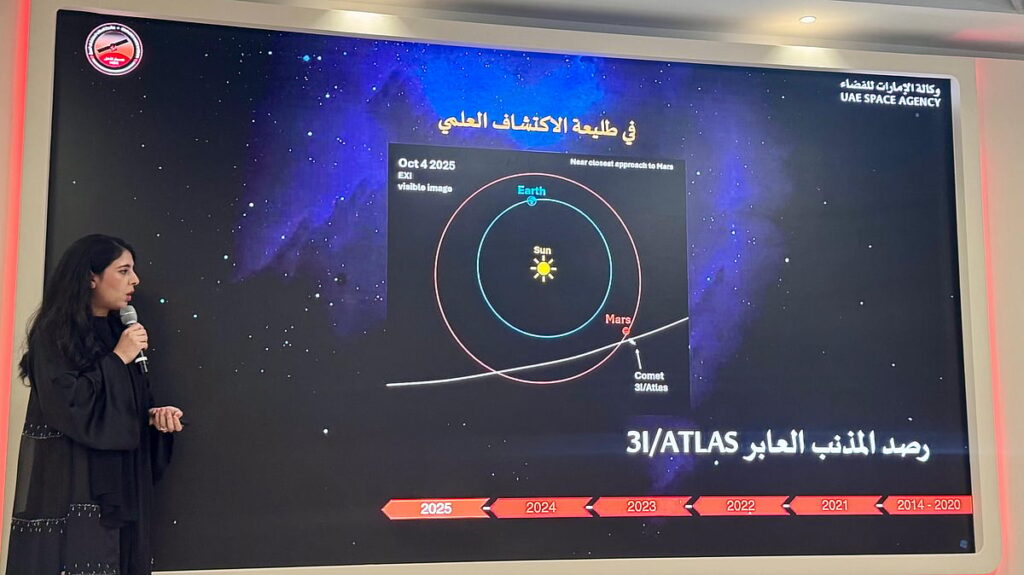
“Anyone in the Mars community knew about this comet coming by. So, to us, it was an opportunity: how can a programme focusing purely on Mars atmosphere be repurposed to support even more? It was an easy decision to go ahead and do it. We saw the value of this and how it can support the science community,” said Mohsen Al Awadhi, director of the Space Missions Department at the UAE Space Agency.
Al Awadhi said the observation also reflects a broader ambition: using the UAE’s space programme to give back to the global scientific community. And critically, he noted, what Hope Probe captured is not simply another data point among many. According to Al Awadhi, it stands apart.
“The observation that we have is very unique compared to the other programmes and what has been publicly published so far, especially that the payload that we have is also different. It provides a different type of data set,” he said.
Why Hope Probe could witness it
In October 2025, the Hope Probe expanded its scientific reach beyond Mars by capturing a series of images of the comet in visible and ultraviolet wavelengths, using its EXI and EMUS instruments.