
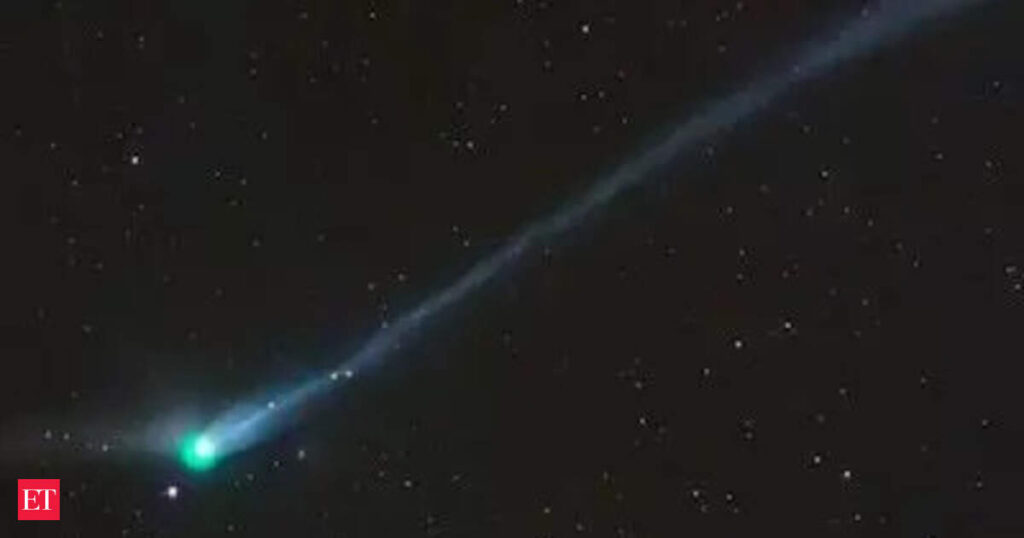
A faint green comet known as Comet Wierzchoś, officially designated C/2024 E1, is quietly passing through the inner solar system, drawing intense interest from astronomers worldwide.
That examination frames expectations correctly. Despite dramatic photos circulating online, Comet Wierzchoś (C/2024 E1) is simply too faint for unaided human vision. At almost magnitude +7, it sits well beyond naked-eye detection, even under pristine dark skies. Binoculars are the bare minimum; a small telescope is a superior view.
From the northern hemisphere, observers are further challenged by geometry. The comet surrounds low over the south-western horizon, within the obscure constellation Sculptor an area several seasoned stargazers would struggle to detect without guidance. Southern hemisphere viewers get a higher angle and clearer sightline, but visibility still needs optical support.What This Comet Actually IsC/2024 E1 is not a fleeting spectacle but a relic from the dawn of the solar system, a body developed approximately 4.5 billion years ago, composed initially of ancient ice and dust. Its nucleus is currently estimated to be between two and ten kilometres wide, revised downward from earlier, more generous estimates. Live Events
Tonight, the comet passes Earth at almost 151 million kilometres, around the same distance that separates our planet from the Sun. After that, it’s gone not into another orbit, but out of the solar system completely. Over decades or centuries, gravitational forces will push it onto a one-way path into interstellar space. There will be no return.
The comet was initially discovered on 3 March 2024 by Kacper Wierzchoś, a Polish astronomer working at Mount Lemmon Observatory. Using a 1.5-metre Cassegrain telescope, he detected the object in four short exposures when it was a surprisingly faint magnitude 20.4, over a billion kilometres from the Sun.
What elevated C/2024 E1 from curiosity to scientific prize was follow-up observation by the James Webb Space Telescope in June 2024. Observed at about 7 astronomical units, Jupiter’s distance, JWST detected carbon dioxide actively venting from the comet’s coma. Notably missing was carbon monoxide.
That absence is significant. CO is more volatile than CO₂ and would generally appear first. Its disappearance indicates that the comet lost near-surface carbon monoxide early in its existence, likely before being flung into the distant Oort Cloud during the solar system’s chaotic youth. The conclusions were published in a peer-reviewed paper in Monthly Notices of the Royal Astronomical Society Letters.The Green Glow Explained (and Why It’s Often Misunderstood)The comet’s emerald tint has captured widespread attention, but it’s often mischaracterized. The green color does not arrive from carbon dioxide. Instead, it is the outcome from diatomic carbon (C₂) fluorescing when exposed to ultraviolet sunlight.
Comets like 3I/ATLAS, Comet Lemmon, and Comet Lovejoy all featured similar coloration. Explaining the phenomenon as “carbon” is technically accurate and scientifically imprecise much like lumping diamonds and graphite together without distinction.
A Timeline of a One-Way JourneyPerihelion: January 20, approximately 84 million kilometres from the SunVenus flyby: January 1 at 0.191 AUClosest approach to Earth: February 17 at around 94 million milesThe ejection process won’t be quick. It could take decades or centuries before the comet formally exits the Sun’s gravitational impact, followed by millions of years drifting between stars. One day, perhaps, another civilization will discover a faint green blur falling toward their star never realizing it once belonged here.Can You See It Tonight?If you have a telescope, yes possibly.
Direct your view toward Sculptor, low in the south-western sky following sunset. Offer your eyes 20 minutes to dark-adapt. Anticipate a faint, fuzzy smudge, not the dramatic long-exposure images circulating online. Those photos need dark-sky reserves, long integrations, and specialized equipment.
But if you do spot it, you’ll know what you’re seeing: something older than Earth, illuminating green under ultraviolet light, passing by once and only once.
Missed It? Don’t Worry — 2026 Is Looking WildIf this comet escapes past you, keep watching. Astronomers are already tracking:C/2026 A1 (MAPS) — a possible daylight-visible sungrazer in April, if it survives
C/2025 R3 (Pan-STARRS) — a strong candidate for the Great Comet of 2026, potentially reaching magnitude 3FAQs:
Q1. What is Comet Wierzchoś?
Comet Wierzchoś is an icy body from the outer solar system detected as C/2024 E1. It is composed of ancient material left over from planetary formation.
Q2. Why is the comet green?
The green color arrives from diatomic carbon molecules illuminating under ultraviolet sunlight. This is a common chemical reaction seen in several comets.