
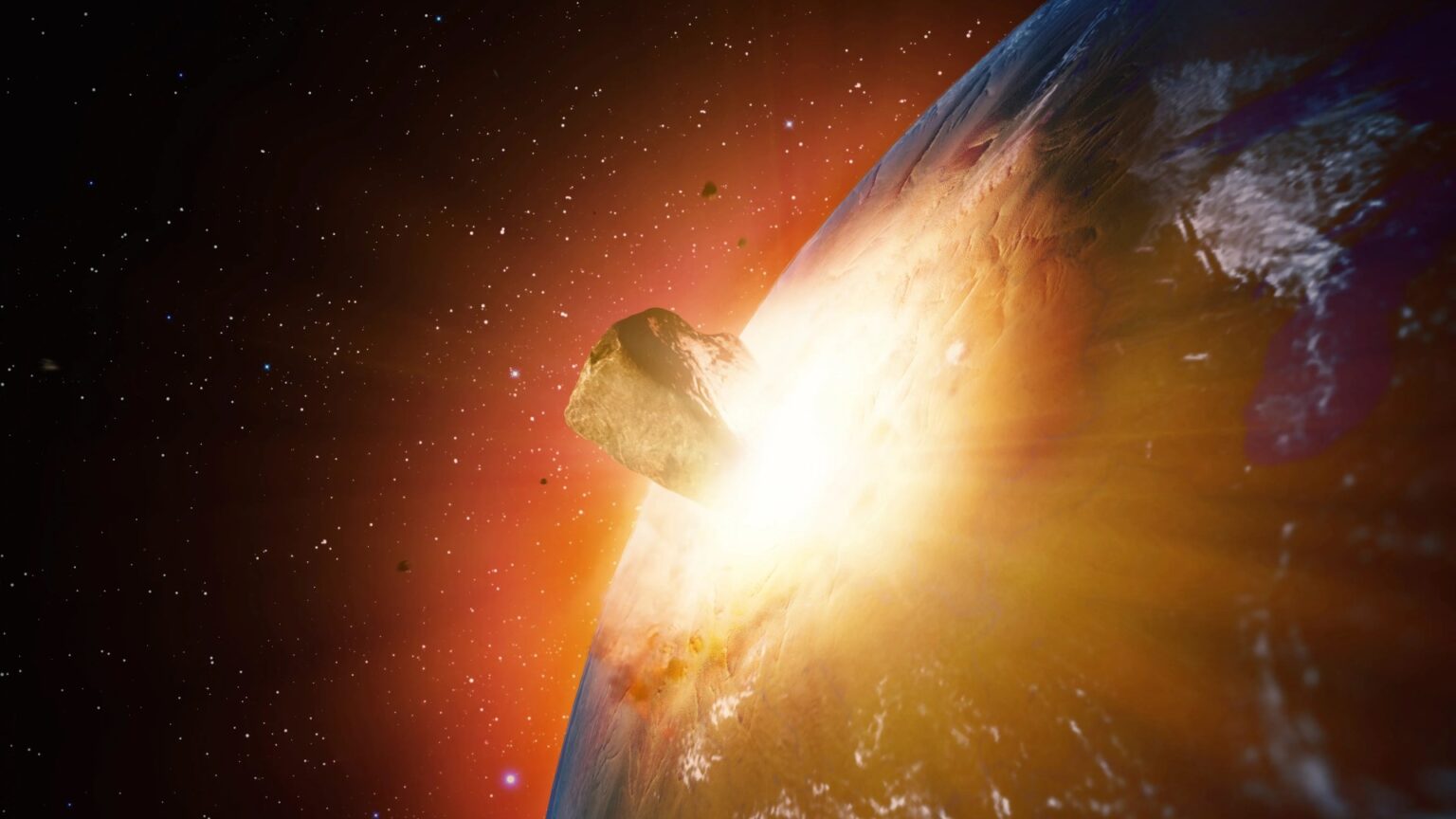
EARTH cannot defend itself against the thousands of “city killer” asteroids that are zooming around space near our planet, Nasa chiefs warn.
They reckon there are about 15,000 undetected medium-sized rocks in striking distance of the globe.
Sign up for The US Sun newsletter
Thank you!
Illustration of what a devastating asteroid impact would look like from spaceCredit: Getty
A mission in 2022 demonstrated how knocking an asteroid off course could be achievedCredit: NASA
The Dart mission was considered a successCredit: NASA/ASI/University of Maryland
A 2022 mission called Dart proved that in an emergency we could bash one off course with a rocket.
But the expedition leader said we are not prepared to do it again if in danger.
Dart mission chief Dr Nancy Chabot, from Johns Hopkins University in Maryland, US, said: “We worry about these city killer asteroids.
“Dart was a great demonstration but we don’t have that sitting around ready to go if there was a threat we needed to use it for.
BLASTING OFF
Nasa delays first human Moon mission since 1972 by WEEKS after fuel leak
STELLAR VIEW
Nasa reveals stunning pic of ‘star NURSERY’ where stellar babies form
“We don’t know where 50 per cent of the 140-metre asteroids are, which is a concern.
“We would not have any way to go and actively deflect one right now.
“We could be prepared but I don’t see that investment being made.”
She warned that space agencies do not have the cash to keep defences on high alert.
Dr Kelly Fast, Planetary Defense Officer at Nasa HQ, said the medium asteroids are the ones that worry her most.
Speaking at the conference of the American Association for the Advancement of Science (AAAS) in Arizona, she said: “What keeps me up at night is the asteroids we don’t know about.
Sign up for The Sun Tech newsletter for gadgets, games u0026 more

Hello! I’m Sean Keach, The Sun’s Head of Technology and Science
I’ve been writing about gadgets, games and the future of technology for more than a decade.
During that time I’ve penned thousands of articles, filmed hundreds of videos, talked tech on TV and radio, and travelled around the world to bring you the latest on Apple, Meta, Google, Amazon, Netflix and more.
And I’ve got a weekly newsletter called The Sun Tech that you can read for free every Thursday.
I bring you the latest from the world of tech, including behind-the-scenes action, exclusive content, expert analysis, and plenty of help advice – so please follow along!
“Small stuff is hitting us all the time so we’re not so much worried about that.
“And we’re not so worried about the large ones from the movies because we know where they are.
“It’s the ones in between, about 140 metres and larger, that could really do regional rather than global damage and we don’t know where they are.
“It’s estimated there are about 25,000 of those and we’re only about 40 per cent of the way through.
“It takes time to find them, even with the best telescopes.”
Nasa is launching a mission called Surveyor in 2027 in a bid to find at least 90 per cent of asteroids measuring wider than 140m within a decade.
What’s the difference between an asteroid, meteor and comet?
Asteroid: An asteroid is a small rocky body that orbits the Sun. Most are found in the asteroid belt (between Mars and Jupiter) but they can be found anywhere (including in a path that can impact Earth)
Meteoroid: When two asteroids hit each other, the small chunks that break off are called meteoroids
Meteor: If a meteoroid enters the Earth’s atmosphere, it begins to vapourise and then becomes a meteor. On Earth, it’ll look like a streak of light in the sky, because the rock is burning up
Meteorite: If a meteoroid doesn’t vapourise completely and survives the trip through Earth’s atmosphere, it can land on the Earth. At that point, it becomes a meteorite
Comet: Like asteroids, a comet orbits the Sun. However rather than being made mostly of rock, a comet contains lots of ice and gas, which can result in amazing tails forming behind them (thanks to the ice and dust vapourising)