
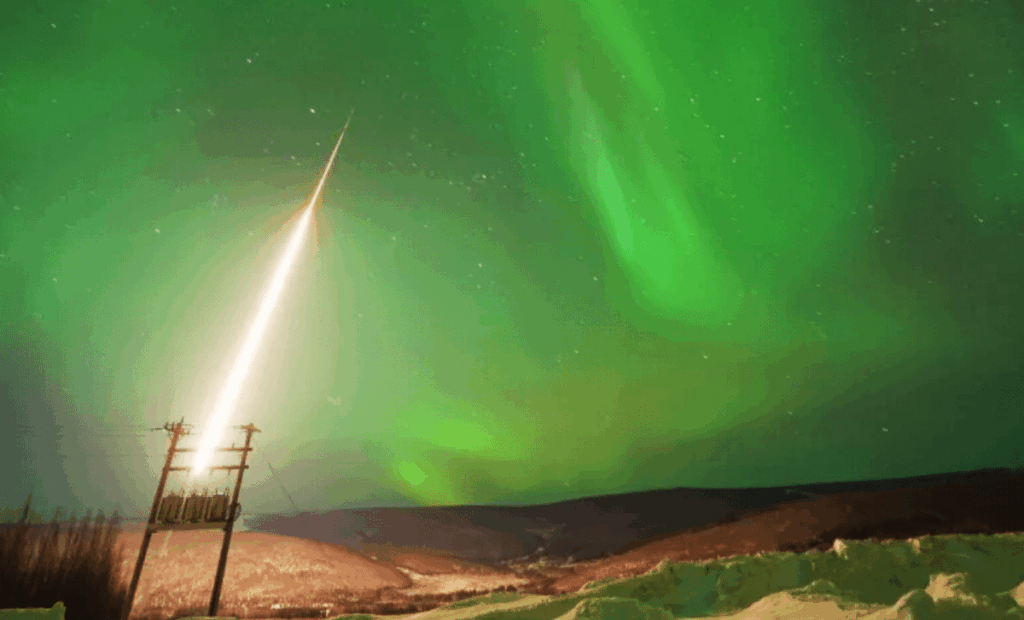
NASA’s recent twin rocket missions from Alaska are aimed at unlocking the mysteries of auroras, specifically the rare and little-understood black auroras. Launched from the Poker Flat Research Range near Fairbanks, these suborbital missions represent a major leap in our understanding of auroral behavior and their interaction with Earth’s atmosphere.
The BADASS Mission: Unraveling the Mystery of Black Auroras
The Black and Diffuse Auroral Science Surveyor (BADASS) mission, launched on February 9, 2026, seeks to investigate one of the most puzzling auroral phenomena: black auroras. These occur when electrons, instead of flowing toward Earth as they do in typical auroras, shoot upward into space. This reversal in the direction of electron flow is still not fully understood, and scientists are eager to decipher the mechanics behind it. According to NASA, he BADASS mission aims to gather data on how and why this reversal happens and what impact it could have on the environment of space and Earth’s magnetosphere. The rocket, reaching altitudes of up to 224 miles (360 kilometers), carried sophisticated scientific instruments that successfully collected data that could shed light on these black auroras.
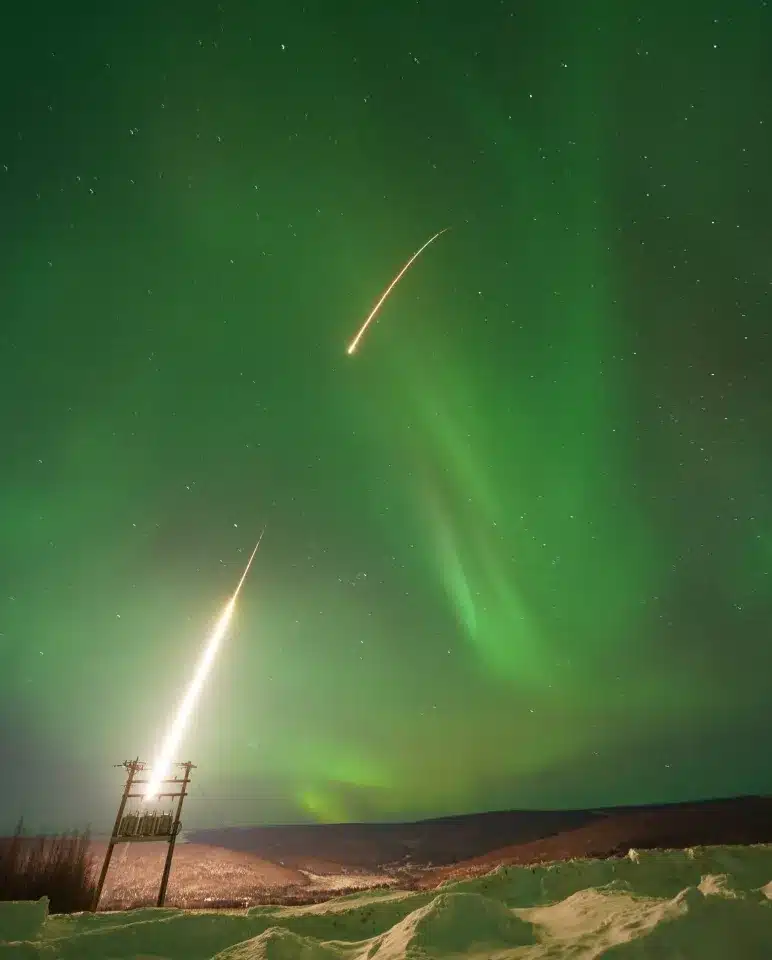 A long exposure shot of the Black and Diffuse Auroral Science Surveyor sounding rocket launch. The two bright streaks show the firing of the first stage and second stage motors as the rocket is propelled into the aurora.
Craig Heinselman, University of Alaska, Fairbanks/Geophysical Institute
Exploring the Inner Workings of Auroras with the GNEISS Mission
Another vital mission launched on February 10, 2026, was the Geophysical Non-Equilibrium Ionospheric System Science (GNEISS) mission. The GNEISS mission uses a pair of sounding rockets to create a “CT scan” of the aurora’s electric currents. This experiment focuses on the inner dynamics of the auroras, providing crucial data on how electric currents flow through the ionosphere. As Kristina Lynch, the principal investigator for GNEISS and a professor at Dartmouth College, explained,
“We’re not just interested in where the rocket flies. We want to know how the current spreads downward through the atmosphere.”
This research is pivotal for understanding how auroras interact with Earth’s atmosphere and magnetosphere, providing insights that could help protect satellites, astronauts, and power grids from geomagnetic storms.
The mission successfully launched two rockets that reached altitudes of 198 miles (319 kilometers) each, transmitting valuable data during their brief flights. By combining these in situ measurements with ground-based imagery, researchers hope to piece together a detailed map of the plasma under the aurora.
“It’s essentially like doing a CT scan of the plasma beneath the aurora,” said Lynch.
The data gathered will offer a three-dimensional view of the aurora’s electrical environment, helping to advance the study of these mysterious light shows.
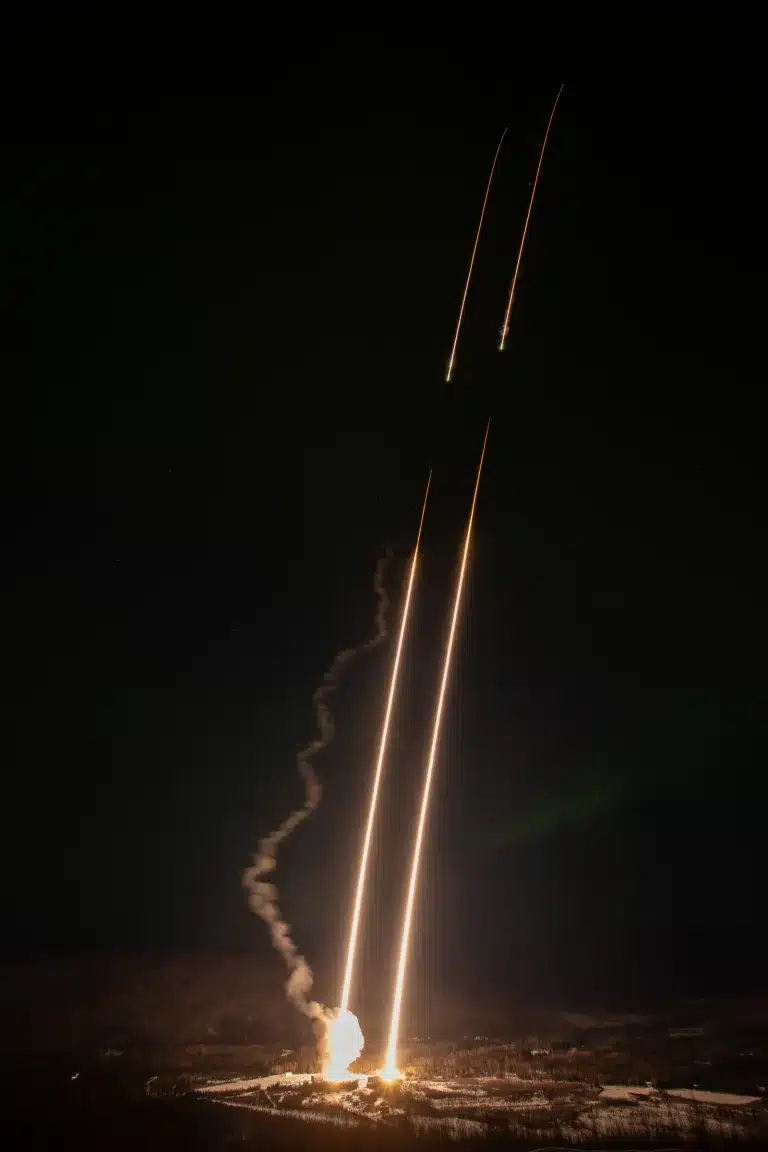 A long exposure shot of the two Geophysical Non-Equilibrium Ionospheric System Science sounding rockets showing the firing of the first stage and second stage motors.
NASA/Teik Araya
The Importance of Auroral Studies for Space and Earth
Auroras are more than just a beautiful spectacle in the night sky; they are an essential part of understanding space weather. These light displays are the visible result of solar wind particles colliding with Earth’s magnetosphere, which can lead to geomagnetic storms. While auroras themselves are harmless, the storms that accompany them can cause significant disruptions. Geomagnetic storms can interfere with satellite communications, GPS systems, and even disrupt power grids. Studying auroras helps scientists develop better predictive models for these storms and devise strategies to protect technology and infrastructure.
In addition, astronauts in space are also at risk from these storms. Understanding auroras can help NASA and other space agencies develop better protective measures for astronauts, ensuring their safety during space missions. This is why the data collected from these rocket missions is not only crucial for scientific advancement but also vital for the safety and functionality of our space-faring infrastructure.
NASA’s Commitment to Protecting Astronauts and Satellites
NASA’s involvement in studying auroras is not just about scientific curiosity but also about safeguarding technology in space and on Earth. By understanding the currents and behaviors that power auroras, NASA can develop better methods for predicting and mitigating the impact of solar storms. As space exploration continues to evolve, and with missions to the Moon and Mars on the horizon, ensuring the safety of astronauts and the functionality of space systems is critical. The BADASS and GNEISS missions will provide invaluable data to address these challenges and protect vital technologies in the years to come.
A New Frontier in Space Research: The Role of Ground-Based and In Situ Data
The combination of in situ data from the rockets and ground-based imagery is revolutionary in the study of auroras. This innovative approach enables scientists to create detailed models and simulations of auroral behavior, providing a clearer understanding of the complex interactions between solar wind and Earth’s atmosphere. As Lynch said,
“If we can put the in situ measurements together with the ground-based imagery, then we can learn to read the aurora.”
This integrated methodology will undoubtedly shape future research in space weather and auroral studies, opening new doors for discovery.
The BADASS and GNEISS missions represent just the beginning of NASA’s exploration into the complex world of auroras. These missions will provide data that will be used for years to come, informing future missions and space weather predictions.