

NASA has chosen a prominent UC San Diego scientist to lead a satellite mission that will more clearly map the edges of ice sheets and ice packs in Earth’s environmentally sensitive polar regions.
Glaciologist Helen Fricker also will be studying land and vegetation masses, gathering data that can be broadly used to assess the nature and health of some of the most isolated spots on Earth.
The research will be conducted with a cutting-edge Lidar imaging system that will be carried aboard the Earth Dynamics Geodetic Explorer, a new satellite that NASA is developing.The satellite isn’t expected to be launched for at least four years.
“EDGE will deliver greater global coverage than all prior missions combined, giving us the ability to monitor land, vegetation, land, ice and coastal regions simultaneously,” Fricker said in a statement.
 Sailors stand on the deck of the USS Somerset, a U.S. Navy San Antonio-class amphibious transport dock as it sails out of San Diego Bay on Monday, March 3, 2025. (K.C. Alfred / The San Diego Union-Tribune)
Artemis II update: The San Diego-based warship USS Somerset is continuing to train for the recovery of the four NASA astronauts who will splash down in the ocean off San Diego at the end of the Artemis II mission. Their spacecraft had been scheduled to lift off earlier this month. But the launch has been pushed into early March. The astronauts will go on a roughly 10-day trip in which they will repeatedly orbit the moon. They will become first crewed deep-space explorer in more than 50 years.
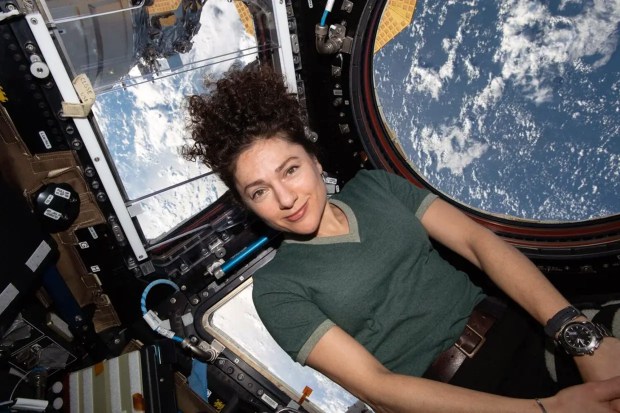 Astronaut Jessica Meir (NASA)
Space station update: NASA astronaut and UCSD graduate Jessica Meir has settled into place aboard the International Space Station, where she will spend most of the next eight months studying how microgravity affects the human body, research expected to benefit astronauts who will eventually fly to the moon and, possibly, Mars.