
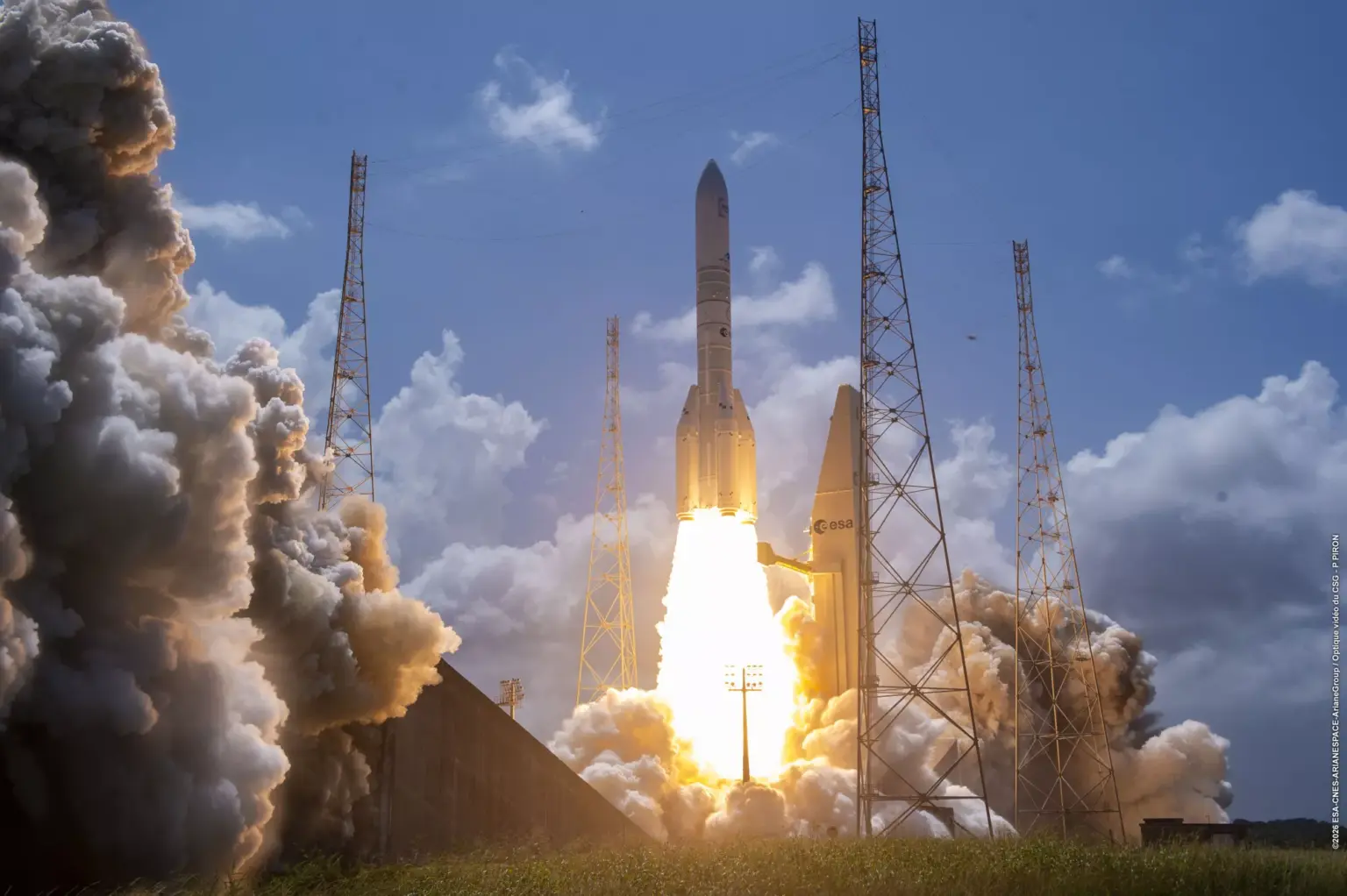
Arianespace has launched the most powerful version of Europe’s Ariane 6 rocket for the first time, deploying 32 satellites for Amazon’s low Earth orbit broadband constellation from the Guiana Space Center in French Guiana.
The Ariane 64 variant, equipped with four P120C solid rocket boosters rather than the two used on the standard Ariane 62, lifted off on February 12 on the VA267 mission. It carried the heaviest payload ever placed into orbit by a European launcher, delivering approximately 44,000 lbs (20 metric tons) to a low Earth orbit at an altitude of roughly 1,526ft (465km).
Heavier lift
The four-booster configuration nearly doubles the payload capacity of the Ariane 62, which can lift around 22,800 lbs (10,350kg) to low Earth orbit (LEO). The Ariane 64 is rated for up to 47,400 lbs (21,500kg) to LEO and 25,400 lbs (11,500kg) to geostationary transfer orbit (GTO), placing it in a comparable class to the expendable SpaceX Falcon 9, which can deliver approximately 50,300 lbs (22,800kg) to LEO.
The mission also marked the first use of the rocket’s long fairing configuration, which accommodated 32 satellites under a 66ft (20m) high fairing and gave the launcher a total height of 203ft (62m). It was the sixth Ariane 6 flight overall.
Martin Sion, CEO of ArianeGroup, said, “This new success is a major milestone for the development of Ariane 6 as it was the first flight in the four-booster version. This successful entry into service once again highlights the quality of the teams at ArianeGroup and its European partners.”
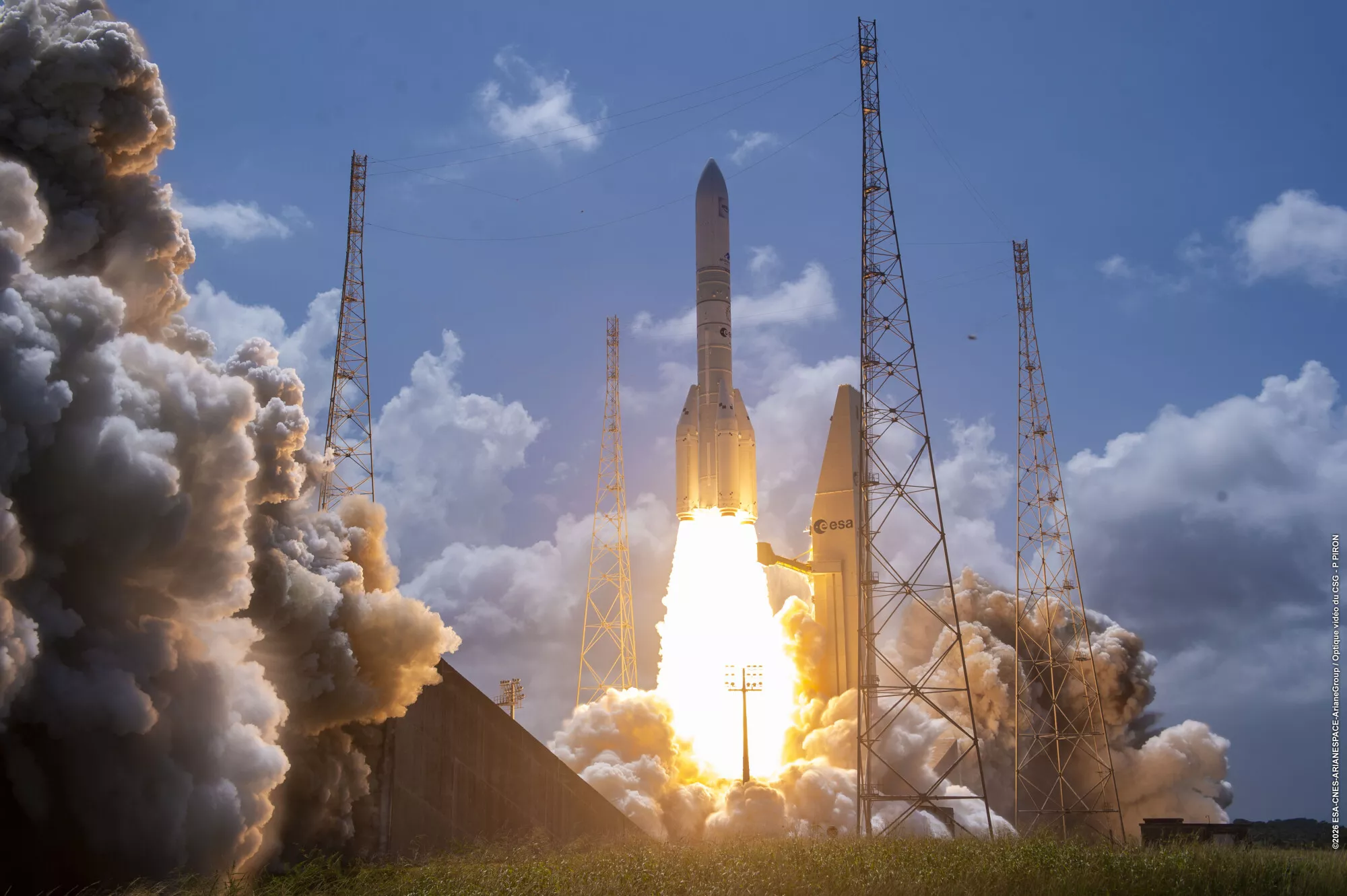 The first Ariane 64 lifts off from the Guiana Space Center on the VA267 mission, carrying 32 Amazon Leo satellites to low Earth orbit (Image: ESA/CNES/Arianespace/ArianeGroup)
Launch competition
The Ariane 64’s LEO capacity positions it as a medium-to-heavy-lift vehicle in a competitive market. Blue Origin’s New Glenn, which first launched in January 2025, can loft approximately 99,000 lbs (45,000kg) to LEO, while United Launch Alliance’s (ULA) Vulcan Centaur is rated for around 60,000 lbs (27,200kg). SpaceX’s Falcon Heavy leads the operational field at roughly 141,000 lbs (63,800kg) to LEO.
Development of Ariane 6 started in the early 2010s as a lower-cost successor to the Ariane 5 and was formally selected by the European Space Agency (ESA) in December 2014.
The two-stage hydrolox Ariane 6 rocket is powered by the Vulcain 2.1 engine on the first stage and the re-ignitable Vinci engine during the upper stage. Both engines completed qualification firing test campaigns at the German Aerospace Center test facility in Lampoldshausen, Germany.
Ariane 6 development and testing
Originally planned for a 2020 debut, the program faced repeated delays before an extensive full-scale test campaign was completed at the Guiana launch site between mid-2022 and early 2024. This included multiple cryogenic fueling rehearsals, a seven-minute hot-fire test of the core stage Vulcain 2.1 engine, and qualification testing under degraded conditions to verify system robustness.
Ariane 6 completed its maiden flight on July 9, 2024, in the two-booster Ariane 62 configuration, successfully deploying multiple satellites to orbit. Its first commercial mission followed in March 2025. The rocket has more than 30 flights booked, with up to eight launches planned for this year.
The VA267 mission initiates the first of 18 Ariane 6 launches contracted by Amazon Leo to support deployment of its broadband satellite constellation. ArianeGroup is also developing an upgraded P160C booster, which extends the existing P120C by 3.3ft (1m) and carries an additional 31,000 lbs (14 metric tons) of propellant, with 16 of the 18 Amazon Leo missions planned to use this enhanced configuration.