
Millions of years ago, when the universe was very young, there were galaxies that were just starting to be formed. But a recent discovery, led by researcher Seiji Fujimoto from the University of Toronto and published in Nature Astronomy, is making scientists rethink some basic ideas about how the first galaxies of the universe grew.
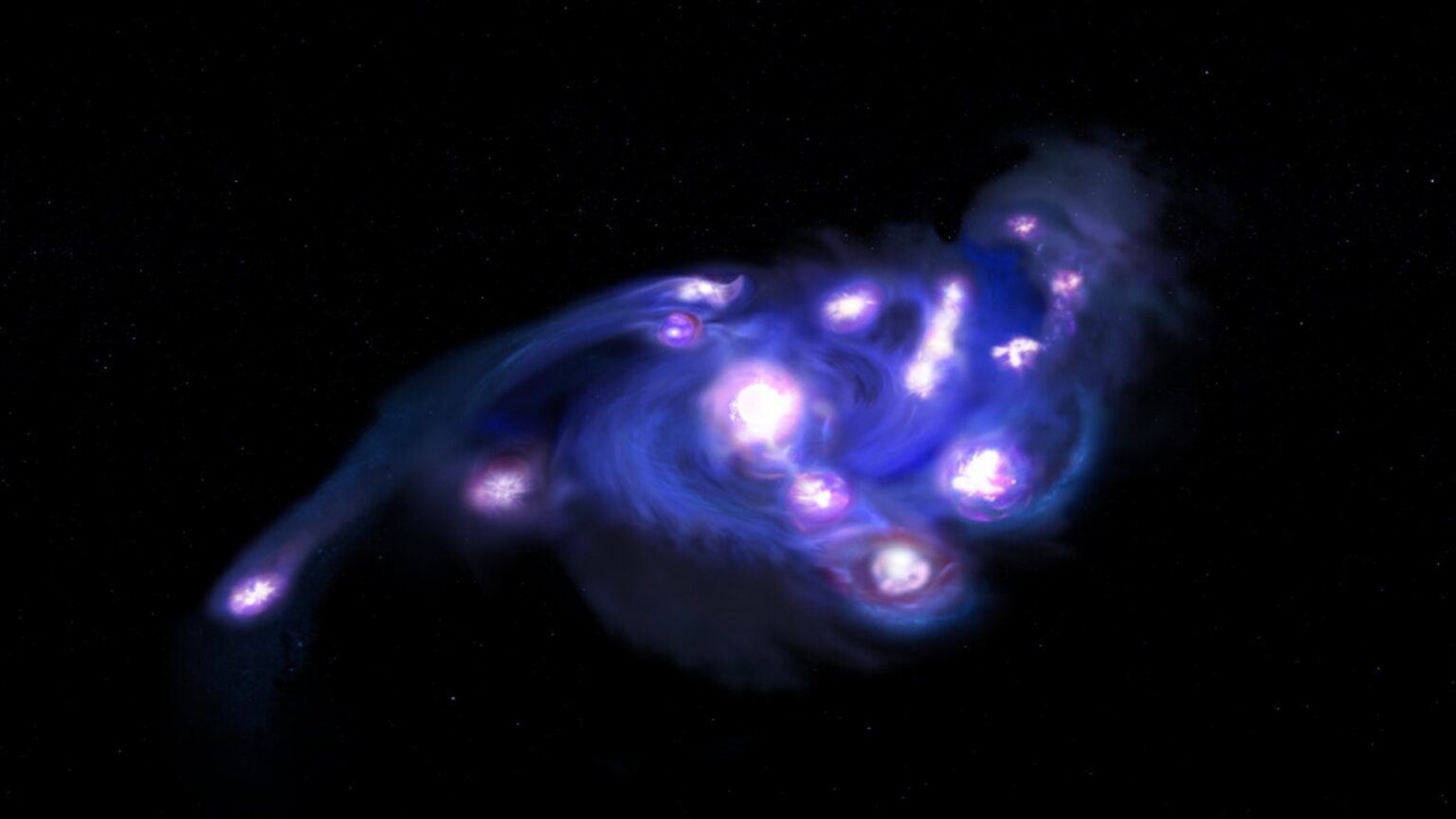
One of the galaxies seemed to be quiet and simple in the first images, but when scientists got to see it in more detail, they discovered something surprising: it was formed by at least 15 very active regions where stars were born very fast, as if it were a cluster of bright cosmic grapes. So, let’s find out more about this incredible discovery, shall we?
A very old galaxy
The studied galaxy existed about 930 million years ago after the Big Bang. Even though this might sound like a long time ago, in universe terms this is not that much. The current universe is around 13.8 billion years, so we are talking about a very early stage in its history.
In the first images taken by the Hubble Space Telescope, this galaxy looked like it was rotating in an organized way, similar to many modern galaxies. Nothing seemed to be unusual inside it.
Gravity
To be able to better observe this faraway and faint cosmic system, astronomers relied on a phenomenon called gravitational lensing. This happens when a massive object, like a galaxy cluster in the foreground, bends and magnifies the light from objects behind it. The effect works like a giant cosmic magnifying glass.
Thanks to this, scientists could see details that normally would be too small or weak to be detected. It was first identified through the ALMA Lensing Cluster Survey and then it was observed for more than 100 hours to get the most information possible.
Cluster of ‘’cosmic grapes’’
When researchers analyzed higher-resolution data, the galaxy’s smooth appearance disappeared. Instead of a uniform disk, they found at least 15 compact star-forming clumps packed inside the same rotating system.
These clumps are dense regions filled with gas where stars are forming very quickly. According to the study, these compact regions produce roughly two-thirds of the galaxy’s ultraviolet light. This means most of the galaxy’s brightness comes from these small, intense hotspots rather than from stars spread evenly across the disk.
And, why have we mentioned several times the word ‘grapes’? Well, because the bright clumps resemble a bunch of grapes grouped together, so the galaxy earned the nickname “Cosmic Grapes.”
A rotating disk that should not be so clumpy
There’s another aspect that surprised scientists: gas measurements show that one side of the galaxy is moving away from us while the other side is moving toward us.
What makes this unusual is the combination of order and irregularity. Many computer simulations struggle to create a young, faint galaxy that is both smoothly rotating and filled with so many compact star-forming clumps. According to many models, such a galaxy should not look this organized and this clumpy at the same time.
What this means for early galaxy formation
Researchers emphasize that this cosmic system is not considered a rare or extreme case. Based on its mass, size, and star formation activity, it appears to be a typical early galaxy. That is what makes the discovery especially important.
So, if one normal-looking young galaxy can hide so much internal structure, then many other early galaxies may simply look calm because we cannot yet see their fine details clearly.