
For over six decades, China’s space endeavors have achieved globally remarkable accomplishments, spanning from the launch of DFH-1 on April 24, 1970 to the manned space program, lunar exploration program, and the BeiDou Navigation Satellite System. Chang’e-4 and Chang’e-6 accomplished the first soft landing, roving exploration, and sample return from the far side of the Moon, yielding significant discoveries and scientific insights into the lunar origin and evolution.
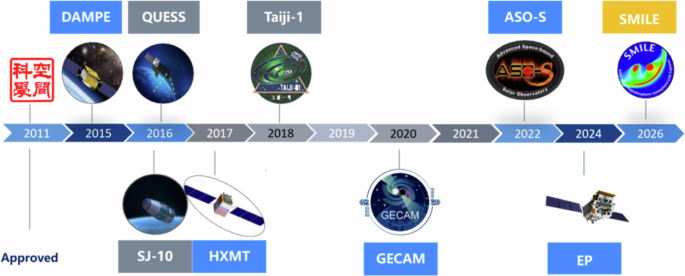
The Double Star Program (2003–2004) marked China’s first space science mission driven primarily by scientific objectives, ushering in a new era for the nation’s space science endeavors. In collaboration with the European Space Agency’s Cluster mission, it achieved humanity’s first coordinated six-point exploration of Earth’s space environment, establishing an exemplary model for China-Europe cooperation in space science. Since 2012, the country’s space science has entered a “fast-track” phase of innovative development. A number of space science missions have been implemented, focusing on scientific themes such as the origin and evolution of the universe and the relationship between the solar system and humanity. Led by the Chinese Academy of Sciences through its Strategic Priority Program on Space Science (2011 approved), a series of dedicated space science satellites has been established. This distinguished fleet includes missions such as the Dark Matter Particle Explorer (DAMPE, “Wukong”, launched in 2015), SJ-10 (2016), the Quantum Experiments at Space Scale (QUESS, “Mozi”, 2016), the Hard X-ray Modulation Telescope (Insight-HXMT, 2017), Taiji-1 (2018), Gravitational wave high-energy Electromagnetic Counterpart All-sky Monitor (GECAM, 2020), the Advanced Space-based Solar Observatory (ASO-S, “Kuafu-1”, 2022), the Einstein Probe (EP, “Tianguan”, 2024) and Solar wind Magnetosphere Ionosphere Link Explorer (SMILE, scheduled launch in 2026) (Fig. 1).
Fig. 1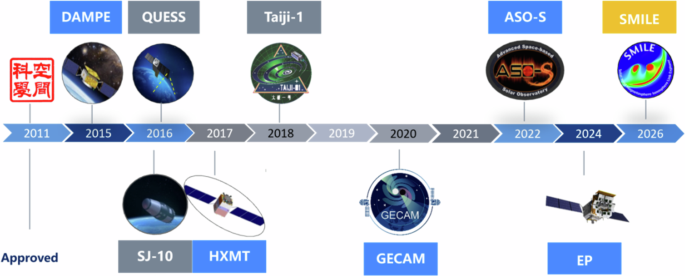
Strategic priority program on space science.
Over the past fifteen years, China’s original achievements in space science have begun to demonstrate breakthroughs across multiple fronts, collectively reflecting the continuous expansion and deepening of scientific research toward the “four extremes.” In the extremely macroscopic domain, a full-sky X-ray map has been produced using independently developed instruments. Furthermore, the first successful satellite-to-ground quantum key distribution and quantum teleportation have been achieved. At the extremely microscopic level, the finest spectral structures of cosmic-ray electrons, protons, helium nuclei, and boron nuclei have been measured with unprecedented precision. Under extreme conditions, the strongest magnetic field in the universe has been directly measured for the first time, and the fastest jet in close proximity to a black hole has been detected. In the realm of highly integrated interdisciplinary research, a deep fusion and coordinated advancement of science, technology, and engineering has been achieved.
In 2025, a series of new scientific highlights were achieved based on the fleet of space science satellites. DAMPE obtained, for the first time internationally, the most precise spectrum of secondary cosmic-ray boron nuclei in the TeV/n energy range and discovered a new spectral structure1 (Fig. 2). Insight-HXMT observed the first results of terrestrial gamma-ray flash2, and extensively observed the new black hole transient Swift J1727.8-1613 exhibited a series of X-ray flares during its 2023 outburst3. GECAM made the first international observation of a stable millisecond-period pulsation signal in a gamma-ray burst powered by a newborn magnetar, providing key evidence for understanding the nature of the remnants from compact star mergers4. ASO-S captured harmonic quasi-periodic pulsations in a white-light solar flare5 and revealed anomalous electron acceleration behavior in high-energy C-class solar flares6. EP successfully detected a mysterious fast X-ray transient, EP240315a. Analysis of this event suggests that the scientific community may need to re-examine and reconsider the theoretical models for the generation mechanisms of gamma-ray bursts, a class of cosmic explosive phenomena7. It also successfully captured a fleeting cosmic X-ray signal designated EP240414a, offering a novel perspective for understanding the processes of stellar death8.
Fig. 2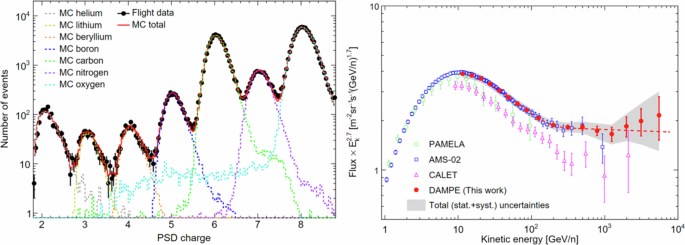
DAMPE observed the spectral hardening of the Boron spectrum (~8σ), which is also the first time for secondary CR observations.
In addition to the series of space science satellites, China has also successfully launched science and technology demonstration satellites such as the “Zhangheng-1” “Xihe” and “Macao Science Satellite-1”. The institutionalized basic research carried out based on the space science satellite series has significantly enhanced China’s scientific and technological influence on the global stage.