
Back to Article List
Visible for a short time after sunset, Comet Wierzchoś is ready for a twilit photo or two, passing through the constellation Sculptor.
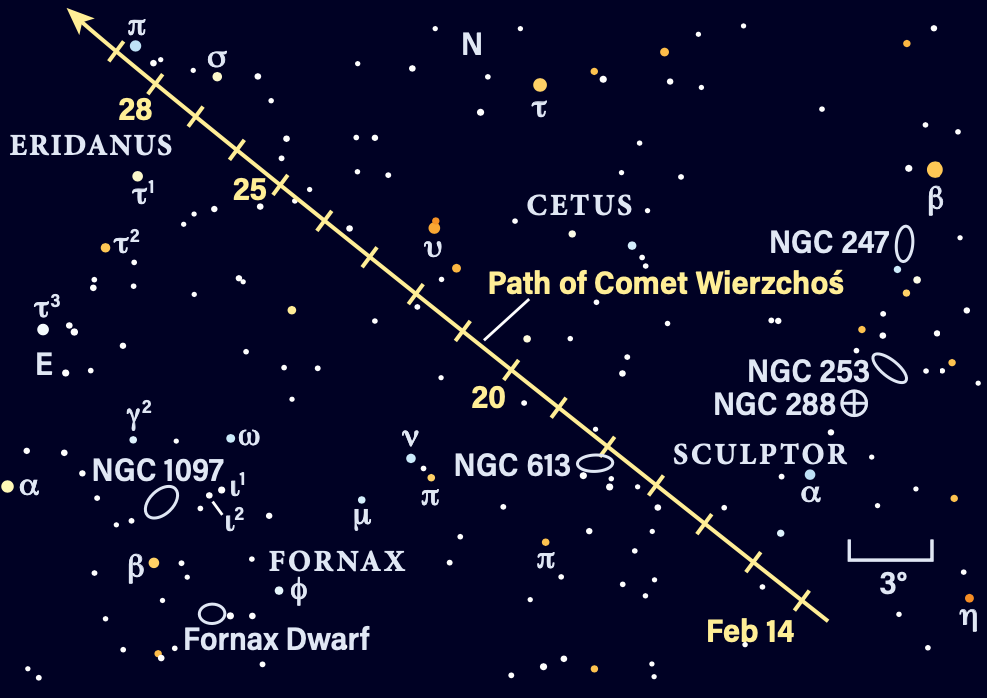
This chart shows the path of Comet Wierzchoś in the second half of February. Only deep-sky objects brighter than 10th magnitude are shown. Credit: Astronomy: Roen Kelly
Looking for a sky event this week? Check out our full Sky This Week column.
February 15: Saturn and Neptune stand close
Now roughly 7th magnitude, Comet C/2024 E1 (Wierzchoś) is readily visible in the Northern Hemisphere once more. With New Moon less than a day away, it’s the perfect time to check in on this cometary visitor, now visible for a short time after sunset in the constellation Sculptor.
However, you’ll have to be quick — half an hour after sunset, Comet Wierzchoś is only 10° above the southwestern horizon. It sets around 7:30 P.M. local time, but you should be able to catch it in binoculars or a telescope as twilight deepens. Tonight, the comet is just over 4° southeast of 4th-magnitude Alpha (α) Sculptoris, and about 4.5° southwest of NGC 613, a lovely barred spiral galaxy. However, the latter will be difficult to pick out in twilight — observers at higher altitudes and with photographic setups may be able to image it, but conditions are unfortunately not ideal.
Wierzchoś will climb higher above the horizon each night, improving visibility in the coming days. However, the waxing Moon will float nearby by the end of the week. Nonetheless, try following the comet under medium power with your scope to look for details as its appearance evolves.
Sunrise: 6:51 A.M.
Sunset: 5:37 P.M.
Moonrise: 6:34 A.M.
Moonset: 4:55 P.M.
Moon Phase: New
*Times for sunrise, sunset, moonrise, and moonset are given in local time from 40° N 90° W. The Moon’s illumination is given at 10 P.M. local time from the same location.