
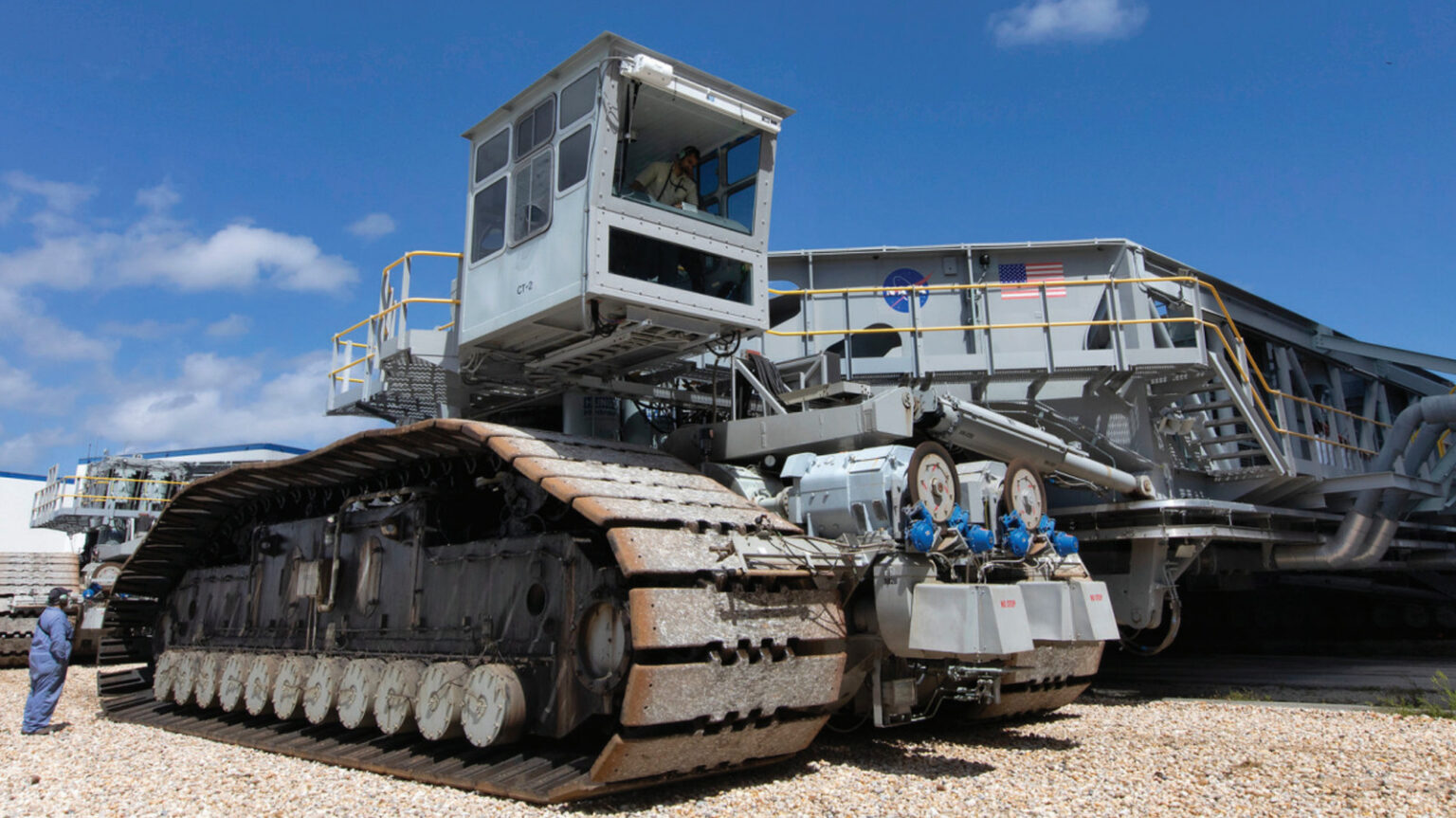
The largest and heaviest self-propelled ground vehicle on the planet, per Guinness, sits at NASA’s Kennedy Space Center in Florida. Creatively dubbed Crawler-Transporter 2, this monstrosity is the size of a baseball diamond, and while it’s over 50 years old, it will be expected to continue to dutifully serve the national space program for decades to come. NASA says it has a max speed of just 2 miles per hour, slower when laden with a launch payload. Even at those slow speeds, the CT-2 has logged over 2,300 miles on its odometer, powered by a pair of massive ALCO 251C V16 diesel engines making a combined 5,500 horsepower.
CT-2 has been upgraded to Super Crawler specifications so it can handle the extra weight of Space Launch System rockets ahead of the Artemis project that means to return humans to the moon (as well as of huge budget cuts Congress might not make). While the machine itself weighs a full 6.6 million pounds, an SLS rocket is an additional 5.8 million pounds. To shove around that much weight, the two diesel engines work in conjunction with 16 electric traction motors with a combined 6,000 horsepower and instantly variable torque. When it was built in 1965, the CT-2 required the equivalent of 20 Hi-Po V8 Mustangs to move around, but in 2026 this machine could theoretically be moved by the horsepower equivalent of just four Lucid Air Sapphires.
So did ALCO build these engines specifically for the space program to use as a ground transporter diesel generator? No, of course not. ALCO is short for American Locomotive Company, and these engines kicked off production a decade earlier in Schenectady, New York. The original use, the intended use, of the ALCO 251C was powering trains across the American, Mexican, and Australian countryside.
An engine to move mountains
Decades later, the 251C is still in production for power generation, despite ALCO’s demise in 1969. While it isn’t used to power trains any longer, it has lived on as a stationary backup generator for industrial plants and municipal purposes. Obviously, if NASA trusts this engine to power its shuttle mover, it has to have a long life, significant uptime, and be ready for action at a moment’s notice in unpredictable coastal Florida weather.
It probably hasn’t really sunk in yet just how big this engine is (though its output is dwarfed by the massive engines that made the SS United States the fastest ocean liner). To put it in perspective, each cylinder is 9 inches in diameter and has a stroke of 10.5 inches, or about 10.95 liters per cylinder. Multiply that by 16 cylinders and two engines, and NASA’s load mover has, more or less, the same displacement as 175 Kia Seltos.
At just 32 feet per gallon of fuel used, the Crawler-Transporter 2 is pretty inefficient for a hybrid. That translates to about 165 gallons of fuel burned to move a single mile. Forget miles per gallon!
When you watch the launch sequences for NASA’s upcoming manned moon missions, you’ll see the CT-2 doing what it does best, what it was built to do 61 years ago. I hope I still have this kind of athletic prowess when I’m 61 years old.