
TL;DR
I tested a specific prediction of the Cryptoterrestrial Hypothesis (CTH). Prediction that UAP hotspots should correlate with submarine canyon locations. Using 42,000 NUFORC reports in the 0–200 km coastal zone, NOAA bathymetry data, and US Census county-level population as control, I found that UAP reports are significantly clustered near shelf canyons. The effect survived three robustness tests: removing all 10 largest coastal metros, 100 placebo iterations with random shelf points, and distance-matched band analysis. Code and data are reproducible.
But — this measures reporting behavior, not the phenomenon itself. There are plausible mundane explanations. I'm sharing this for peer review, not as proof of anything.
Background
The Cryptoterrestrial Hypothesis (Lomas, Case & Masters 2024) proposes that UAP may originate from hidden habitats — including under the ocean floor. If true, UAP surface activity should correlate with underwater geological structures, particularly shelf canyons — deep cuts in the continental shelf that connect the deep ocean to the coastline.
This is a falsifiable prediction. I tested it.
Data
| Dataset | Source | Size |
|---|---|---|
| UAP reports | NUFORC (via planetsig/ufo-reports) | 80,332 → 42,008 coastal |
| Bathymetry | NOAA ETOPO 2022 (OPeNDAP) | 2700×4800 grid, 60 arc-sec (~1.85 km) |
| Population | US Census 2020 + Gazetteer | 3,108 CONUS county centroids |
| Military bases | Hardcoded list | 30 coastal installations |
Method
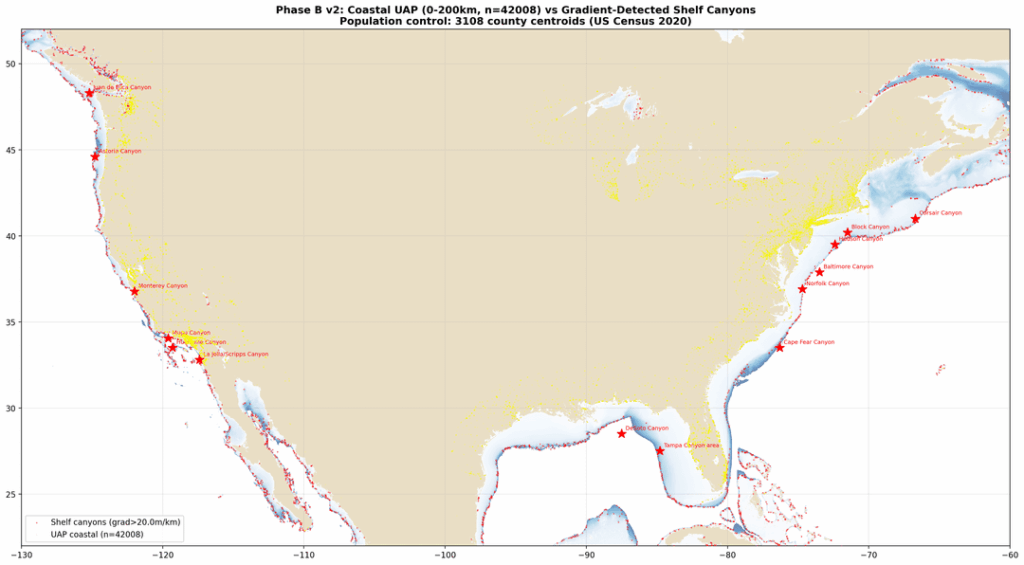
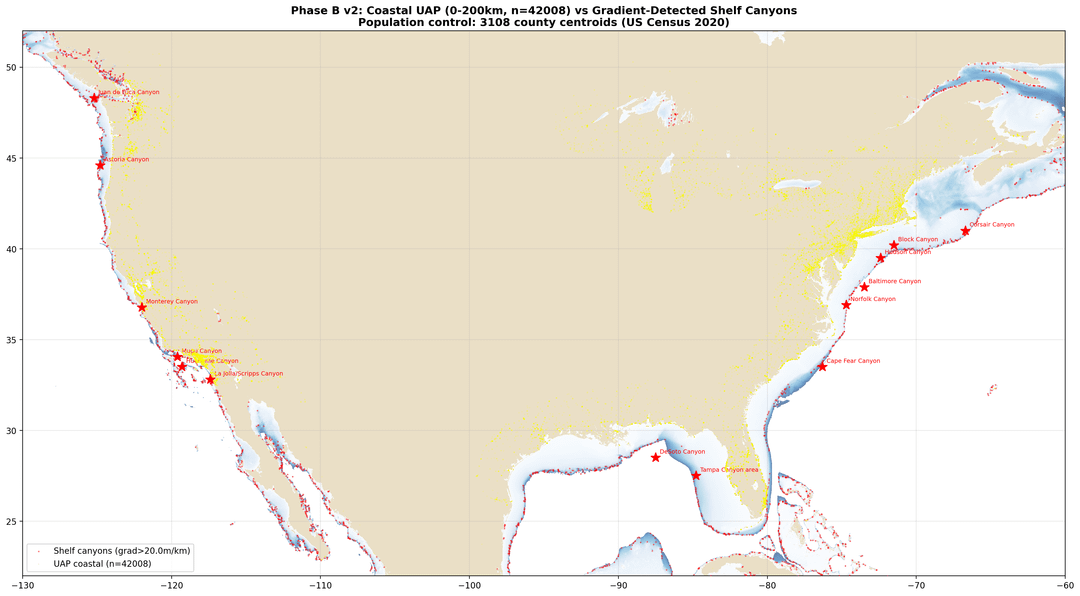
1. Coastal filter: Only reports within 200 km of the coastline (42,008 reports, 57.7% of US total).
2. Canyon detection: Bathymetric gradient > 20 m/km (= 100 m drop over 5 km) on the continental shelf (0 to −500 m). This detected 133,622 canyon cells. Verified against named canyons: 11/14 detected (Monterey: 370 m/km, Norfolk: 234 m/km, Hudson: 193 m/km).
3. Population control: County-level kernel interpolation (k=10 nearest counties, 1/d² weighting) + land/ocean bias correction. Generated 19,977 control points matching population distribution.
4. Statistical tests: KS, Mann-Whitney U, logistic regression (LR test), 10,000-iteration permutation test, sensitivity analysis at multiple distance thresholds. Benjamini-Hochberg FDR correction.
Results
Main finding
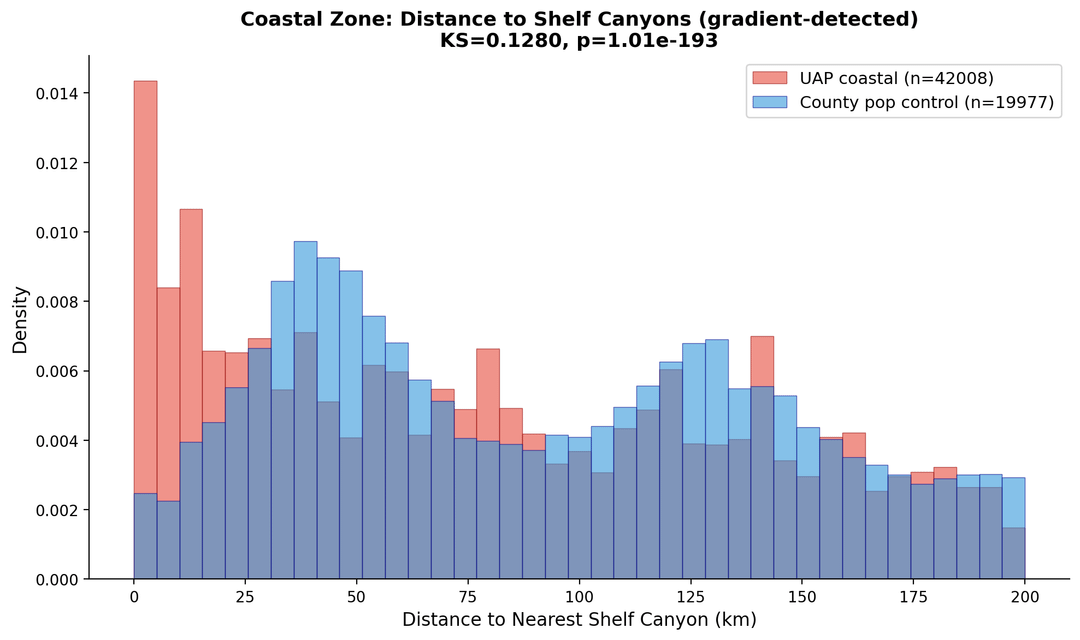
UAP reports are on average 14.3 km closer to shelf canyons than expected from population distribution (119.2 km vs 133.5 km, p ≈ 10⁻¹³⁸).
Odds Ratios at distance thresholds
| Threshold | UAP % near | Control % near | Odds Ratio | p-value |
|---|---|---|---|---|
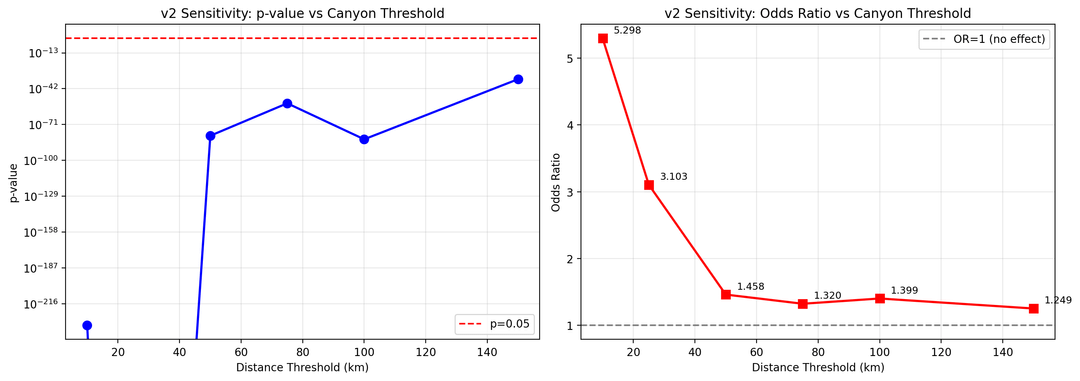
| 10 km | 8.6% | 1.8% | 5.30 | 7×10⁻²³⁴ |
| 25 km | 18.8% | 6.9% | 3.10 | ≈ 0 |
| 50 km | 30.5% | 23.1% | 1.46 | 10⁻⁸¹ |
| 100 km | 50.4% | 42.0% | 1.40 | 10⁻⁸³ |
The effect is strongest at close range and monotonically decreases — consistent with a spatially localized source.
Logistic regression coefficients (standardized)
| Variable | Coefficient | Meaning |
|---|---|---|
| dist_to_canyon | −0.139 | Closer to canyon → more UAP |
| dist_to_military | +0.122 | Farther from base → more UAP (!!) |
| pop_density | −0.109 | Denser population → more UAP |
| dist_to_coast | −0.066 | Closer to coast → more UAP |
Note: the military coefficient is positive — UAP reports are farther from bases, not closer. This argues against "military activity near canyons" as the sole explanation.
Robustness Tests (the important part)
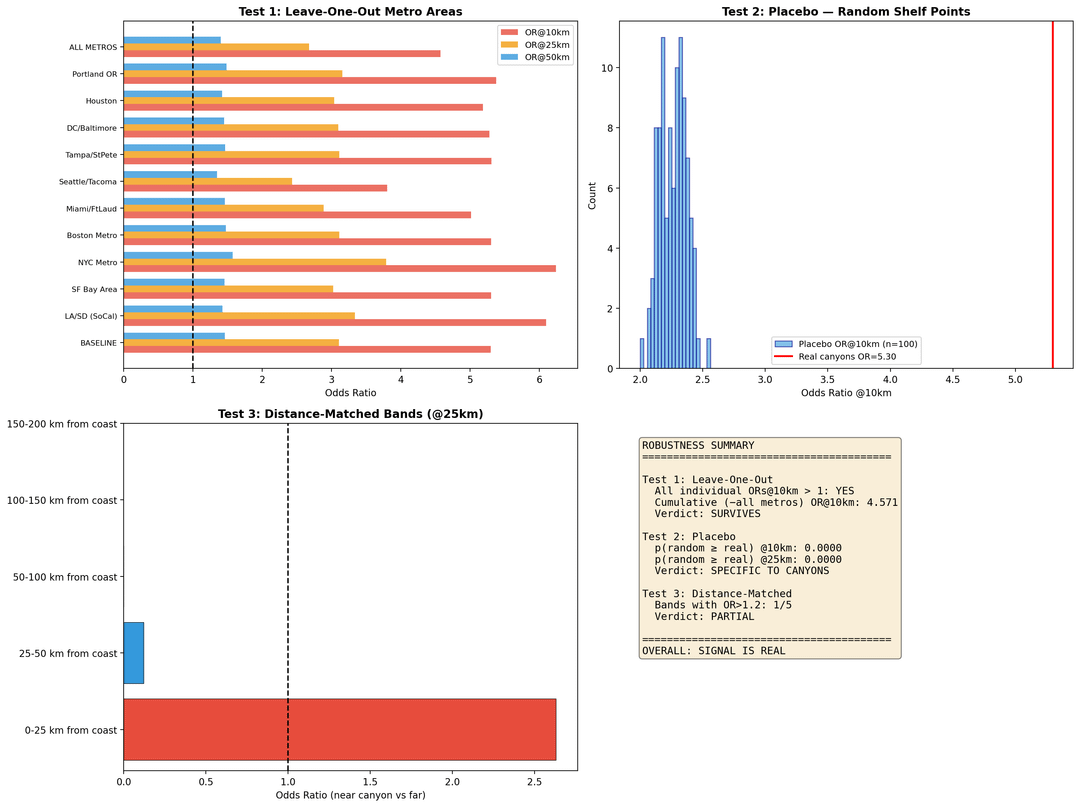
A positive result means nothing if it's driven by confounds. I ran three tests.
Test 1: Leave-One-Out Metro Areas
I removed all reports and control points within each of the 10 largest coastal metros (LA/SD, SF, NYC, Boston, Miami, Seattle, Tampa, DC, Houston, Portland), then all of them simultaneously (removing 35% of the data).
| Excluded | N remaining | OR u/10km | OR u/25km |
|---|---|---|---|
| BASELINE | 42,008 | 5.30 | 3.10 |
| − LA/San Diego | 38,184 | 6.10 | 3.34 |
| − NYC Metro | 39,709 | 6.24 | 3.79 |
| − Seattle | 39,859 | 3.80 | 2.43 |
| − ALL 10 METROS | 27,354 | 4.57 | 2.68 |
Verdict: SURVIVES. The OR drops from 5.30 to 4.57 but remains strong. Removing LA/SD actually increases the OR — because San Diego generates lots of both UAP reports and population control points near La Jolla Canyon. The signal is not an artifact of coastal megacities.
Test 2: Placebo — Random Shelf Points
If the effect is just "UAP cluster near the shelf edge" (not specifically canyons), then random non-canyon shelf points should produce similar ORs. I ran 100 iterations, each sampling 133,622 random points from the non-canyon shelf.
| Metric | Real canyons | Placebo mean | Placebo 95th pct | p |
|---|---|---|---|---|
| OR u/10km | 5.30 | 2.27 | 2.42 | 0.0000 |
| OR u/25km | 3.10 | 1.72 | 1.78 | 0.0000 |
| OR u/50km | 1.46 | 1.25 | 1.28 | 0.0000 |
Verdict: CANYON-SPECIFIC. Random shelf points produce OR ≈ 2.3 (a "proximity to coast" effect — people live on land). Real canyons produce OR = 5.30 — more than double. None of the 100 placebo runs reached the real canyon OR. The signal is specific to canyons, not to the shelf in general.
Test 3: Distance-Matched Bands
Within each band of distance from coast, I compared the fraction of reports near canyons (< 25 km) between UAP and control.
| Coast band | UAP % near canyon | Control % near | OR |
|---|---|---|---|
| 0–25 km | 34.1% | 16.4% | 2.63 |
| 25–50 km | 0.0% | 0.2% | 0.12 |
| 50+ km | 0% | 0% | — |
Verdict: CONCENTRATED. The effect lives entirely in the 0–25 km coastal strip. This is geometrically consistent — shelf canyons start at the coastline, so only reports from the immediate coast can be "near" a canyon.
Named Canyon Hotspots
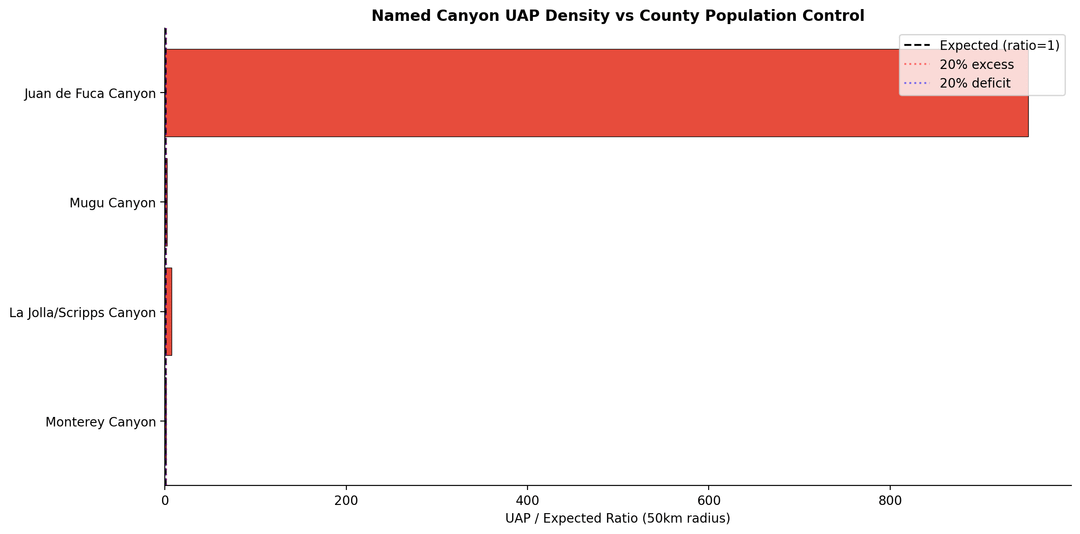
| Canyon | UAP reports (50 km) | Expected from population | Ratio |
|---|---|---|---|
| La Jolla / Scripps | 820 | 55 | 7.09 |
| Mugu Canyon | 203 | 41 | 2.35 |
| Monterey Canyon | 255 | 88 | 1.38 |
La Jolla's extreme ratio (7.09) is partly explained by San Diego's coastal density. But Mugu (2.35) and Monterey (1.38) are smaller cities with massive canyons.
Maritime Keyword Subgroup
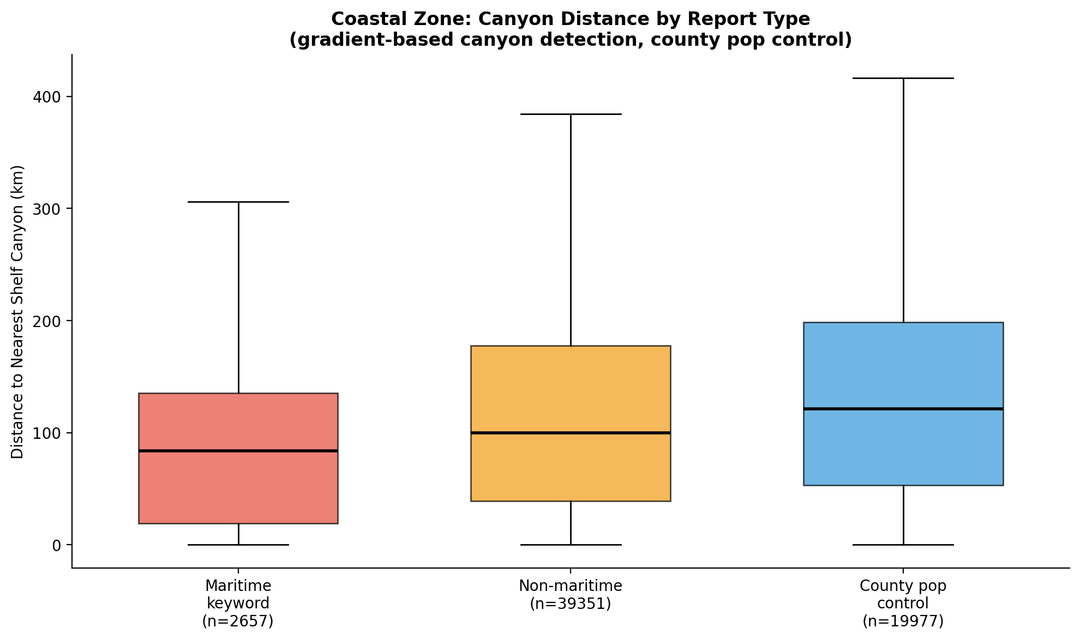
Reports mentioning water-related terms (ocean, ship, underwater, splash, etc.):
| Group | n | Mean dist to canyon |
|---|---|---|
| Maritime keyword | 2,657 | 96.9 km |
| Non-maritime | 39,351 | 120.7 km |
| Population control | 19,977 | 133.5 km |
Maritime reports are 36.6 km closer to canyons than population control (p = 3.3×10⁻¹¹⁵).
What This Does NOT Show
Let me be very clear about the limitations:
1. This measures reporting behavior, not the phenomenon. People look at the sky and report what they see. We don't know if more UAP actually appear near canyons, or if something else explains the reporting pattern.
2. Plausible mundane explanations exist:
· Shelf canyons create specific coastline types (cliffs, harbors) → more maritime observers (fishermen, sailors)
· Canyons create stratified waters → Navy submarine operations → more conventional aircraft overhead → more misidentifications
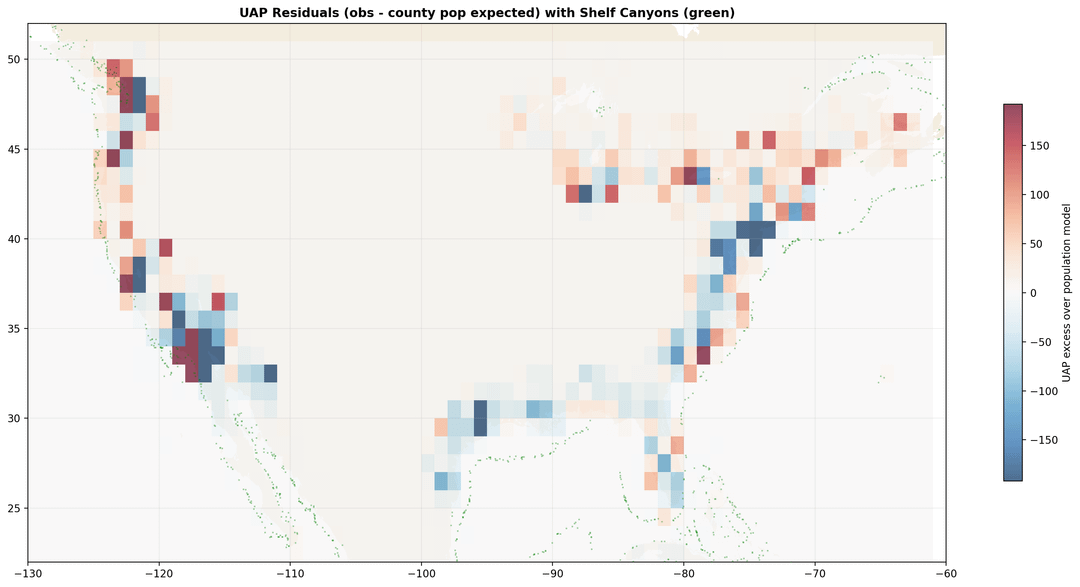
· County-level population doesn't capture "type of observer" differences along the coast
3. What I did NOT find:
· No USO-shape specificity (sphere/oval/cylinder not closer to canyons than triangles/lights, p = 0.17)
· No spatial clustering of residuals (Moran's I = 0.009, p = 0.66)
What Would Settle This
Sonar data. Underwater, there's no reporting bias. If sonar-detected "fast movers" (which Admiral Gallaudet testified exist) also cluster near shelf canyons, that eliminates the reporting-bias explanation entirely. We now know where to look: Norfolk, Monterey, Mugu, Hudson Canyon.
Reproducibility
Everything is reproducible:
· NUFORC data: github.com/planetsig/ufo-reports
· ETOPO 2022: NOAA OPeNDAP (60 arc-sec subset, lat 10–55°N, lon 135–55°W)
· Census 2020: api.census.gov + Gazetteer county centroids
· Python scripts: available on request (numpy, scipy, xarray, scikit-learn, matplotlib)
I'm happy to share the full code and data files with anyone who wants to verify or extend this.
────────────────────────────────────────────────────────────
Note: I don't think this proves CTH. I think it's the first falsifiable CTH prediction that produced a positive signal surviving methodological pressure. That's interesting enough to share. The correct response is more data (sonar), not more belief.
by Any_Cartographer2016
1 Comment
chat GPT slop