
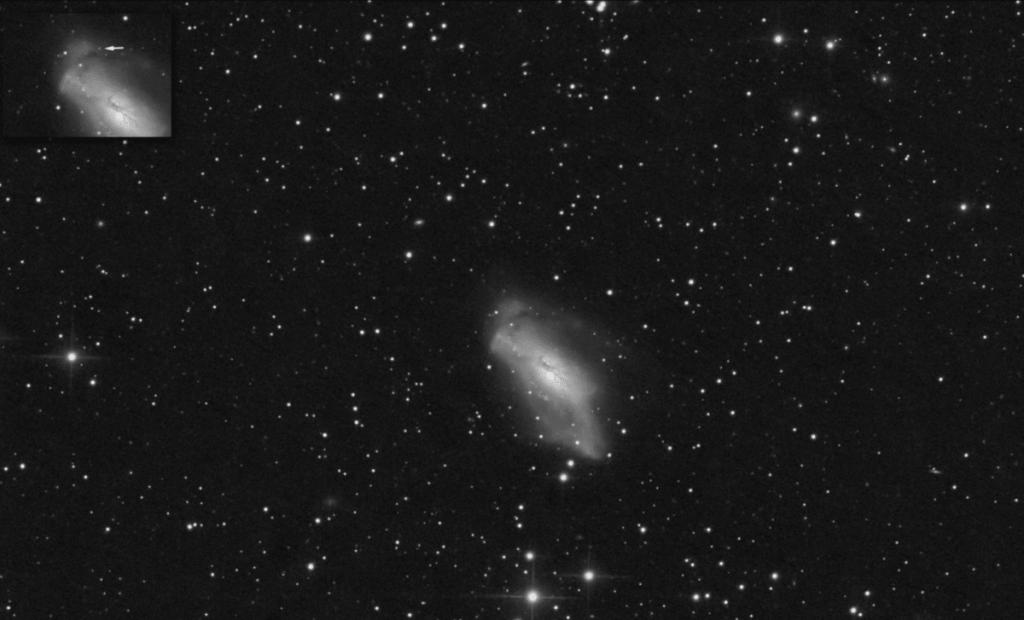
Astronomers have recently made an exciting discovery: SN 2024abfl, a low-luminosity Type IIP supernova in the galaxy NGC 2146. This rare find is shedding new light on how stars explode and the processes behind these cosmic events. Led by Xiaohan Chen from the Chinese Academy of Sciences, a team of researchers analyzed data from various telescopes, including those at the Xinglong Station observatory in China, to uncover unexpected features of the supernova. Their study, available on arXiv, offers fresh insights into stellar evolution, the life cycles of stars, and the role of supernovae in shaping galaxies.
Understanding Type IIP Supernovae and Their Importance in Astronomy
Supernovae, some of the most energetic and luminous events in the universe, have long been a subject of interest for astronomers. These stellar explosions are classified based on the presence or absence of hydrogen in their spectra. Type I supernovae, lacking hydrogen, contrast with Type II supernovae, which exhibit hydrogen lines in their spectra. Type II supernovae, further classified into subtypes such as Type IIL (Linear) and Type IIP (Plateau), are crucial for understanding stellar evolution. While SNe IIL are characterized by a rapid decline in brightness, Type IIP supernovae are notable for their prolonged plateau phase, where their luminosity remains relatively constant for an extended period. This plateau can last for up to 100 days, providing a valuable opportunity to study the underlying mechanisms driving the explosion. SN 2024abfl, as a low-luminosity member of this class, has provided unique insights into how these events unfold.
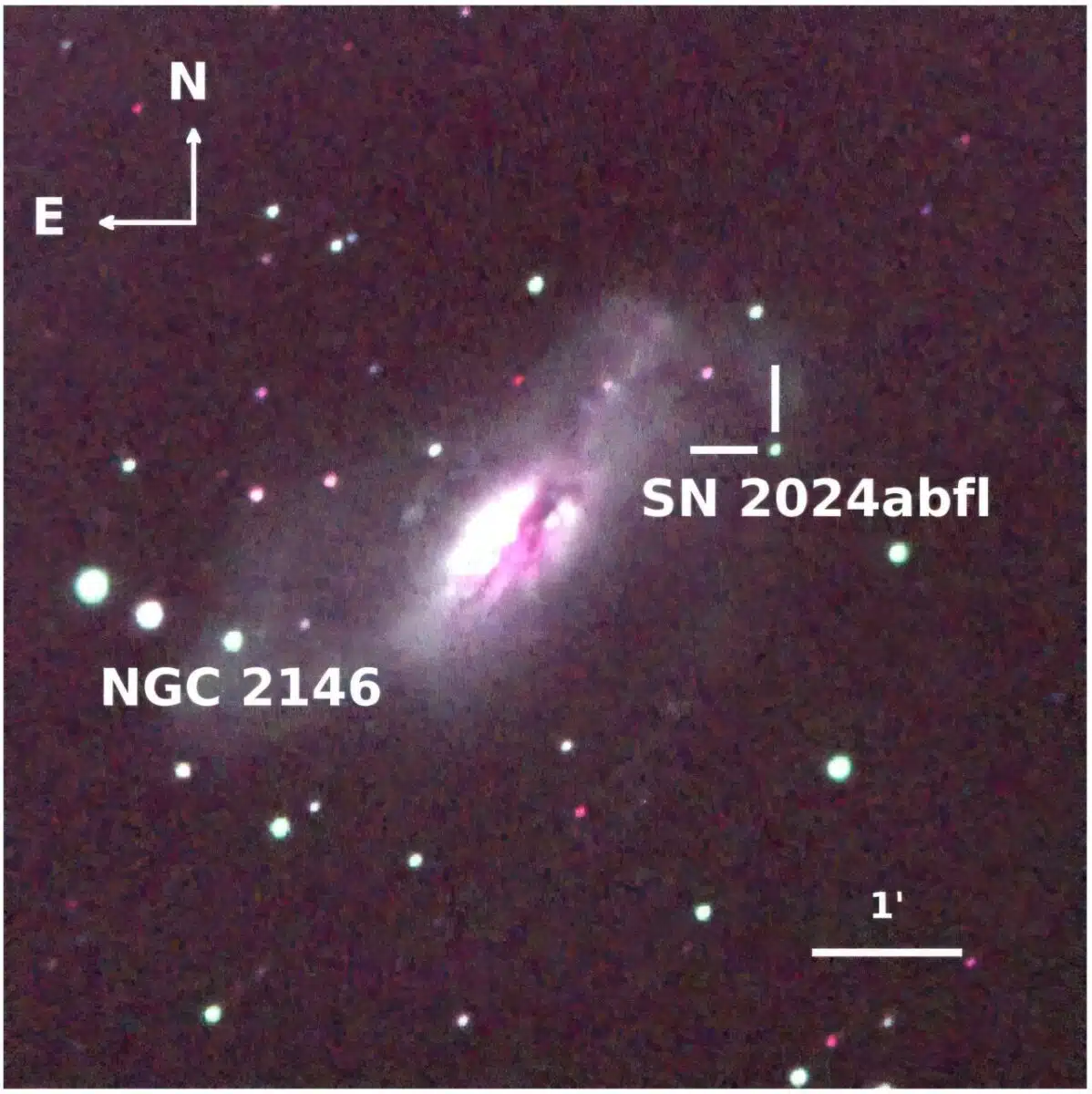 SN 2024abfl and its host galaxy NGC 2146. Shown is an RGB composite assembled from Xinglong 35-cm telescope g-, r-, and i-band exposures at t = 4.4 days after the explosion. Credit: Chen et al., 2026.
The Discovery of SN 2024abfl: A Low-Luminosity Event
SN 2024abfl, which was first observed on November 15, 2024, in the nearby galaxy NGC 2146, immediately caught the attention of astronomers. The supernova appeared with an apparent magnitude of 17.5, suggesting that it was a relatively dim event compared to more typical Type IIP supernovae. Despite its lower luminosity, SN 2024abfl exhibited many of the expected characteristics of its class, including the extended plateau phase. However, its absolute magnitude during this plateau was much dimmer, around −15 mag, which is significantly lower than that of typical Type IIP events. This has led researchers to classify SN 2024abfl as a low-luminosity Type IIP, providing a new and important example of how such supernovae can vary in their intensity and duration.
The Progenitor Star: Clues to the Origins of SN 2024abfl
One of the key findings of the study, available on arXiv, is the identification of a possible progenitor star for SN 2024abfl, which was initially estimated to have a mass between 9 to 12 solar masses. The progenitor star was most likely a red supergiant, a stage in the life cycle of certain stars just before they explode as supernovae. Through analysis of archival data from the Hubble Space Telescope, the researchers were able to pinpoint this potential progenitor, adding an important piece to the puzzle of how low-mass stars end their lives. The study of SN 2024abfl’s progenitor star is vital because it challenges the idea that only more massive stars (those over 15 solar masses) can produce Type IIP supernovae. This finding expands the range of progenitor stars that can give rise to these types of explosions.
The Plateau Phase of SN 2024abfl: A Closer Look at Its Duration and Brightness
The plateau phase of a Type IIP supernova is a period where the brightness of the explosion remains stable, which provides astronomers with a valuable window into the physical processes occurring during the event. In the case of SN 2024abfl, the plateau phase lasted for an extraordinary 126.5 days, a duration that is notably longer than that of more typical supernovae in this category. This extended plateau suggests that the star’s outer envelope was unusually thick, which would have caused the explosion to brighten more slowly and remain visible for a longer period. The prolonged plateau of SN 2024abfl, combined with its low luminosity, makes it an important object for astronomers seeking to understand the range of behaviors exhibited by Type IIP supernovae.
Spectroscopic Insights: What the Light Curves Reveal About SN 2024abfl
Spectroscopic data collected during the observation of SN 2024abfl provided further insights into the explosion’s evolution. The spectral evolution of SN 2024abfl was found to be similar to that of other Type IIP supernovae but with notable differences. For example, the supernova showed much slower ejecta velocities than typical for this class of event. About 37 days after the explosion, a high-velocity hydrogen-alpha absorption feature emerged, suggesting that the inner ejecta contained a plume of matter moving at much higher speeds. Later, around 24 days after this feature appeared, two additional emission features were detected at velocities of about 2,000 km/s, potentially indicating interaction with the circumstellar medium surrounding the progenitor star. This interaction could have contributed to the unique characteristics of the supernova’s light curve.
Nickel-56 and Energy of SN 2024abfl: A Supernova of Lower Energy
One of the most intriguing aspects of SN 2024abfl is its energy output, which was found to be significantly lower than that of typical supernovae. The mass of the nickel-56 isotope produced in the explosion was estimated to be about 0.009 solar masses, which is much smaller than in more luminous events. The initial kinetic energy of the explosion was calculated to be approximately 42 quindecillion ergs, indicating that this was a relatively low-energy event. The lower energy output of SN 2024abfl suggests that its progenitor star had a less energetic death, which in turn might be a result of its lower initial mass. These findings highlight the variability of supernovae and their dependence on the progenitor star’s mass and composition.