
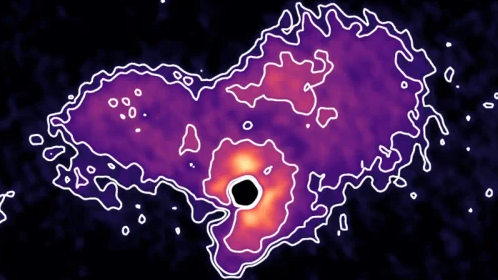
Astronomers have spotted a heart in the cosmos — and it’s not Cupid’s doing, but rather a dying star shedding its layers — just in time for Valentine’s Day.
A red giant star called Mira A, located about 300 light-years from Earth, has ejected a vast cloud of gas and dust resembling the shape of a heart. The lovely cloud glows against the void of space, not unlike a cosmic Valentine’s Day signal.
You may like
“We were very surprised to see this structure,” study lead author Theo Khouri, an astronomer from Chalmers University, said in a statement. “We also see that the star’s illumination of the surrounding dust varies in an unexpected way, which implies that the star acts like a lighthouse — illuminating its environment unevenly.”
The expelled matter amounts to roughly seven Earth masses, far more than scientists would expect, with gas filling the heart’s interior and dust outlining the edges. The star’s light also sweeps across the cloud like a cosmic beacon, causing the heart-shaped plume to glow as if it were radiating love into space.
“We know that stars like Mira lose mass as they age, but we did not expect it to happen in such large and sudden bursts,” Khouri added.
The discovery was made using data from the European Southern Observatory’s (ESO) Very Large Telescope (VLT) and the Atacama Large Millimeter/submillimeter Array (ALMA) in Chile. By combining observations taken between 2015 and 2023, astronomers were able to map the two large clouds that form the heart-shaped plume in stunning detail, revealing not just the shape but the dynamics of the ejected material.
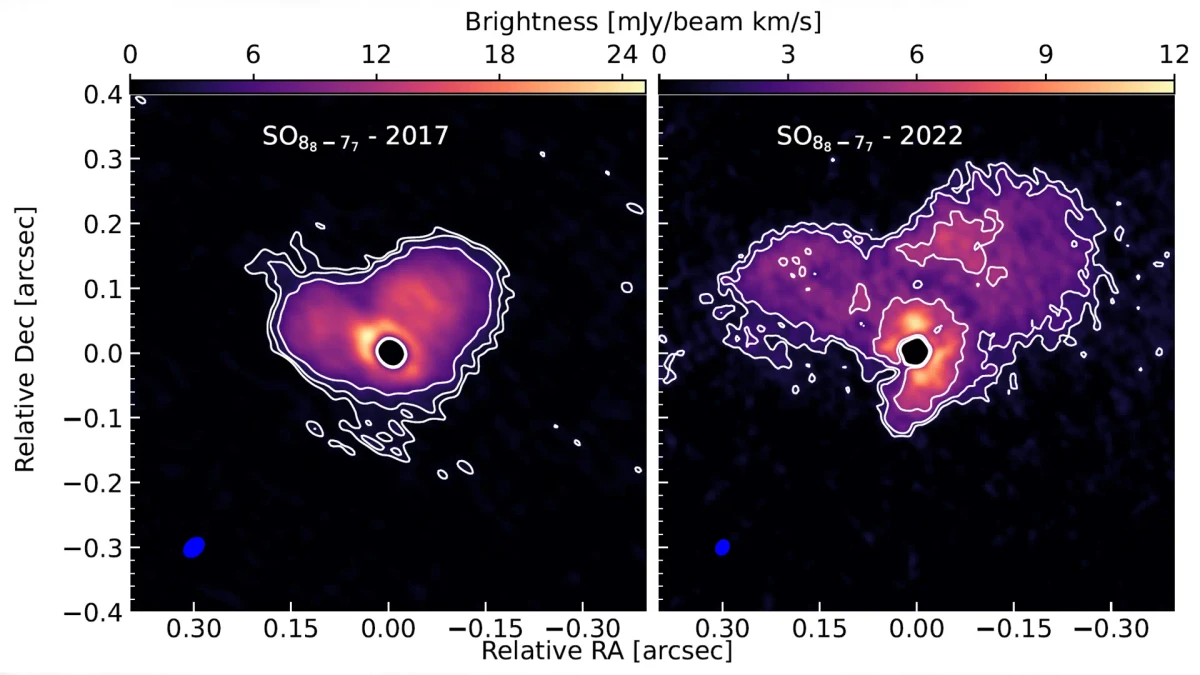
The heart-shaped cloud is seen on this graph in the study. (Image credit: Khouri et al.)
Such asymmetrical, massive ejections challenge previous models of how stars like Mira A lose mass in their final stages, offering a new window into the complex deaths of stars and how they enrich the cosmos with elements that will one day form new stars and planets, according to the study.
“We will keep monitoring the expanding cloud around Mira A, as it is becoming so large that it may start to affect its companion star, the white dwarf Mira B,” Khouri said. “It is already gathering some of the material ejected by Mira A.”
The heart-shaped outflow from Mira A offers a romantic spectacle for Valentine’s Day, and reminds us that space is full of striking, endearing cosmic creations.
Their findings were accepted for publication on Feb. 3 in Astronomy and Astrophysics.