
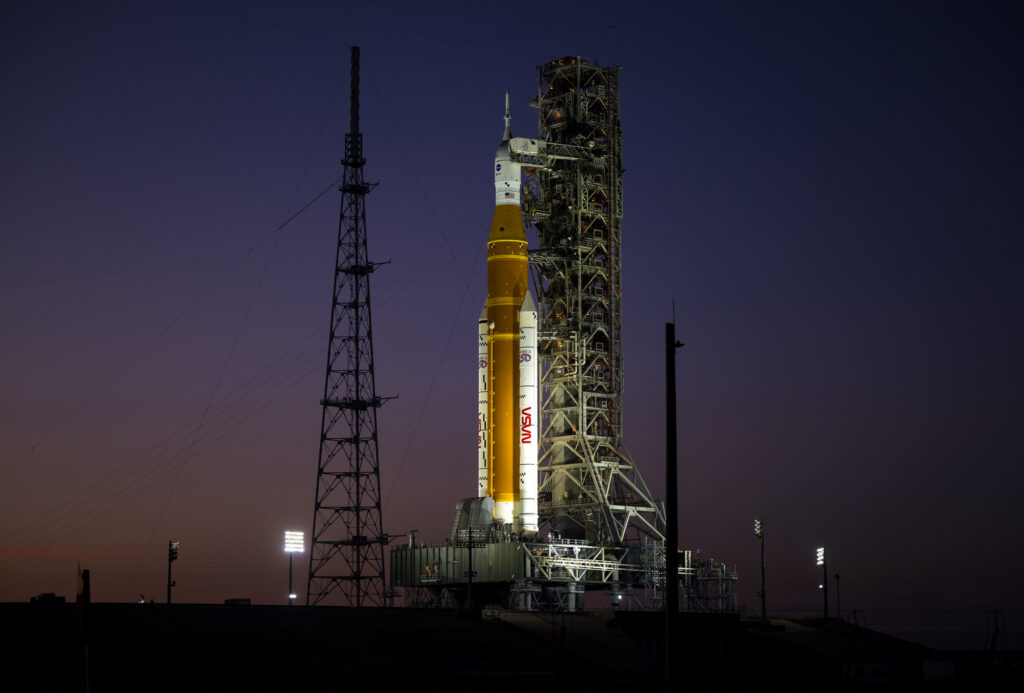
WASHINGTON — A NASA test to confirm repairs to seals in the Space Launch System’s liquid hydrogen fueling system was only partially successful because of problems with ground equipment.
In a statement late Feb. 13, NASA said it performed a “confidence test” the previous day on the SLS core stage fueling system, partially filling the stage’s liquid hydrogen tank to test seals that had been replaced in a fueling interface.
The seals were the suspected cause of hydrogen leaks during a wet dress rehearsal Feb. 2, when the SLS was loaded with liquid hydrogen and liquid oxygen as part of a practice countdown. The leaks forced an early end to the test, and NASA later said it planned to replace two seals in hydrogen lines that transfer fuel into the rocket.
In its latest statement, NASA said the confidence test, not announced in advance and first reported by Spaceflight Now, was intended to evaluate the new seals. However, the agency said that “teams encountered an issue with ground support equipment that reduced the flow of liquid hydrogen into the rocket.”
Despite the reduced flow, NASA said it was able to “gain confidence in several key objectives” and collect data at the interface that had been the source of the earlier leak.
NASA Administrator Jared Isaacman mentioned the test, which he described as a “mini wet dress rehearsal,” during coverage of the Crew-12 launch Feb. 13.
“We’re doing a series of mini wet dress rehearsal tests today to make sure we give that vehicle the highest probability of success to get off the pad in early March,” he said during NASA’s webcast of the launch.
At a news conference after the launch, Isaacman said program officials wanted to review data from the tests before deciding whether to proceed with a second full wet dress rehearsal.
“On Artemis 1, we were combating hydrogen leaks multiple times,” he said. “We obviously encountered that again on the Artemis 2 wet dress rehearsal.”
“From some of the early views, we did not see some of the leaks for the portion of the test we were running that at a comparable period during the full Artemis 2 wet dress we did,” he said. He did not mention the reduced flow of liquid hydrogen into the stage, which could affect the ability to fully evaluate the new seals.
“We will continue to do everything available to gain confidence going into the full wet dress,” he said.
In the new statement, NASA said it plans to inspect the ground support equipment and replace a filter believed to have caused the reduced hydrogen flow.
The agency has not announced a date for a second wet dress rehearsal, but Isaacman said there was still time to conduct one ahead of the next Artemis 2 launch opportunity in early March.
“We have a lot of time ahead of us,” he said. “We could undertake more than one wet dress, if necessary. We’re going to make absolute most use of the time that we have leading up to the start of the window.”
Related