
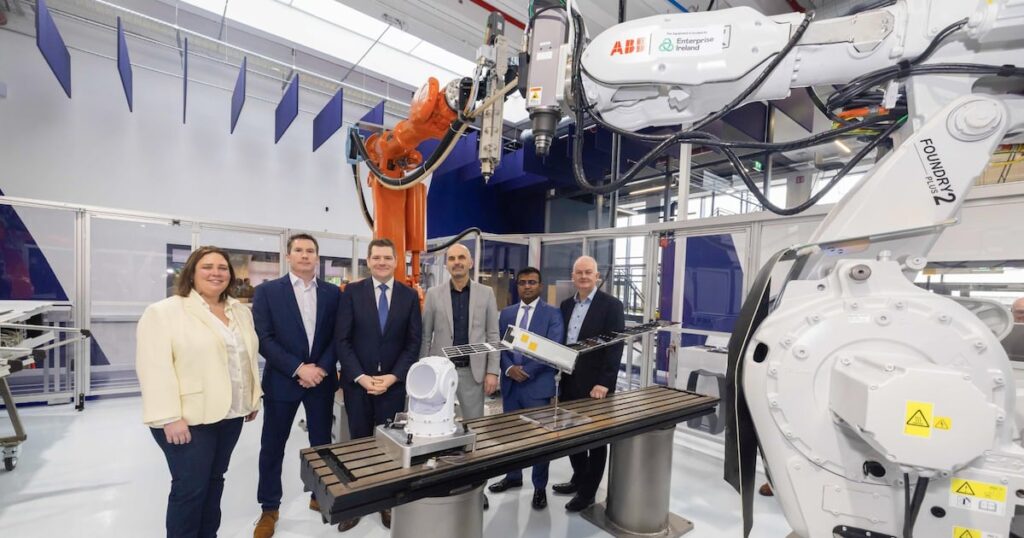
Ireland’s first European Space Agency (ESA) lab has been launched in Co Westmeath to oversee the development of technology that could be used in space or elsewhere.
ESA Phi-Lab Ireland will be headquartered at the Irish Manufacturing Research (IMR) facility in Mullingar.
The new lab is run in collaboration with the Amber Centre at Trinity College Dublin.
A variety of technology will be developed and tested at the centre, including artificial intelligence, quantum computing and robotics. As well as the potential to be used in space, the products may end up in terrestrial manufacturing, agriculture and climate innovation.
The lab was formally launched by Minister for Enterprise Peter Burke in Mullingar on Friday as part of a wider Irish commitment to the ESA. The Department of Enterprise is due to invest €170 million in the agency over the next five years.
The Minister said the launch “strengthens Ireland’s position, and the midlands region, as a hub for advanced research, innovation and high-value enterprise”.
He announced the first companies that will be supported by the lab – Mbryonics and Ubotica Technologies – both having been selected from an open call for submissions last year.
At the event, Burke encouraged companies to apply for the second open call for proposals which will welcome projects from companies “seeking to advance their position in the European space market” and “that in the past have never considered their products for the space sector”, a statement from the department said.
Since the publication of Ireland’s National Space Strategy for Enterprise in 2019, there are now 120 “space-active” companies working with ESA in Ireland.
Barry Kennedy, IMR chief executive, described the new lab as “a significant milestone in Ireland’s space and innovation ambition”.
“This facility positions Ireland at the forefront of European space-enabled innovation,” he said.
Dietmar Pilz, director of technology at the ESA, said the lab would help ensure that innovation developed for space “delivers real benefits for industry, society and Europe’s long‑term competitiveness”.