
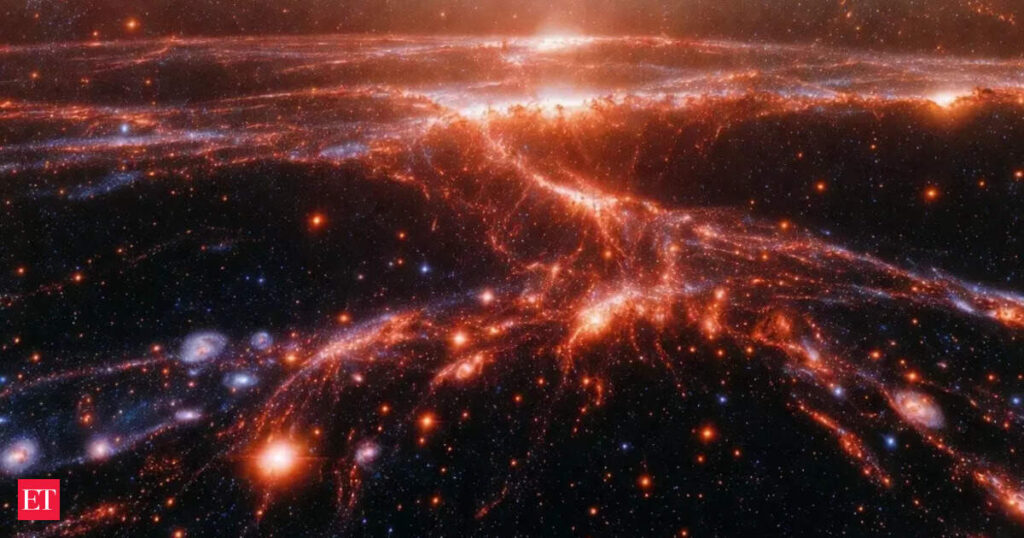
In December 2025, NASA unveiled the first all-sky cosmic map from its new space observatory, SPHEREx (Spectro-Photometer for the History of the Universe, Epoch of Reionisation, and Ices Explorer). Unlike traditional surveys that detect only a few broad colours of light, SPHEREx captures the cosmos across 102 distinct infrared wavelengths, many of which are invisible to the human eye. These narrow “colours” allow scientists to extract detailed information about the composition, distance, and history of celestial objects. According to Dave Gallagher, Director of the Jet Propulsion Laboratory, “SPHEREx is a mid-sized astrophysics mission delivering big science” because its data will enable new ways of mapping the universe’s structure and evolution.
By measuring not only where galaxies appear on the sky but also how much their light has been stretched by cosmic expansion, SPHEREx produces a three-dimensional map of the universe. This capability represents a significant advancement over earlier all-sky surveys that lacked precise redshift or depth information.
What Makes SPHEREx’s Map UniqueTraditional sky surveys capture images in broad wavelength bands that show objects’ shapes and brightness, but they reveal limited information about physical properties. SPHEREx uses infrared spectroscopy to split light into more than 100 narrow spectral bands, capturing signatures that indicate chemical composition and distance. This spectral richness allows scientists to distinguish between stars, galaxies, gas, and dust more effectively than broad-band imaging alone.
Beth Fabinsky, SPHEREx project manager at JPL, has emphasised that the mission’s “superpower” is scanning the entire sky in 102 colours every six months, producing massive datasets that are richer than those of any previous all-sky survey. By continuously revisiting the full sky over its two-year primary mission, SPHEREx will improve data quality and sensitivity, enabling increasingly detailed cosmic maps that chart structures from nearby galaxies to the edge of the observable universe.
 Live Events
Probing the Universe’s Earliest MomentsOne of SPHEREx’s central scientific goals is to investigate cosmic inflation, the rapid expansion of the universe experienced within the first fraction of a second after the Big Bang. Inflation is believed to have left subtle imprints on the large-scale distribution of matter. By charting galaxy positions and clustering patterns across enormous cosmic volumes, SPHEREx can test predictions of inflationary models. Scientists will analyse how galaxy clustering varies with distance and cosmic time, thereby refining theories about how primordial fluctuations evolved into the complex web of galaxies observed today.
SPHEREx will complement other cosmological surveys by focusing on spectral measurements that add depth and context to galaxy maps. In presentations at professional astronomy conferences, researchers have noted that SPHEREx’s data will tighten constraints on models of the early universe and help scientists understand how large-scale cosmic structures formed.Galaxy Formation and EvolutionBy collecting spectral data for millions of galaxies, SPHEREx creates a powerful resource for studying galaxy formation and evolution. Infrared spectra provide information on stars, gas, and dust within galaxies, revealing how these components change over billions of years. With redshift measurements indicating relative distances, researchers can reconstruct how galaxies grew and interacted across cosmic history.
This long-term view allows scientists to trace the formation of structures from the early universe to the present, illuminating processes such as star formation, mergers, and the influence of dark matter on galaxy evolution.
Searching for Water and Organic MoleculesSPHEREx is also equipped to investigate fundamental questions about the raw ingredients for life. Many molecules, including water ice, carbon dioxide, and organic compounds, have characteristic infrared signatures. SPHEREx’s spectral survey will detect and quantify these substances across the Milky Way, especially where they reside on dust grains in interstellar clouds.
NASA scientists estimate that much of the galaxy’s water exists as ice coating tiny dust particles. Understanding the abundance and distribution of water and organic molecules informs models of star and planet formation and provides context for questions about habitability in planetary systems.
How the Mission WorksSPHEREx operates from a sun-synchronous low Earth orbit, sweeping the sky systematically as Earth rotates beneath it. The spacecraft builds its cosmic map by repeatedly observing every part of the sky, producing overlapping spectral measurements that enhance sensitivity and reliability. The mission’s spectrophotometer separates incoming light into narrow wavelength bands, allowing detailed analysis of each object’s spectral fingerprint. By comparing these spectra across large samples of galaxies, scientists obtain both chemical insights and distance estimates via redshift.A Legacy of Open Data and CollaborationAll SPHEREx data are released to the public through NASA’s archives, enabling astronomers worldwide to explore and use the dataset for research beyond the mission’s original goals. This open data approach accelerates discovery and encourages diverse scientific investigations, from detailed studies of individual galaxies to broad tests of cosmological theories.
SPHEREx builds on a tradition of space-based all-sky surveys, such as those conducted by the Planck and WMAP missions, which mapped the cosmic microwave background. Where earlier missions provided snapshots of the universe’s infancy, SPHEREx adds spectral depth to the universe’s more recent history, filling critical gaps in understanding how cosmic structures emerged and evolved.
Charting the Future of Cosmic DiscoverySPHEREx’s new all-sky map marks a major step forward in observational cosmology. By combining wide-field coverage with high spectral resolution, the mission reveals the universe in unprecedented detail and provides tools to address some of the most profound questions in astrophysics. As subsequent surveys accumulate deeper and broader data, scientists expect SPHEREx’s legacy to extend far into the future, shaping how humanity understands the cosmos’s origin, structure, and potential for life.