
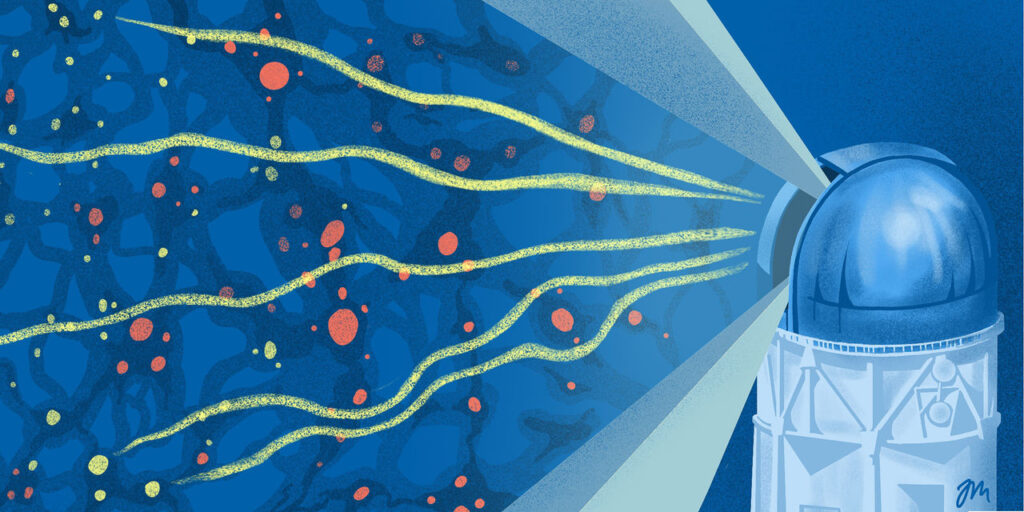
Researchers say a repulsive force they call dark energy is behind the universe’s accelerating expansion, overcoming gravity which would be expected to slow the expansion. By mapping hundreds of millions of galaxies, detecting thousands of supernovae, researchers are using patterns of cosmic structure to get closer to understanding the phenomenon.
Between 2013 and 2019, the project surveyed about one-eighth of the sky over the course of 758 nights of observation. During that time, researchers have catalogued hundreds of millions of galaxies to make some of the most precise measurements yet of the distribution of matter in the universe.
According to Astronomy magazine, the survey is the first to investigate dark energy by combining observations from four different probes to gather the most comprehensive data to date on the way our cosmos has expanded over time.
“We can test for what values of parameters produce theory predictions that agree the best with our measurements, and how much those values can change before predictions disagree significantly with the observables,” Muir told Astronomy. “In other words, we’re constraining what parameter values plausibly describe the real universe.”
The survey represents 20 years of research and scholarship, she said.
“One of the key accomplishments of this effort has been the role the work has had in training a generation of scientists,” Muir told Astronomy.
Read the Astronomy magazine story.
Featured illustration at top: UC Assistant Professor Jessica Muir is part of the Dark Energy Survey examining the role this enigmatic force plays in the universe. Illustration/Jessica Muir