
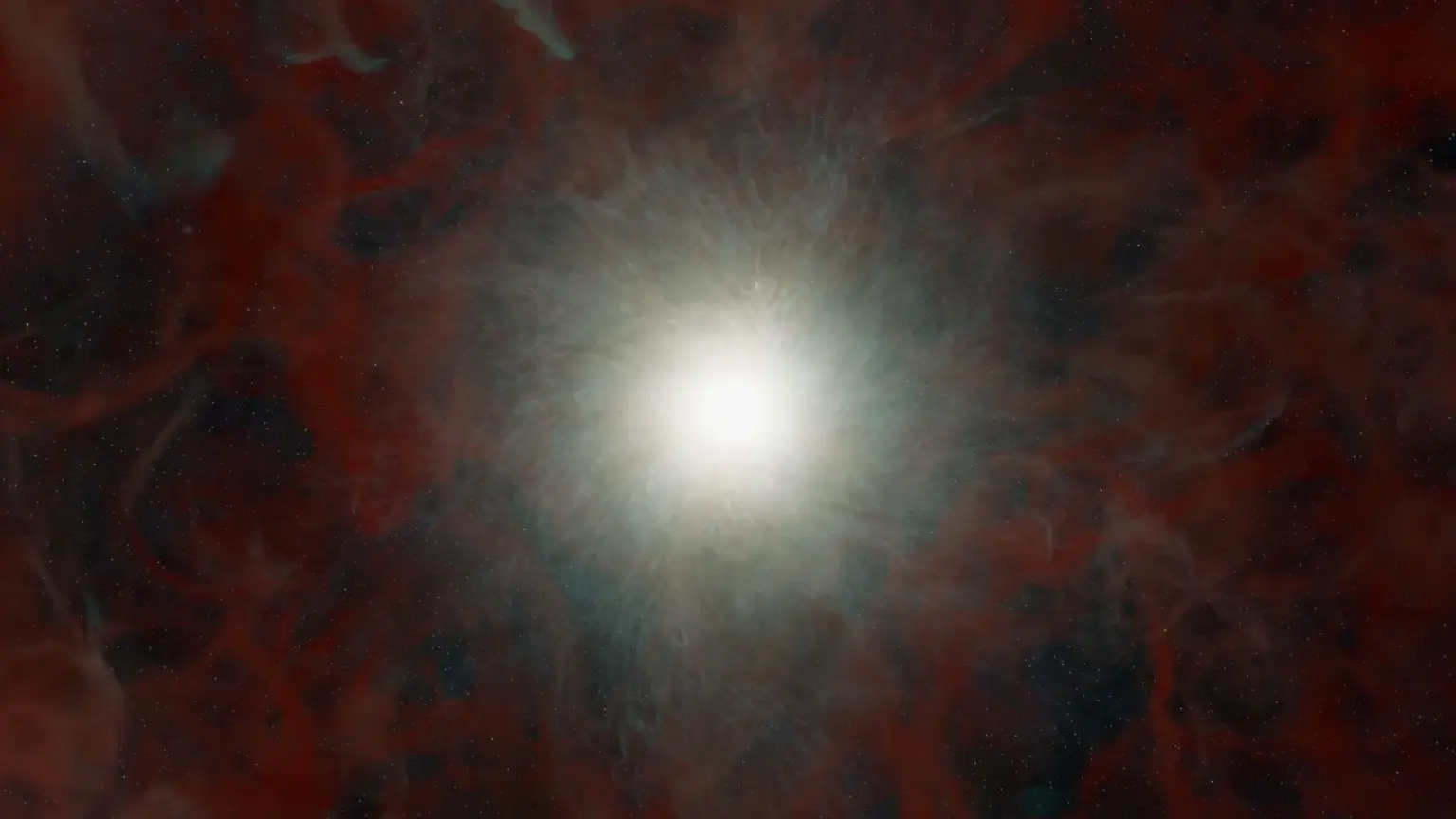
Astronomers have directly observed a massive dying star skip a supernova explosion and instead collapse into a black hole. This event provides the most detailed set of observations ever assembled of a star making that transition, giving researchers an unusually complete view of how stellar black holes form.
By combining fresh telescope data with more than a decade of archived observations, scientists were able to test and refine long standing theories about how the most massive stars end their lives. Rather than exploding outward in a brilliant supernova, this star’s core gave way under gravity and formed a black hole. In the process, its unstable outer layers were gradually pushed outward.
The findings, published February 12 in Science, are drawing attention because they offer a rare look at the birth of a black hole. The results may help explain why some massive stars explode dramatically at the end of their lives, while others collapse quietly.
“This is just the beginning of the story,” says Kishalay De, an associate research scientist at the Simons Foundation’s Flatiron Institute and lead author on the new study. Light from dusty debris surrounding the newborn black hole, he says, “is going to be visible for decades at the sensitivity level of telescopes like the James Webb Space Telescope, because it’s going to continue to fade very slowly. And this may end up being a benchmark for understanding how stellar black holes form in the universe.”
The Disappearance of M31-2014-DS1 in Andromeda
The star, known as M31-2014-DS1, was located about 2.5 million light-years away in the Andromeda Galaxy. De and colleagues examined data collected between 2005 and 2023 from NASA’s NEOWISE mission along with other ground and space telescopes. They discovered that the star began brightening in infrared light in 2014. Then in 2016, its brightness dropped sharply in less than a year.
By 2022 and 2023, the star had nearly vanished in visible and near-infrared wavelengths, fading to just one ten-thousandth of its former brightness in those bands. What remains can now only be detected in mid-infrared light, where it glows at roughly one-tenth of its original intensity.
De says, “This star used to be one of the most luminous stars in the Andromeda Galaxy, and now it was nowhere to be seen. Imagine if the star Betelgeuse suddenly disappeared. Everybody would lose their minds! The same kind of thing [was] happening with this star in the Andromeda Galaxy.”
When the team compared the observations with theoretical predictions, they concluded that such an extreme drop in brightness strongly indicates that the star’s core collapsed and formed a black hole.
Why Some Massive Stars Fail to Explode
Stars shine because nuclear fusion in their cores converts hydrogen into helium, creating outward pressure that counteracts gravity. In stars at least 10 times more massive than our sun, this balance eventually breaks down when nuclear fuel runs low. Gravity then overwhelms the outward pressure, causing the core to collapse and form a dense neutron star.
In many cases, a flood of neutrinos released during this collapse generates a powerful shock wave that tears the star apart in a supernova. But if that shock wave is too weak to eject the surrounding material, much of the star can fall back inward. Theoretical models have long suggested that this fallback can turn the neutron star into a black hole.
“We’ve known for almost 50 years now that black holes exist,” says De, “yet we are barely scratching the surface of understanding which stars turn into black holes and how they do it.”
The Key Role of Convection
The detailed study of M31-2014-DS1 also helped researchers revisit a similar object, NGC 6946-BH1, which had been identified a decade earlier. Reanalyzing both cases revealed a crucial missing ingredient in understanding what happens to a star’s outer layers after a failed supernova. The answer lies in convection.
Convection arises from large temperature differences inside a star. The core is extremely hot, while the outer layers are much cooler. This contrast drives gas to circulate between hotter and cooler regions.
When the core collapses, the outer gas is still in motion because of this churning process. According to models developed at the Flatiron Institute, that motion prevents most of the outer material from plunging straight into the black hole. Instead, some inner layers circle the black hole, while the outermost layers are pushed outward.
As the expelled material travels away, it cools. At lower temperatures, atoms and molecules combine to form dust. That dust blocks light from the hotter gas closer to the black hole, absorbs energy, and reemits it in infrared wavelengths. The result is a lingering reddish glow that can last for decades after the original star has disappeared.
Co-author and Flatiron Research Fellow Andrea Antoni developed the theoretical framework behind these convection models. Drawing on the new observations, she says, “the accretion rate — the rate of material falling in — is much slower than if the star imploded directly in. This convective material has angular momentum, so it circularizes around the black hole. Instead of taking months or a year to fall in, it’s taking decades. And because of all this, it becomes a brighter source than it would be otherwise, and we observe a long delay in the dimming of the original star.”
Much like water spiraling down a drain rather than dropping straight through, gas continues orbiting the newly formed black hole as gravity gradually pulls it inward. This delayed infall means the entire star does not collapse all at once. Even after the core quickly gives way, some material falls back slowly over many decades.
Researchers estimate that only about one percent of the star’s original outer envelope ultimately feeds the black hole, producing the faint light still observed today.
Building a Bigger Picture of Black Hole Formation
As they analyzed M31-2014-DS1, the team also reexamined NGC 6946-BH1. The new study provides strong evidence that both stars followed a similar path. What first seemed like an unusual case now appears to be part of a broader category of failed supernovae that quietly produce black holes.
M31-2014-DS1 initially stood out as an “oddball,” De says, but it now seems to be one of several examples, including NGC 6946-BH1.
“It’s only with these individual jewels of discovery that we start putting together a picture like this,” De says.