
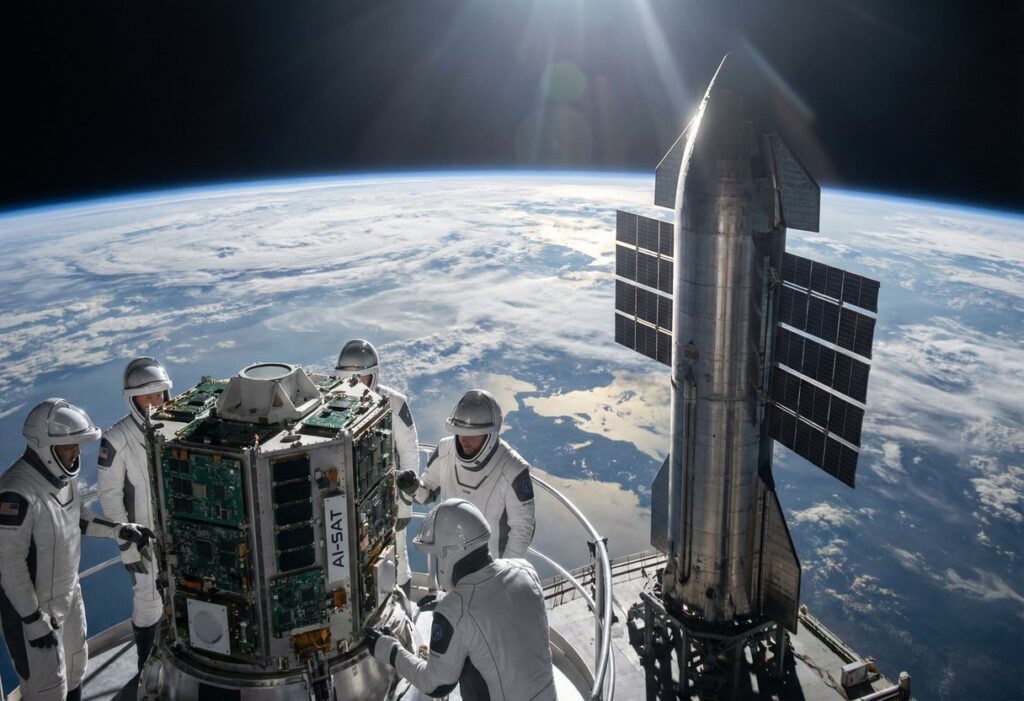
Is the next great data center 300 miles above your head? Musk is trying to fuse rockets with reasoning and sunlight with silicon, while critics wonder if this countdown ends on the launchpad or in the history books.
Elon Musk is stitching together his rockets and algorithms into a $1.25 trillion colossus, betting that a tighter fuse can ignite the next stage of human progress. The deal folds xAI into SpaceX, with shares swapped and missions kept intact for now, but the real play is to weld orbital hardware to artificial intelligence and abundant solar power. On the drawing board are data centers circling Earth, satellite constellations doubling as processors, and a sprint toward the stuff of Kardashev scale lore. The pitch is breathtaking, the timeline brisk, and the skeptics loud, especially after earlier Mars-by-2026 vows that never left the launchpad.
A game-changing merger
Elon Musk has stitched together a new center of gravity for his empire: SpaceX now absorbs xAI into a single, industrial powerhouse valued around $1.25 trillion. The bet is straightforward and audacious. Fuse cutting-edge AI with orbital hardware and logistics to accelerate space exploration and technological breakthroughs. Indeed, when rockets, satellites, and neural networks share one balance sheet, speed becomes strategy rather than slogan.
The mechanics of the merger
The transaction clocks in at $250 billion, with xAI folded into SpaceX and shareholders exchanging their stakes at a conversion rate of 0.1433 SpaceX shares per xAI share. Both brands persist for now, signaling a phased integration guided by engineering priorities rather than marketing. Internally, leaders describe a consolidation that protects momentum, then tightens the weave once programs prove their mutual lift.
Deal value: $250 billion
Implied group valuation: $1.25 trillion
Exchange ratio: 0.1433 SpaceX per xAI
Solar-powered space ambitions
Musk’s blueprint stretches beyond software and launch pads. Power-hungry AI will, he argues, migrate to orbit, where solar energy is abundant and persistent. Think constellations of data-center satellites feeding compute to Earth while harvesting sunlight at scale (on the Kardashev scale, this nudges toward Type II ambition). He even contends that within 2–3 years, the cheapest AI compute could be in space (by his estimate), a claim meant to realign how capital targets energy and chips.
Historical wealth and global impact
With SpaceX’s valuation uplift, an IPO could unlock rivers of capital for heavy manufacturing, rapid launch cadence, and AI training clusters. Observers say such a listing might propel Musk toward the first trillionaire milestone, depending on his stake and market conditions. But the bigger lever is operational: AI-augmented Starship design, smarter Starlink routing, autonomous in-space assembly, and—crucially—financing Moon bases and Mars surface systems through profitable orbital compute and communications.
Ambition versus skepticism
None of this escapes scrutiny. Timelines have slipped before—Mars settlement once floated for 2026—so critics question whether space-based AI centers and interplanetary infrastructure can mature this fast. Yet boldness has yielded results at SpaceX: reusable boosters and near-global satellite internet, for example. Is this audacity or overreach? The merger, at least, aligns money, hardware, and algorithms behind a single propulsion: turn sunlight, vacuum, and code into compounding progress.