
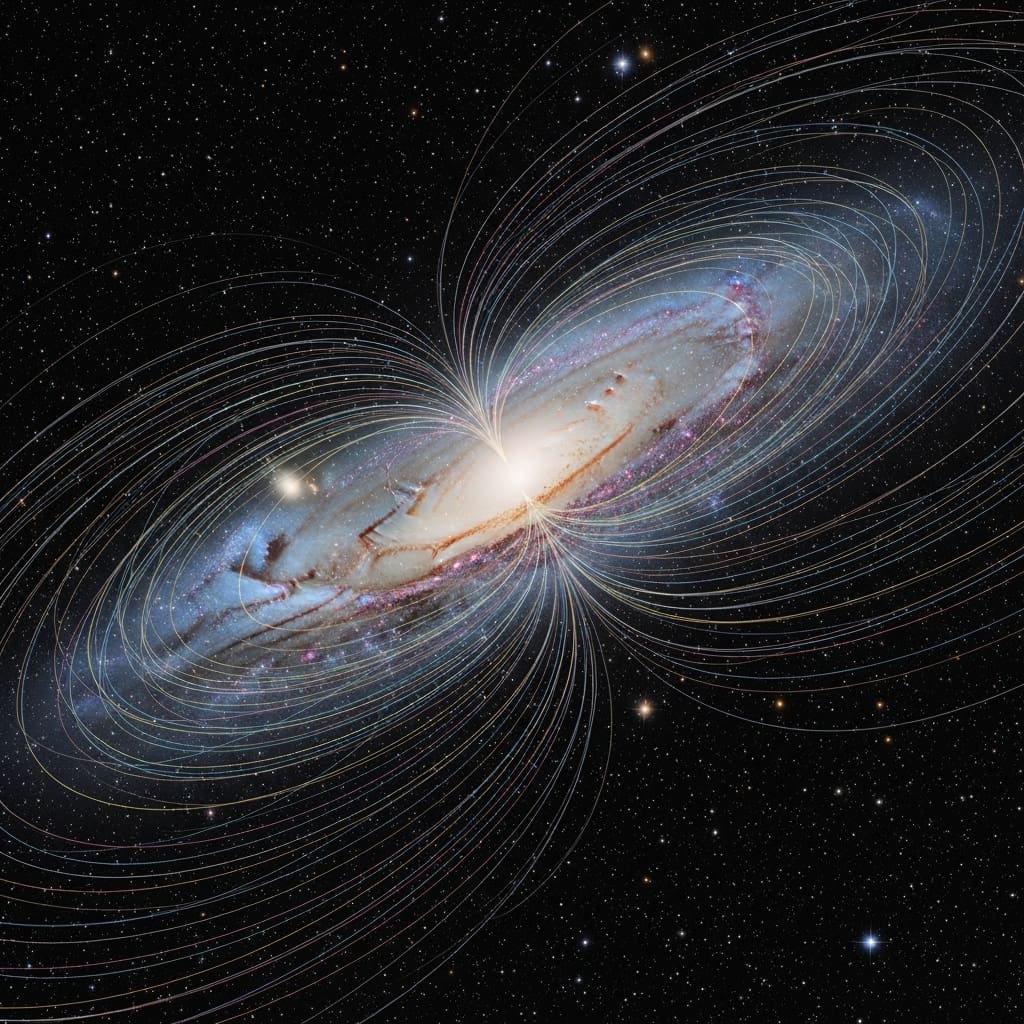
Scientists are increasingly focused on understanding how microscopic processes at the cosmological horizon influence the large-scale evolution of the Universe. Yu. L. Bolotin from the National Science Center Kharkov Institute of Physics and Technology, V. V. Yanovsky, and D. A. Yerokhin have explored this connection through the lens of Barrow-Tsallis entropy, a framework accounting for both gravitational and long-range interaction effects. Their research reveals a precise relationship between parameters defining the microscopic structure of spacetime foam and those governing macroscopic nonextensive effects, achieved using a novel method for determining cosmological model parameters. This work is significant because it provides exact relationships, limiting uncertainty to current measurements of cosmographic parameters and offering a potential pathway to describe the late-time evolution of the Universe using fractional derivatives.
Recent work has established a precise mathematical relationship linking the microscopic structure of quantum foam, the hypothesized fabric of spacetime at extremely small distances, to the macroscopic behaviour of dark energy and the expansion of the cosmos. This research, building on the concept of entropic cosmology, offers a novel approach to addressing longstanding problems in cosmology by synthesising gravity and thermodynamics without invoking unknown forms of dark matter or dark energy. The study centres on the Barrow, Tsallis entropy, a modified definition of entropy that accounts for both quantum gravitational effects and the non-extensive nature of interactions over vast cosmic distances. Researchers developed a general method for determining the parameters of cosmological models, revealing an exact relationship between the parameter describing the quantum foam’s microscopic structure and the parameter governing macroscopic non-extensive effects. This connection is significant because it suggests a deep underlying principle governing the interplay between quantum gravity and cosmic expansion. Furthermore, the work demonstrates the feasibility of using fractional derivatives, a mathematical tool for describing systems with memory effects, to model the late-time evolution of the Universe. The resulting relationships are exact, meaning any uncertainty in predicting the behaviour of the cosmos stems solely from existing uncertainties in measuring fundamental cosmological parameters. This precise connection between microscopic and macroscopic scales opens new avenues for exploring the nature of dark energy and refining our understanding of the Universe’s ultimate fate. The implications extend beyond theoretical cosmology, potentially informing future investigations into the quantum structure of spacetime itself. A detailed analysis of cosmological models underpinned the work, employing a general method to determine parameter values within these models. Central to this investigation was the Barrow entropy, a modified form of the standard Bekenstein entropy designed to incorporate quantum gravitational effects and account for deformation of black hole event horizons, expressed as SB = (A/4AP)1+∆2, where ∆ represents the deformation parameter and A denotes the area of the horizon. To model quantum fluctuations on horizon surfaces, the study considered a system where the Euclidean dimension, D, could vary between 1 and 3, corresponding to transformations of the horizon area into either a line or a volume. This dimensional range directly informed the permissible values for the deformation parameter ∆, restricting it to the interval of -1 ≤ ∆ ≤ 1. The research also incorporated the Tsallis entropy, a non-additive generalisation used to describe systems exhibiting long-range interactions, related to the Bekenstein entropy via the equation ST = (SBH)δ, with δ serving as a positive parameter quantifying the degree of nonextensivity. A key methodological innovation involved constructing a generalised Barrow, Tsallis entropy, SBT, by first deforming the horizon area due to quantum effects, represented by A → A1+∆2, and then incorporating this modified area into the Tsallis entropy formulation, resulting in the expression SBT = γ (A/AP)(1+∆2)δ. The research then explored the effective Barrow exponent, ∆eff = 2(δ − 1) + ∆δ, demonstrating how the combined entropy could be expressed in a form analogous to the original Barrow entropy, but with a modified parameter range dictated by both ∆ and δ. Fundamental inequalities relating length measurement accuracy to cosmological parameters have been derived using Barrow, Tsallis entropy. Specifically, the research establishes that δL ≥ (Ll2 p )1/3, where δL represents the accuracy of length measurement and L is length itself. A corresponding inequality, Λ−1 ≥γ−1/3L1−δ 3 (2+∆)l δ 3 (2+∆) p, was found, linking the cosmological constant Λ to microscopic foam structure described by γ and macroscopic non-extensive effects represented by δ and ∆. Excluding quantum effects (∆ = 0) and non-extensivity corrections (δ = 1) returns a value of 0.4, serving as a benchmark for model viability. The density of holographic dark energy, ρde ∝Hα, is determined by the entropy parameters α = 4 −2δ −δ∆, which were then expressed in terms of observed cosmographic parameters q0 and j0. This transformation effectively reduces the two-parameter Barrow, Tsallis entropy model to a one-parameter model defined as [∆, δ(∆)], demonstrating a connection between microscopic (∆) and macroscopic (δ) parameters and illustrating an implementation of the infrared, UV correspondence. Estimates of permissible model parameters align with non-extensivity parameter values previously obtained using machine learning techniques. The persistent challenge of reconciling general relativity with quantum mechanics finds an unusual testing ground in cosmology. Understanding the universe’s earliest moments, and the very fabric of spacetime at the smallest scales, demands grappling with concepts like spacetime foam, a hypothetical, fluctuating structure at the Planck scale. This work offers a novel approach, linking the microscopic properties of this foam to the large-scale, observed behaviour of the universe through the lens of non-extensive thermodynamics and Barrow, Tsallis entropy. What distinguishes this investigation is its mathematical precision. By establishing exact relationships between parameters describing the foam’s microstructure and those governing macroscopic cosmic evolution, the study sidesteps some of the usual uncertainties plaguing cosmological modelling. The use of fractional derivatives to model late-time behaviour is particularly intriguing, offering a potential refinement to the standard ΛCDM model. However, the accuracy of any conclusions is ultimately bound by the precision of initial measurements. Future work will likely focus on refining these models with data from next-generation surveys, such as those probing baryon acoustic oscillations and Type Ia supernovae, and exploring whether these connections can offer insights into the long-standing Hubble tension. The search for quantum gravity’s imprint on the cosmos is a long game, and this represents a subtle, yet potentially significant, step forward.
👉 More information
🗞 Cosmographic Connection Between Cosmological And Planck Scales: The Barrow-Tsallis Entropy
🧠 ArXiv: https://arxiv.org/abs/2602.12077