
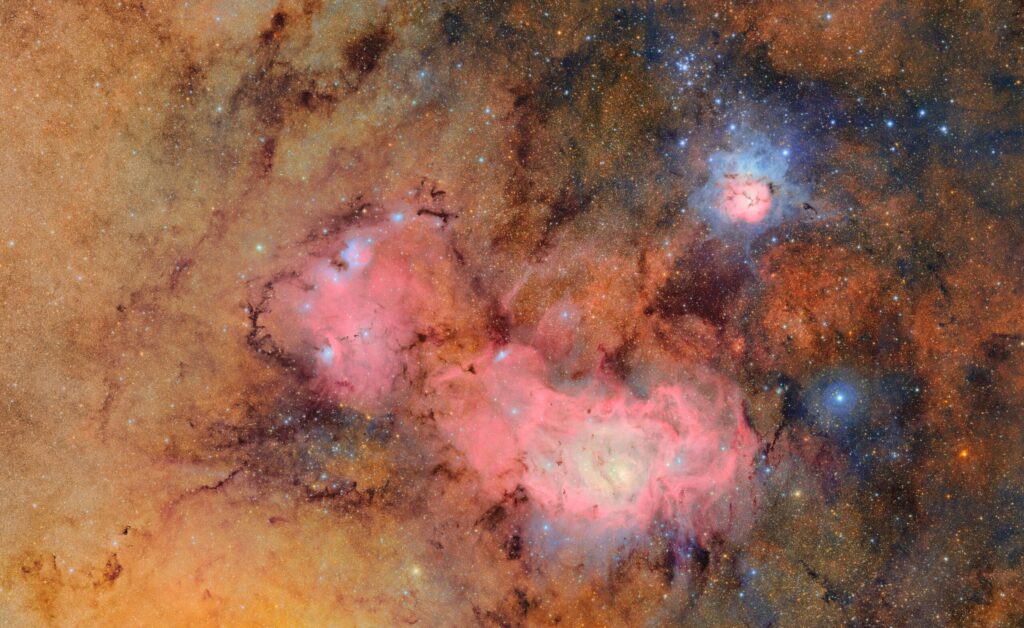
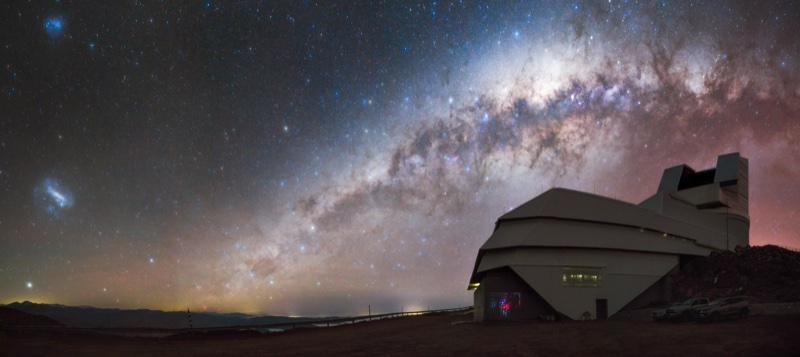
The Vera C. Rubin Observatory sits atop Cerro Pachón, Chile, beneath the starry Southern Hemisphere sky. The plane of the Milky Way arcs at right above the observatory; the Large and Small Magellanic Clouds appear at left. Rubin will survey nearly the entire southern sky every three to four days for the next 10 years. NSF–DOE RUBIN OBSERVATORY/P.J. ASSUNCAO LAGO
01
Vera Rubin Observatory begins its survey
On June 23, the Vera C. Rubin Observatory released its first images to great fanfare. Viewers around the world streamed the press conference from schools, museums, and planetariums, marveling at expansive nebulae and packed fields of galaxies in exquisite detail. Additionally, the observatory released movies of moving asteroids and twinkling stars to highlight its ability to chart the cosmos in real time.
Located in Chile and jointly funded by the National Science Foundation and U.S. Department of Energy (DOE), the project originally known as the Large Synoptic Survey Telescope (LSST) began construction in 2015. In 2019 it was renamed for astronomer Vera Rubin (1928–2016), whose work charting the rotation of galaxies was instrumental in the discovery of dark matter. It houses the 8.4-meter Simonyi Survey Telescope, whose three-mirror design guides light into the 3,200-megapixel LSST Camera — the largest digital camera in the world. It can capture some 9.6 square degrees of sky in one shot. Displaying a single image at full size would require the resolution of 400 4K TVs.
The observatory’s 10-year survey of the Southern Hemisphere sky is called the Legacy Survey of Space and Time. It will image nearly the entire southern sky every three to four days for the next 10 years, taking some 1,000 images per night. An average field will receive 800 to 1,000 visits (9.2 hours total exposure time), with select regions seeing up to 1,100 visits (9.2 hours total exposure time). The result: 20 terabytes of data each night, and some 60 petabytes of raw data and 60 petabytes of processed, calibrated data at the end of 10 years.
This observatory represents a giant leap in our ability to explore the cosmos and unwrap the mysteries of the universe,” said Kathy Turner, U.S. DOE program manager for the observatory, during the first-look press conference. Rubin has four main science goals to: map the Milky Way and its satellites, to map the Milky Way, to inventory the solar system’s small bodies, to map the Milky Way and its satellites — to understand dark matter and dark energy, to inventory the solar system’s small bodies, and to discover and track astronomical transients. By mapping 20 billion galaxies, as well as studying effects such as gravitational lensing — the bending of light from distant objects by foreground galaxy clusters — Rubin will trace out the structure of the universe, which is dictated in large part by the distributions of dark matter and the influence of dark energy. Charting billions of stars in the Milky Way and its satellites will help illuminate the nature and history of our home galaxy.
Rubin aims to create a high-definition movie of the sky to catch billions of events ranging from exploding supernovae and snacking black holes to transiting planets and never-before-seen asteroids and comets. Transients are flagged and a real-time public alert is issued within 60 seconds. Up to 10 million alerts will go out per night. With an archive of combined images over time, “if something strange appears — an explosion, an outburst, a vanishing star — we can rewind the movie and see what led up to it,” said Yusra AlSayyad, who manages the observatory’s image-processing algorithms, in a press release.
Astronomers must often balance the need for long exposures to view faint and faraway objects with scanning events. Both goals are now achievable simultaneously with Rubin. The Vera C. Rubin Observatory is a “tremendous technological achievement” that “truly will bring an understanding of our universe simply not possible before,” said Secretary of Energy Chris Wright during the press conference. “The movie is started, the cameras are rolling, and we’re going to see our cosmos unfold before us.”