


(NASA via SWNS)
By Dean Murray
Astronauts have been practicing walking on the Moon as their next-generation spacesuit passes milestone testing.
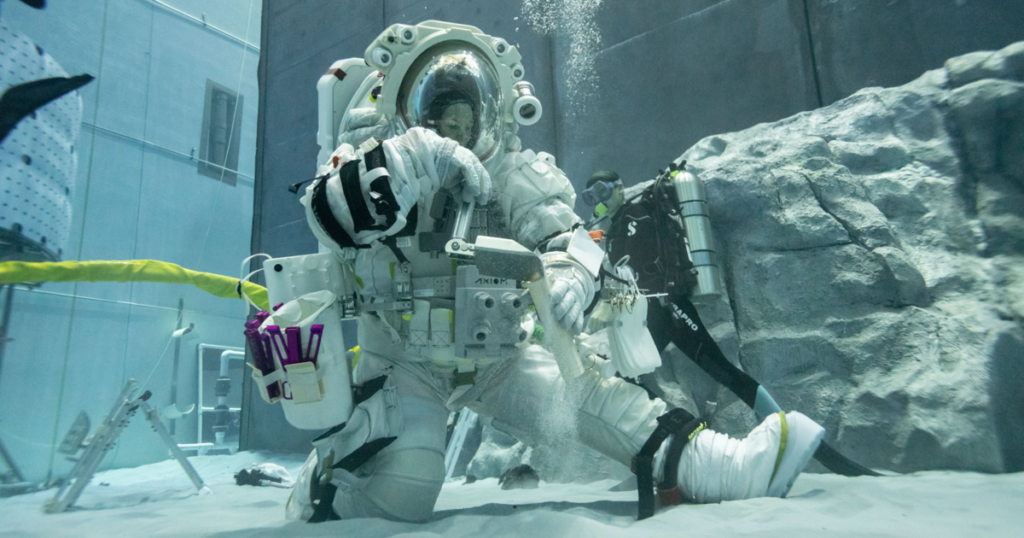
NASA astronauts and spacesuit engineers recently simulated lunar surface operations and tasks underwater wearing the new suits, built by Axiom Space, to demonstrate safety and mobility.
The space agency reported Thursday, Feb. 12, that the spacesuit has passed a contractor-led technical review and is hoped to be used for the Artemis III mission as NASA prepares to send humans to the Moon’s South Pole for the first time.
NASA said: “The AxEMU (Axiom Extravehicular Mobility Unit) is designed to give astronauts increased flexibility and improved mobility for moonwalking, including bending down to collect geology samples and perform a variety of scientific tasks.”
The suit incorporates advanced life-support systems and enhanced protection to withstand the harsh lunar environment. It also features increased sizing options and adjustability to fit a wider range of crew members.
(Bill Stafford/NASA via SWNS)
By Talker
Axiom Space is also developing specialised tools and equipment for work on the lunar surface, allowing astronauts to more easily gather geology samples.
Now that Axiom Space has completed their technical review of the AxEMU, NASA will evaluate whether the spacesuit is ready for the agency’s Artemis III mission that will return American astronauts to the Moon.
Lara Kearney, manager of the Extravehicular Activity and Human Surface Mobility Program at Johnson Space Center in Houston, said: “The completion of their internal review brings Axiom Space one step closer to delivering a next-generation lunar spacesuit.
“This achievement reflects our shared commitment to deliver a safe, capable lunar spacesuit that will enable astronauts to explore the Moon’s surface.”
NASA added: “As part of a Golden Age of innovation and exploration, NASA’s Artemis astronauts will use these new spacesuits, along with advanced landers and rovers, to explore more of the Moon for scientific discovery, economic benefits, and to prepare for future human exploration of Mars.”