
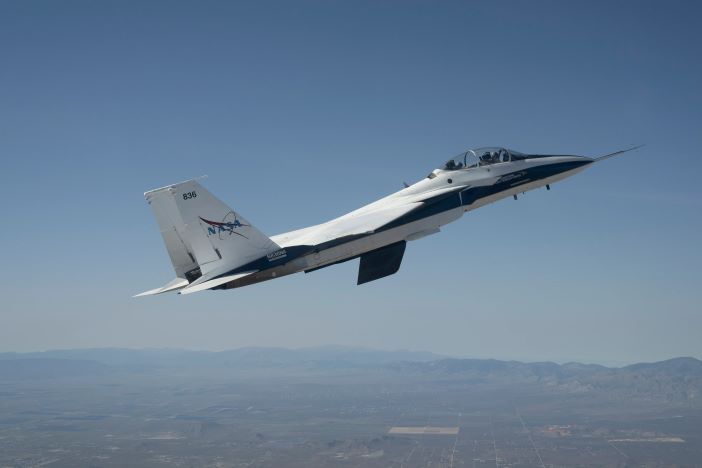
NASA has completed the first flight of its Crossflow Attenuated Natural Laminar Flow scale-model wing in last month.
The 75-minute flight on January 29 saw the 40in (1m) wing model, mounted vertically beneath an F-15B research jet, tested through a series of maneuvers at altitudes ranging from approximately 20,000ft (6,096m) to nearly 34,000ft (10,363m). The team performed turns, steady holds, and gentle pitch changes to confirm the aerodynamic characteristics of the test article.
“It was incredible to see Crossflow Attenuated Natural Laminar Flow (CATNLF) fly after all of the hard work the team has put into preparing,” said Michelle Banchy, research principal investigator for CATNLF. “First flight was primarily focused on envelope expansion.”
NASA engineers measured laminar flow using several tools, including an infrared camera mounted on the aircraft and aimed at the wing model to collect thermal data. Early results showed airflow over the aircraft closely matched predictions from computer models, according to Banchy.
The flight is the first of up to 15 planned for the CATNLF series, which will test the design across a range of speeds, altitudes, and flight conditions. The program builds on earlier computer modeling, wind tunnel testing, ground tests, and the high-speed taxi tests conducted in January.
The new wing design aims to improve laminar flow on swept wings at transonic speeds. Reducing laminar flow reduces wind resistance, saving fuel and money when operating commercial aircraft.