
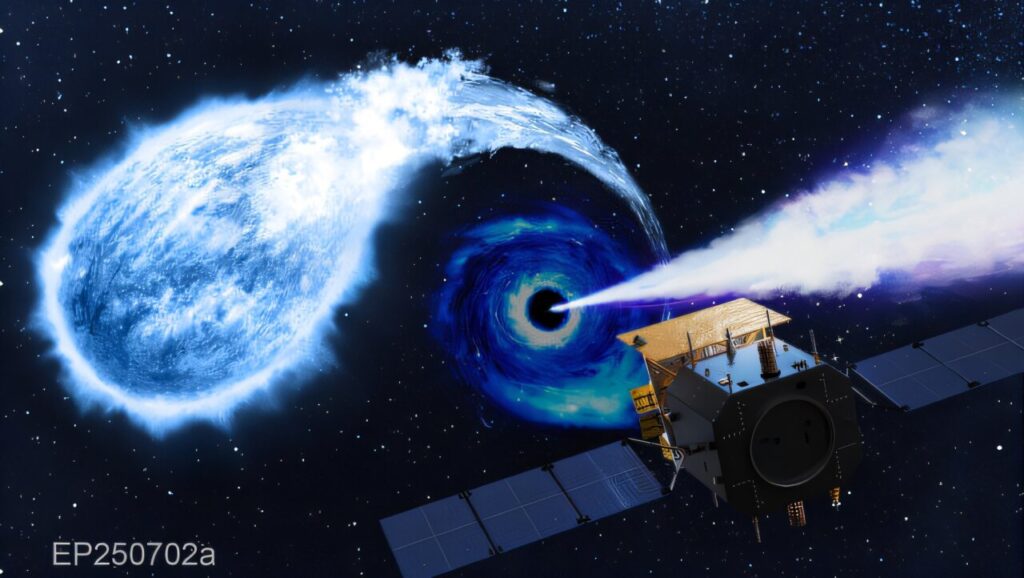
The Einstein probe is a small space telescope created by the PRC that operates in the X-ray range. On July 2, it recorded an incredibly intense event. Scientists now believe that it was a white dwarf being torn apart by a black hole.
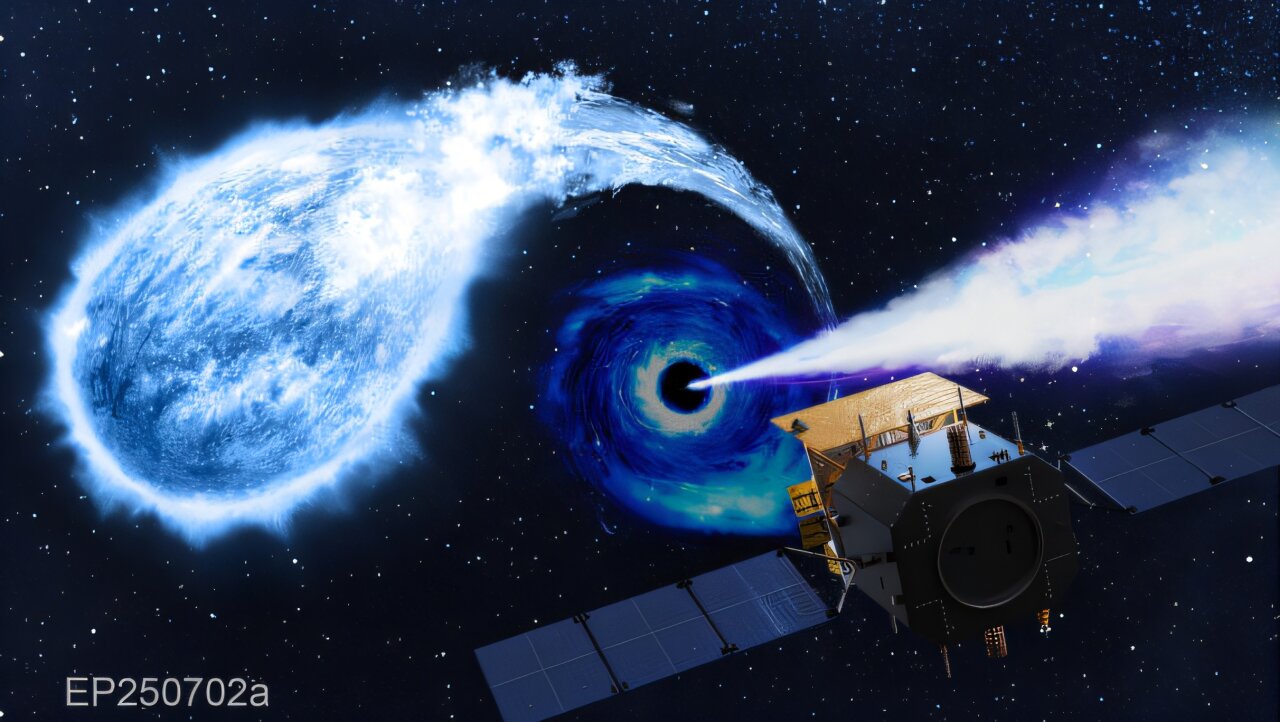 A black hole tore a white dwarf apart. Source: phys.org
Unusual source of X-ray radiation
On July 2, 2025, the Chinese-operated Einstein Probe (EP) space telescope detected an extremely bright source of X-ray radiation whose brightness changed rapidly during a routine survey of the sky. The unusual nature of the signal immediately distinguished it from typical space objects and prompted additional observations by telescopes around the world.
The study was coordinated by the EP Science Center of the National Astronomical Observatories of the Chinese Academy of Sciences (NAOC) with the participation of numerous research institutions in China and other countries. Astrophysicists from the Department of Physics at the University of Hong Kong (HKU), who are members of the Einstein Probe science team, worked with a broader group of collaborators to interpret the event, suggesting that it may represent the moment when an intermediate-mass black hole tears apart and is swallowed up.
If the information is confirmed, this will be the first observable evidence of such an extreme process of black hole “feeding.”
A cosmic event that disrupted the normal order
This discovery was made possible by two unique and complementary EP X-ray instruments. During a routine sky survey on July 2, 2025, the Wide-field X-ray Telescope (WXT), which uses advanced micro-pore “lobster eye” optics and provides a large field of view with high sensitivity, detected a transient X-ray source with forced variability, which was later designated 250702B. Almost simultaneously, NASA’s Fermi gamma-ray telescope recorded a series of gamma-ray bursts from the same region of the sky.
The significance of this event only became clear after scientists studied previous WXT observations. The telescope had already detected prolonged X-ray emissions from this exact location approximately one day before the gamma-ray bursts appeared — a sequence rarely observed in high-energy cosmic explosions. Approximately 15 hours after the initial signal, the source exploded in a series of intense X-ray bursts, reaching a peak luminosity of about 3×10⁴⁹ erg s⁻¹ and becoming one of the brightest instantaneous bursts ever recorded in the Universe.
Combined event monitoring
Thanks to the precise coordinates provided by WXT, several large telescopes around the world quickly conducted observations, successfully identifying the celestial object at different wavelengths and confirming its location in the vicinity of a distant galaxy. Subsequently, another EP instrument, the Far X-ray Telescope (FXT), joined the effort, continuing to monitor and track the rapid evolution of the source. In about 20 days, its brightness decreased more than a hundred thousand times, and the X-ray spectrum shifted from high energies (“hard”) to lower energies (“soft”).
By combining data from EP with subsequent observations across the electromagnetic spectrum, scientists discovered that EP250702a exhibited a number of unusual characteristics that existing models could not fully explain. Its X-ray emission appeared even before the gamma-ray burst, was extremely bright, and evolved exceptionally rapidly. Moreover, the event occurred on the outskirts of the host galaxy rather than at its center, which is rare among known high-energy cosmic phenomena. Among the many theoretical scenarios considered, one explanation ultimately stood out: an intermediate-mass black hole tearing apart a white dwarf.
Astrophysicists explain their model
The Hong Kong University team played a key role in data interpretation and theoretical modeling, which led to the identification of the underlying physical mechanism of the phenomenon. A research team led by Professor Lixin Dai from the Department of Physics and the Hong Kong Institute of Astronomy and Astrophysics (HKIAA) at HKU provided decisive theoretical evidence that drew attention to this particular model. As co-author, she explained: “The white dwarf–intermediate-mass black hole model can most naturally explain its rapid evolution and extreme energy output.”
Dr. Jinhong Chen, co-author of the paper and postdoctoral fellow at the Department of Physics at the University of Hong Kong (HKU), conducted detailed simulations to analyze this model. “Our computational simulations show that the combination of the tidal forces of an intermediate-mass black hole, combined with the extreme density of a white dwarf, can produce jet energies and evolutionary timescales that are highly consistent with the observational data,” he said.
What does this discovery mean for astronomy?
Professor Dai notes the significance of the research: “The robust discussion among international teams, each with their competing models to explain this event, is precisely what highlights its immense scientific value.”
“The mission of the Einstein Probe is to capture unpredictable and extreme transient phenomena in the universe,” said Professor Weimin Yuan of the National Astronomical Observatory of China, chief scientist of the Einstein Probe mission. “The discovery of EP250702a fully demonstrates our capability to be the first to capture the universe’s most extreme moments and further exemplifies China’s ability to make decisive contributions to international astronomical exploration.”
If this is ultimately confirmed, this event will provide the first clear, direct evidence that a medium-mass black hole is tearing apart a white dwarf and forming a relativistic jet. Such a discovery could shed light on the long-awaited but still elusive population of intermediate-mass black holes and open up new avenues for studying their growth, the ultimate evolution of compact stars, and the development of multi-messenger astronomy.
According to phys.org