
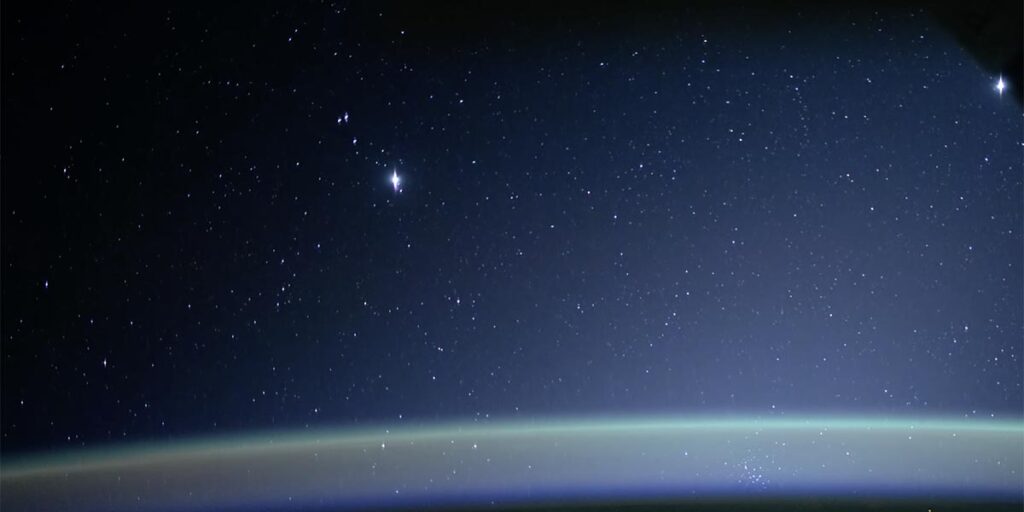
There are currently 16,910 artificial satellites orbiting the Earth
One of the things you miss most when you spend so much time with cloudy nights is being able to see the starry skies.
Voyager 1, the farthest-traveling human-made object, and Spain’s role in its long journey
The beauty of the polar auroras captured from the International Space Station
The mantle of Varda, as Tolkien would say, is one of the most beautiful things one can see from the face of the Earth. When they are clear, the night skies show us the immensity of space and, with it, our smallness within the cosmos. But one of the most privileged places to see the stars is not on Earth, but orbiting around it: the International Space Station (ISS).

The exterior of the Cupola of the International Space Station (Photo: NASA).
The ISS has a beautiful observatory: the Cupola. It was installed by the STS-130 mission, launched on the space shuttle Endeavour on February 8, 2010. The Cupola is located on the Tranquility module (Node 3) of the ISS. Its central window has a diameter of 80 cm, which is an enormous size in space. Manufactured by the European Space Agency (ESA) for NASA, the Tranquility module and the Cupola cost $409 million.

The Cupola of the International Space Station seen from the inside (Photo: NASA).
It should be noted that, just as from Earth, not everything seen in space from the Cupola is a star. After all, our beloved blue planet is surrounded by a multitude of objects, including a huge amount of space debris and also 16,910 artificial satellites, according to ESA data (25,170 have been launched throughout the history of the space race), of which 14,200 are active. Seán Doran has published one of his beautiful videos today showing a swarm of satellites captured from the Cupola of the ISS. The video was created using 2,329 time-lapse images photographed by Jonny Kim of ISS Expedition 73: