
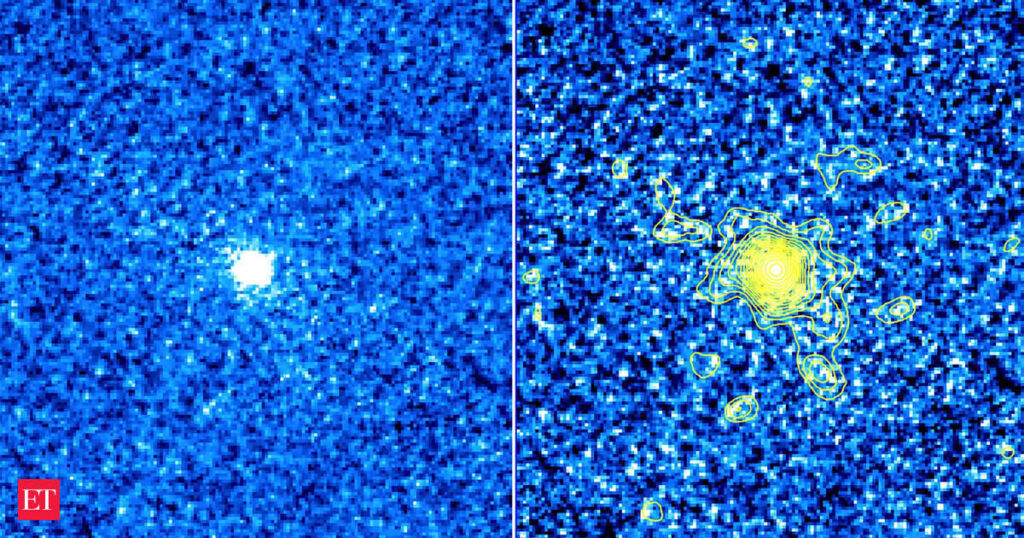
Comet 41P/Tuttle-Giacobini-Kresák is one of the most extraordinary small bodies observed in our Solar System. In 2017, a remarkable event in our Solar System spotted global attention. Comet 41P/Tuttle-Giacobini-Kresák featured an unprecedented change in its rotation: as it approached the Sun, its spin dramatically reduced, almost stopped, and then resumed in the opposite direction. This rare observation provided astronomers a distinctivewindow into the dynamics of small cometary bodies.
Who First Discovered the Phenomenon?Astronomer David Jewitt, from the University of California, Los Angeles, discovered this unusual change by examining images from the Hubble Space Telescope. Jewitt primarily shared his findings on the arXiv platform and subsequently submitted them to The Astronomical Journal, confirming this event as one of the most unusual ever recorded in the Solar System.
How Was the Rotation Measured?Observations from the Neil Gehrels Swift Observatory in March 2017 noted that the comet finished one rotation each 20 hours. By May, this duration had lengthened to 46 hours, a substantial rise compared to normal rotational changes, which generally happens in minutes rather than tens of hours. After vanishing near the Sun, the comet reappeared in December, displaying a rotation period of only 14 hours.What Caused the Spin Reversal?Based on these observations, Jewitt concluded that the comet likely slowed to zero and then resumed spinning in the reverse direction. Astronomer Dennis Bodewits, who also examined the comet, cited that he had never watched “such a large and rapid change.” Live Events
Why Is This Important for Understanding Comets?Jewitt cites that comets could have relatively short lifespans because physical processes, which includes accelerated rotation, lead to their eventual destruction. Spin instability is currently regarded as a critical element in the deterioration and gradual fragmentation of small cometary bodies.
When Will Comet 41P Return?Comet 41P/Tuttle-Giacobini-Kresák will next approach the Sun in early 2028. Astronomers intend to observe the comet for further episodes of instability, aided by the forthcoming operations of the Vera C. Rubin Observatory in Chile, which will improve long-term monitoring of small bodies across the Solar System.
FAQs:Q1. What is Comet 41P/Tuttle-Giacobini-Kresák?
It is a small comet in the Solar System composed of ice and rock. Scientists study it to know about comet behavior and evolution.
Q2. What unusual event occurred in 2017?
The comet’s rotation slowed, almost stopped, and reversed direction. This was captured by the Hubble Space Telescope.