
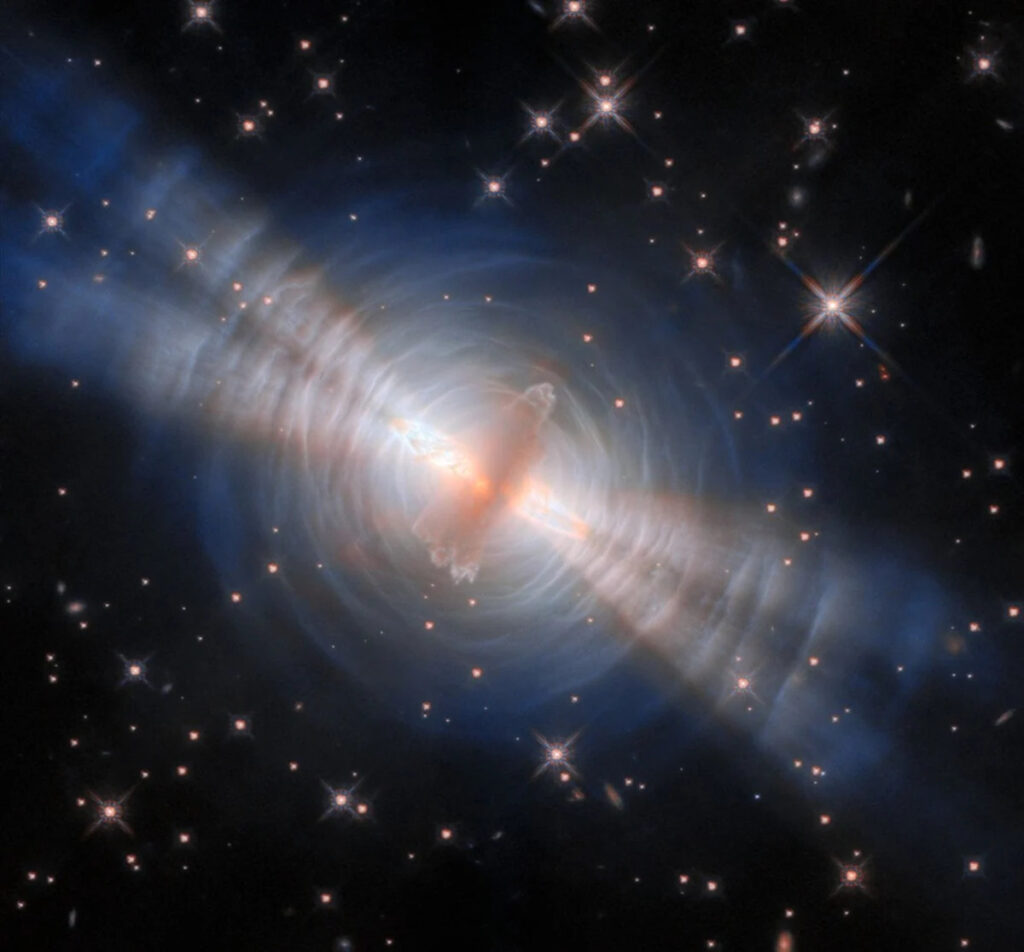
NASA’s Hubble Space Telescope captured a dramatic and stunning view of a nebula with a dying star, according to the space agency.
The image was captured by the Hubble Space Telescope, according to a NASA press release. The telescope orbits about 300 miles above Earth’s atmosphere and can capture images across wavelengths of light that the human eye cannot see, spanning from ultraviolet to near-infrared.
The image Hubble captured was of the Egg Nebula, in the constellation Cygnus, about 1,000 light-years away, according to NASA. Meaning, it takes light, one of the fastest things in the universe, about a thousand years to travel from the Egg Nebula to Earth.
The image shows lights and shadows shaped by stardust freshly ejected by the dying star. The photo is the clearest view of the Egg Nebula, which is home to a dying star similar to our sun.
Here’s what to know about the incredible photo.
SpaceX Crew-12 mission to send 4 astronauts to space station. Photos
1 of 9
The four crew members representing NASA’s SpaceX Crew-12 mission to the International Space Station pose for a portrait at the Johnson Space Center in Houston, Texas. From left are, Roscosmos cosmonaut and Mission Specialist Andrey Fedyaev, NASA astronauts Jack Hathaway and Jessica Meir, Crew-12 Pilot and Commander respectively, and ESA (European Space Agency) astronaut and Mission Specialist Sophie Adenot.
What is the Egg Nebula?
The Egg Nebula is filled with gas and dust that was created by a dying, “sun-like” star, according to NASA.
It is a pre-planetary nebula, also known as a protoplanetary nebula, meaning it is in a transitional phase that could last for thousands of years. Once it fully transitions, it becomes a planetary nebula, which is a structure made up of the gas and dust made from layers that the dying star ejected, and has absolutely nothing to do with planets, according to NASA.
“It is the first, youngest, and closest pre-planetary nebula ever discovered,” NASA said.
The star is similar to our sun, but is closer to the end stage of its life.
Like most creatures on Earth, sun-like stars need fuel to continue and shed their outer layers as they begin to use up their remaining fuel reserves, which are made up of hydrogen and helium.
Its current transition phase makes it ideal for researchers and scientists to study the sun before it reaches the final stages of its life and becomes a planetary nebula, similar to the Helix, Stingray and Butterfly nebulae, which have stars trapped in glowing shells.
Julia Gomez is a Trending reporter for USA TODAY and covers popular toys, scientific studies, natural disasters, and trending news. Connect with her on LinkedIn, X, Instagram, and TikTok: @juliamariegz, or email her at jgomez@gannett.com.
This article originally appeared on USA TODAY: NASA’s Hubble captures clearest image of dying star nebula