
Mammoth Hot Springs in Yellowstone National Park. (Credit: CC photo via Wikimedia Commons; https://commons.wikimedia.org/wiki/File:Mammoth_Hot_springs_04.jpg)
On Earth, life thrives in some of the most seemingly inhospitable environments.
Single-celled organisms like bacteria teem in the hot springs of Yellowstone National Park, where temperatures reach nearly 200 degrees Fahrenheit (93 degrees Celsius). Others dwell deep underground or several miles above Earth’s surface in the stratosphere.
For years, scientists in a field called astrobiology have sought out these organisms. They want to know not just how life evolved on Earth, but how it might evolve on other worlds. They investigate moons in our solar system like Europa and Enceladus where vast and salty oceans lie beneath thick layers of ice.
“There have been so many of these extreme niches that astrobiologists have discovered on Earth,” said Tristan Caro, an astrobiologist who earned his doctorate in geological sciences at CU Boulder in 2024. “They expand what we can imagine as habitable environments.”
Now, a team of students and early-career researchers have published a perspectives article in the journal Nature Communications tackling the potential of this out-there field.
Srishti Kashyap kneels in front of a “hyper-alkaline” spring in Oman. (Credit: Srishti Kashyap)
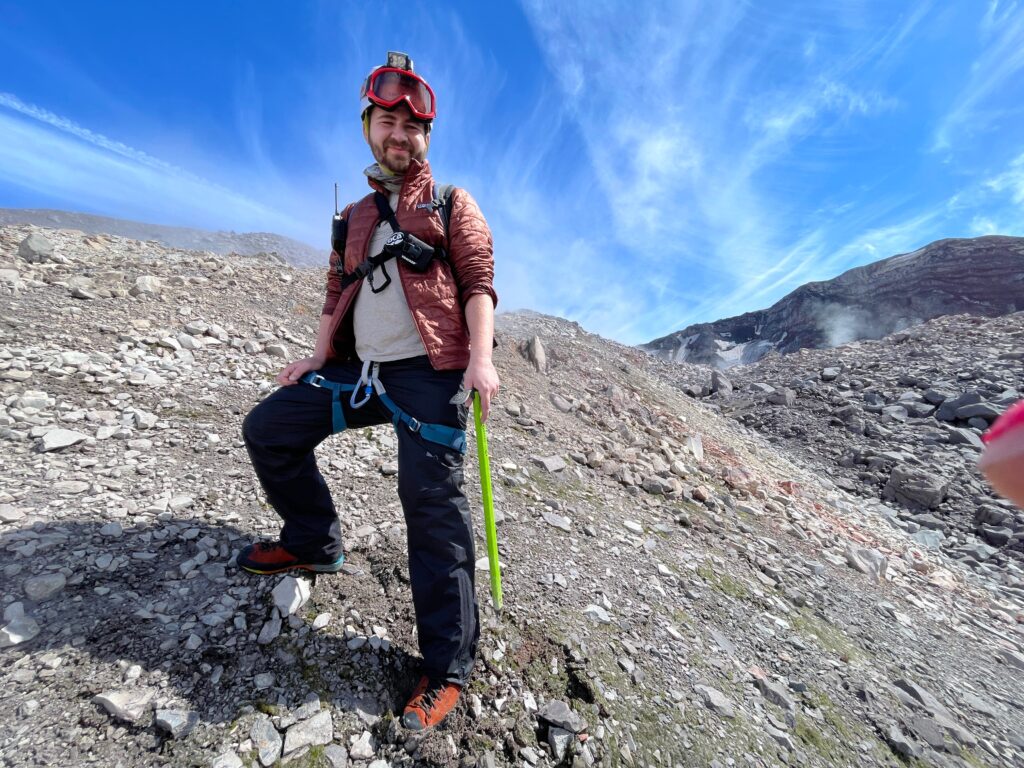
Tristan Caro conducting astrobiology research in the crater of Mt. St. Helens. (Credit: Tristan Caro)
The authors include Caro, Alta Howells, Srishti Kashyap, Catherine Fontana and Sabrina Elkassas and hail from CU Boulder, the California Institute of Technology, Woods Hole Oceanographic Institution and the Massachusetts Institute of Technology.
This group argues that pursuing astrobiology may bring dual benefits for humanity. The study of astrobiology can help scientists answer some of the biggest questions ever asked, such as: “Are we alone in the universe?” The discipline also inspires new technologies that may one day make life better on Earth, such as cleaner sources of fuel and tools that pull greenhouse gases out of the atmosphere.
“Astrobiology might seem really esoteric, but it’s deeply tied to the search for new technologies and energy sources,” said Catherine Fontana, a co-author of the article and a graduate student in the Department of Geological Sciences at CU Boulder.
To mark the new publication, she, Caro and their colleagues discuss what gets them excited about astrobiology—from the almost unbelievable things microbes can do to the fascinating chemistry that exists deep under Earth’s crust. They also share advice for students hoping to get into the field.
As an undergraduate, for example, co-author Kashyap double-majored in astronomy and biology. Then she realized the two subjects weren’t as different as she thought.
“I quickly learned that if I wanted to understand how life could be sustained elsewhere in the universe, I needed to step back and think about the processes that sustain life here,” said Kashyap, now a research associate at CU Boulder and staff scientist at Blue Marble Space Institute of Science.
Microbial ingenuity
For Caro, much of the fun of being an astrobiologist is diving into the world of microbes.
“What really excites me about astrobiology is its focus on what you could call microbial ingenuity, the ways that they have crafted a variety of strategies to survive and thrive in environments that are hostile to larger organisms like us,” said Caro, now a postdoctoral researcher at CalTech.
He noted that scientists employ a DNA synthesis method known as polymerase chain reaction for countless applications, including COVID screenings and ancestry tests. Researchers first discovered the enzyme that is key to this process inside bacteria living in Yellowstone hot springs.
Fontana studies cyanobacteria, a class of single-celled organisms sometimes known as blue-green algae, that have existed on Earth for 3.5 billion years. Roughly 2.4 billion years ago, they played a key role in causing oxygen concentrations in the atmosphere to spike. Those changes paved the way for the rise of animals, plants and other animals.
Today, researchers are also exploring whether these microbes can become tiny factories—churning out biofuels, biocements and biodegradable plastics.
Elkassas, a co-author the article, explores methanotrophs, microbes that get their energy from methane gas. These microbes live in underground fluids below mud volcanoes in the Pacific Ocean and may absorb large volumes of methane from this environment.
Methane is a potent greenhouse gas and a major contributor to climate change. Some scientists are investigating whether methanotrophs and similar organisms may one day be able to help pull methane from the environment and store it safely underground.
“This research exemplifies the ‘dual approach’ to astrobiology by using studies of extreme environments to better understand carbon sequestration processes on Earth, while simultaneously informing how similar metabolisms might operate on other ocean worlds,” said Elkassas, who recently earned her doctorate from the MIT-Woods Hole Joint Program.