
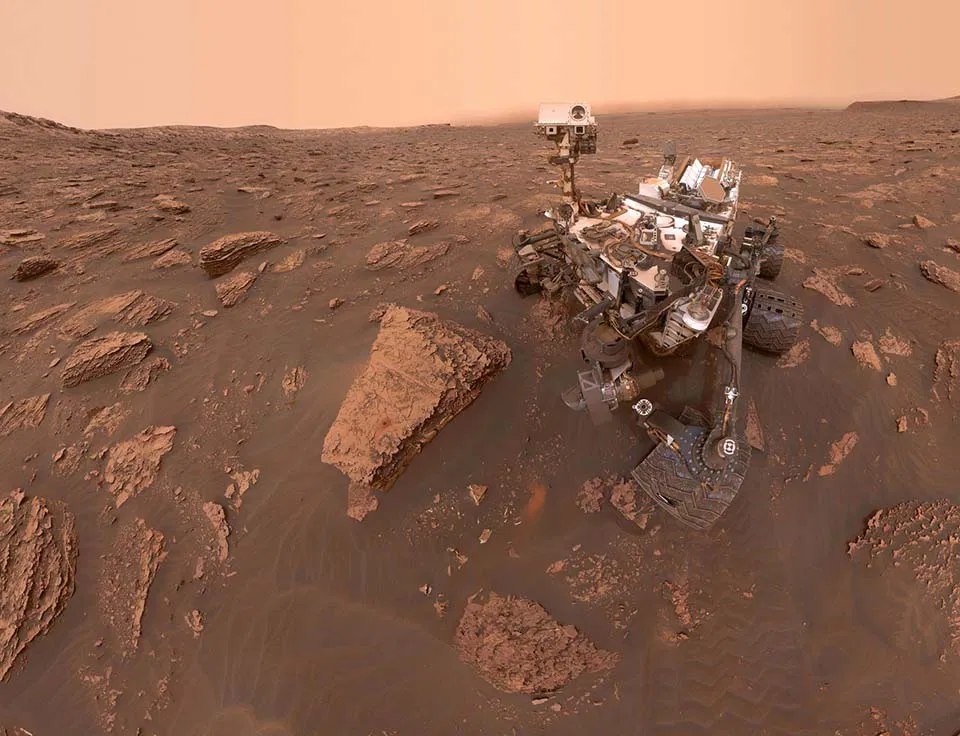
“Extraordinary claims require extraordinary evidence,” as the saying often attributed to the late astronomer Carl Sagan goes. However, new research involving organic compounds discovered on the Red Planet has led one team of researchers to what is indeed an extraordinary possibility: that their presence cannot be fully explained by non-biological sources.
The findings, if confirmed, could offer some of the strongest evidence yet that life may have once existed on Mars.
Since the initial discovery of small amounts of organic compounds in a rock sample collected by the Curiosity rover, interest in the potential for ancient Martian life has remained high. Now, with the publication of a new study in the journal Astrobiology, researchers at NASA Goddard Spaceflight Center have put forward intriguing new data that furthers the search for evidence of extraterrestrial life.
Theories of Life on Mars
While humanity may be eager to discover an intelligent species with which we can meaningfully interact, there is a strong chance that our first glimpse of extraterrestrial life will instead involve either a simple organism or a species long extinct, having existed at a distant point on the cosmic timeline.
Mars presents a scenario in which the planet is a wasteland, with only the faintest chance that extremophiles may still persist in its harsh environment. Scientists believe that Mars was not always like this, though. Billions of years ago, during its Noachian period, the Red Planet was likely much warmer, with a fuller atmosphere and bodies and liquid water on its surface. This is supported by present-day surface features, such as dry riverbeds and sediment layers, which provide evidence of lakes and even flowing water in the distant Martian past.
Curiosity Discovers Organic Compounds
In March 2025, researchers reported that three alkanes: decane, undecane, and dodecane—the largest organic compounds ever discovered on Mars—were found in rock samples collected and analyzed by the Curiosity rover. They came from samples of mudstone collected in the Gale Crater, an impact basin also believed to be a dry lake. Even then, astrobiologists hypothesized that the alkanes found in Gale Crater could be degraded fatty acids.
While such fatty acids can be produced by geological processes, here on Earth, their appearance is much more commonly associated with living organisms.
The data recovered from analyzing the samples in Curiosity’s onboard lab are insufficient to clearly determine whether the molecules were created by living beings or by geological processes. To come closer to answering that question, researchers decided to focus on the geological processes that may be at play, rather than the samples themselves.
Science, in other words, often comes down to being a process of elimination. By studying whether alternative explanations fit the samples—in this case, ideas such as whether meteorite impacts might have deposited the alkanes—researchers could better assess the potential likelihood of ancient life as an explanation.
Searching for Life on Mars
Based on the team’s extensive research, they have reached an intriguing conclusion: that non-biological processes cannot fully explain the presence of alkanes, suggesting that life on ancient Mars is a reasonable alternative hypothesis.
For their studies, the team synthesized a variety of data streams that included Curiosity’s data, laboratory radiation experiments, and mathematical modeling. Their goal was to glimpse what the Martian surface would have been like over the last 80 million years, accounting for the entirety of the rock’s suspected surface exposure time.
From this, the team developed estimates for the amount of organic material that likely existed in the stone before it was destroyed by cosmic radiation, based on the amount of alkanes there today. They discovered the amount required would far exceed what non-biological processes could produce, indicating that life very well could have played a role.
“We argue that such high concentrations of long-chain alkanes are inconsistent with a few known abiotic sources of organic molecules on ancient Mars,” the researchers write, “namely delivery of organics by IDPs and meteorites, atmospheric fallout and deposition from photochemical haze, and organic production from serpentinization and Fischer–Tropsch reactions on the Red Planet.”
“In contrast,” the team adds, “it is not unreasonable to hypothesize that an ancient martian biosphere would be capable of producing this level of complex organic enrichment in martian mudstone deposits, and that allochthonous delivery of hydrothermally synthesized organics could have contributed to the abundance of alkanes found in the Cumberland mudstone.”
Life on Mars is Increasingly Likely but Still Unproven
Overall, the team acknowledges the extraordinary nature of their position, once again evoking Sagan’s famous aphorism.
“We agree with Carl Sagan’s claim that extraordinary claims require extraordinary evidence,” the researchers conclude in their paper, adding that they “understand that any purported detection of life on Mars will necessarily be met with intense scrutiny.”
“In addition, in practice with established norms in the field of astrobiology, we note that the certainty of a life detection beyond Earth will require multiple lines of evidence.”
While the team’s result is hopeful for Mars having once been home to life, more work remains to be done in order to support their claim. For instance, questions linger about how quickly organic molecules decay on Mars, given the planet’s unique conditions.
To that end, the team recommends further studies of radiolytic degradation rates to further test whether life most likely produced the alkanes, which the team nonetheless presents as being a “not unreasonable” hypothesis.
The paper, “Does the Measured Abundance Suggest a Biological Origin for the Ancient Alkanes Preserved in a Martian Mudstone?” appeared in Astrobiology on February 4, 2026.
Ryan Whalen covers science and technology for The Debrief. He holds an MA in History and a Master of Library and Information Science with a certificate in Data Science. He can be contacted at ryan@thedebrief.org, and follow him on Twitter @mdntwvlf.