
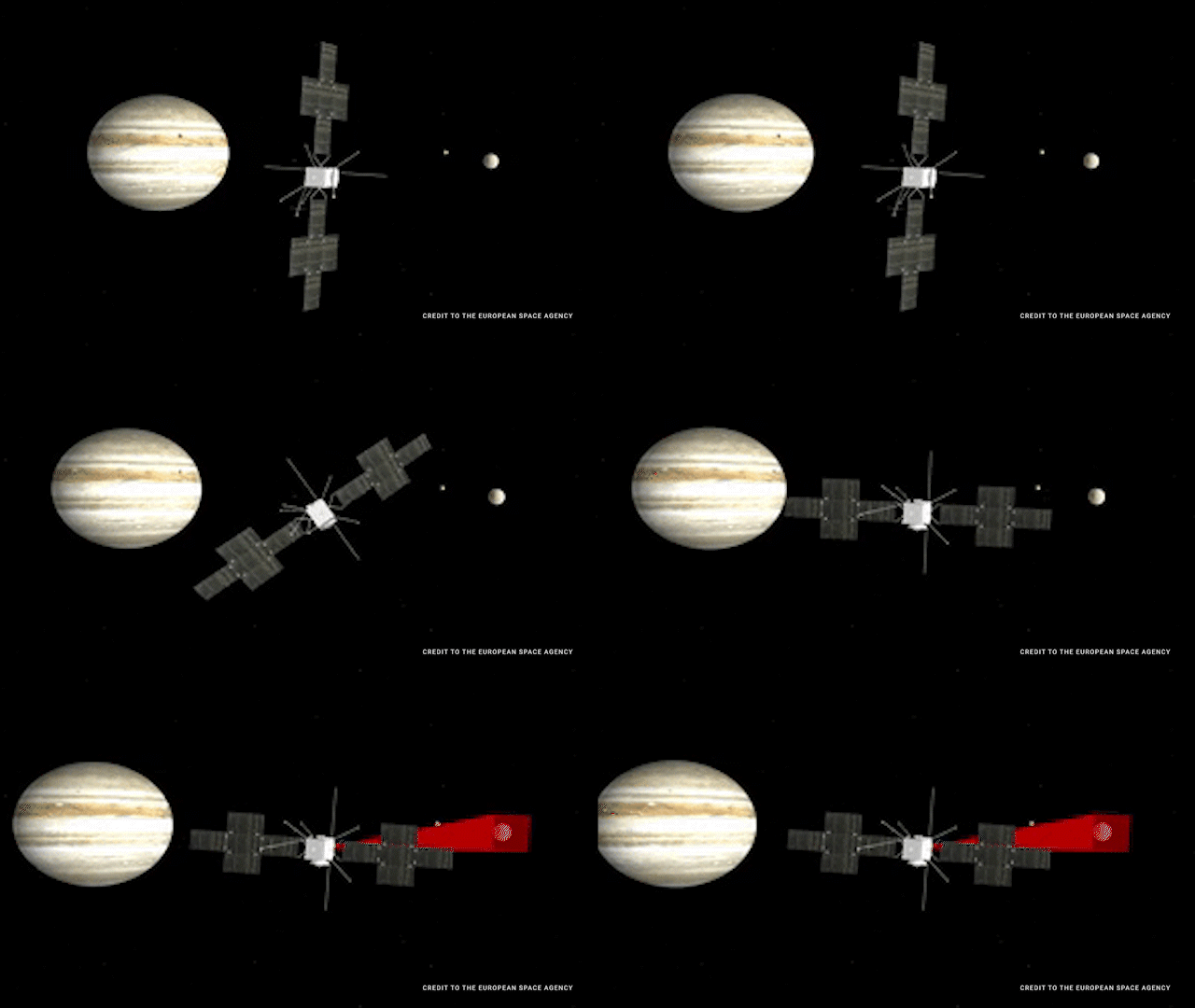
A billion-dollar spacecraft, built to explore Jupiter and its icy moons, has turned its gaze to something even more exotic: a rare visitor from another star system.
Launched in 2023 by the European Space Agency (ESA), the Jupiter Icy Moons Explorer, or Juice, is on an eight-year cruise towards its target planet. Its mission is to observe Jupiter’s atmosphere and magnetosphere, and also its large “Galilean” moons, including some which are candidates for hosting life.
Last summer, however, astronomers spotted a cosmic trespasser.
The comet, now known as 3I/Atlas, was first flagged in July last year, and its trajectory quickly betrayed its origins. It wasn’t gravitationally bound to the sun, which meant it had formed around another star.
It was only the third such “interstellar” visitor to be seen hurtling through our own solar system. As scientists realised that Juice was in a good position to observe it, a new plan was hatched.
Travelling at roughly 220,000 km per hour, relative to the sun, and estimated to be 2.6 km wide, 3I/Atlas was on a trajectory no native comet would take. By late October 2025, it had passed within about 210m kilometres of the sun.
• Iron ‘bar’ found in deep space hints at what might happen to Earth
From Earth, its position was awkward for astronomers. It sat close to the sun in the sky, making ground-based observations difficult. But Juice, on a different track and tens of millions of kilometres away, had a much better, if fleeting, view.
For planetary scientists, it was too good an opportunity to ignore. “We never expected anything like this,” says Paul Hartogh, principal investigator of Juice’s Submillimetre Wave Instrument (SWI). As a comet specialist, he regards it as a kind of gift.
Comets are time capsules. The ice they contain can preserve chemical ratios dating to the birth of their parent systems. If you can measure the composition of an interstellar comet precisely enough, you can start asking a fundamental question: is our solar system typical?
Scientists prize isotopic ratios in particular: subtle shifts in the abundance of heavier and lighter forms of the same element.
The ratio of deuterium (heavy hydrogen) to ordinary hydrogen in water, for instance, can hint at where in an infant solar system it formed. Hartogh helped make the first high-precision measurements of this ratio in a “Jupiter-family” comet (an object where the orbit is strongly controlled by Jupiter), using the Herschel space observatory.
• Supermassive new theory on what lies at the heart of our galaxy
Already, the trajectory of 3I/Atlas hints at an astonishingly ancient origin. It potentially came from the “thick disk” of the Milky Way — an older, “puffier” layer of stars that surrounds the flatter plane of our galaxy where our sun resides.

The image of 3I/Atlas captured by the Hubble Space Telescope on November 30, 2025
NASA/AP
The thick disk is essentially a galactic retirement home, filled with stars and objects that are billions of years older than the neighbourhood we call home. If confirmed, 3I/Atlas would be a messenger not just from another star, but from a much earlier chapter of the galaxy.
The first confirmed interstellar visitor, named 1I/ʻOumuamua, swept through in 2017. Unlike a typical comet, it showed no visible coma — the cloud of gas and dust that forms when ice vaporises in sunlight — yet it accelerated slightly as it departed.

3I/Atlas is a bright dot with a tail, captured last month
NASA/DANIEL MUTHUKRISHNA
That unexplained boost prompted serious scientific debate and, at the fringes, speculation that it might even be a relic of an alien civilisation, before it vanished back into interstellar space.
In 2019, 2I/Borisov developed both a coma and a tail as solar heat released gas and dust from its surface. Its chemistry indicated it formed in the frigid outer reaches of another planetary system, giving scientists their first close look at the raw ingredients of worlds beyond our own.
During 3I/Atlas’s closest approach, the ESA switched on five of Juice’s instruments. Each looks at the comet in a different way, but it was built for the outer Solar System, where sunlight is weak.
Closer to the sun, solar radiation becomes a threat. To protect itself, the spacecraft has been using its 2.5-metre diameter high-gain antenna, as a makeshift sunshield, keeping sensitive components in shadow. That put limits on how long Juice could pivot to observe 3I/Atlas.
Information from the mission is trickling back at the moment and is expected to be released soon. But the larger story is that this probably won’t be the last interstellar visitor. For decades, such objects were theoretical curiosities. Three have now been identified in less than a decade.
• Aurorae brighten skies across Britain
That does not mean they are suddenly more common. Rather, astronomers are getting better at spotting them. Robotic surveys scan the sky nightly, software flags anomalies — faint smudges that would once have been missed are now automatically tracked.
Are we entering an era in which interstellar visitors become routine? “Probably,” says Hartogh.