
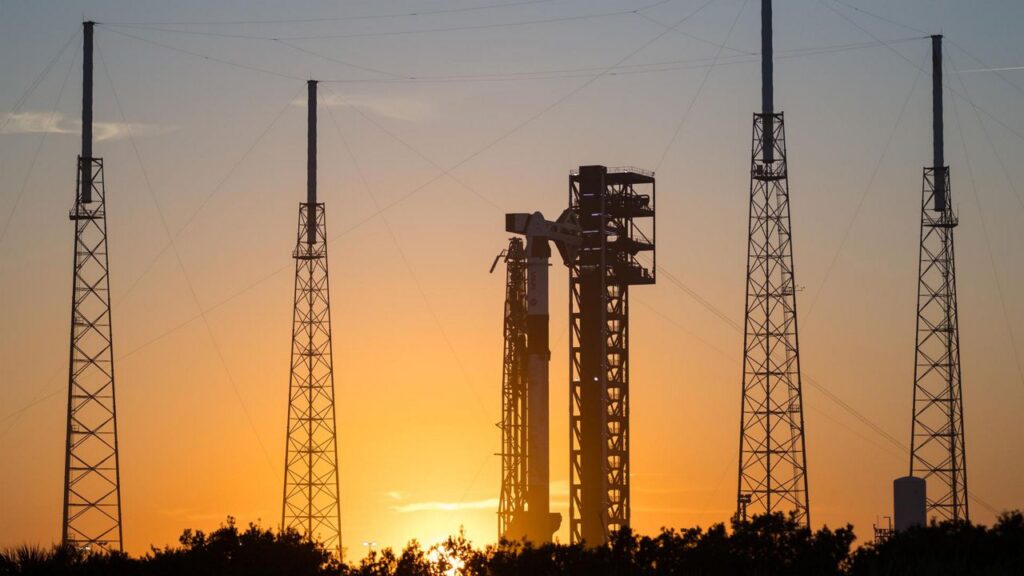
CAPE CANAVERAL SPACE FORCE STATION — As NASA and SpaceX prepare for the Crew-12 mission, it will mark the first time a SpaceX rocket will land near its launch site in Florida.
What You Need To Know
For the first time in Florida, a SpaceX rocket will return near the launch site
Learn more about the four astronauts as they will spend eight months on the ISS
They will be doing various experiments to learn more about the human body in space as well as moon-landing simulations
During the early morning hours on Friday, NASA astronauts Cmdr. Jessica Meir and pilot Jack Hathaway, and mission specialists European Space Agency (ESA) astronaut Sophie Adenot, and Roscosmos cosmonaut Andrey Fedyaev will climb into the Falcon 9 to take off from Space Launch Complex 40 at Cape Canaveral Space Force Station, stated both NASA and SpaceX.
The instantaneous launch is set to take place at 5:15 a.m. ET.
The 45th Weather Squadron is giving an 85% chance of favorable launch conditions, with the only concerns being the cumulus cloud rule and flight through precipitation.
If the launch is a scrub, the next attempt will be Sunday, Feb. 15.
Originally, the launch was set for Wednesday at 6:01 a.m. ET and then it was pushed to 5:38 a.m. ET, Thursday, until finally settling on Friday.
The reason for this was due to the upper-level winds.
The commute to the ISS and a historical landing
This is the first crewed launch of 2026 and SpaceX’s Dragon capsule called Freedom is expected to be screaming at about 17,500 mph (28,164 kph) as it goes into the black of space.
Freedom has had an impressive resume, having been used for four crewed missions.
For the first-stage Falcon 9 rocket booster B1101, this will be its second mission. Its first mission was last month and it was the first launch of 2026: Starlink 6-88 mission.
And it will be a long commute to work for them. The astronauts are expected to arrive at the International Space Station at around 3:15 p.m. ET on Valentine’s Day.
And this is going to be a historical landing for the Sunshine State. Because the Crew-12 mission will have four people onboard, the first-stage booster must land at Landing Zone 40 at Cape Canaveral Space Force Station, which is adjacent to the launch pad at Space Launch Complex 40, as seen in this embedded Facebook post. Landing Zone 40 is at the top right of the photo.
This will be the first time a Falcon 9 rocket will land near its launch site in Florida. The first-stage boosters usually land on a droneship out in the Atlantic Ocean or at a landing zone on land but away from the launch site.
However, SpaceX’s lease on Landing Zone 1 at Cape Canaveral Space Force Station ended in July 2025.
Back in May 2023, Space Launch Delta 45 issued a press release, stating, “SLC 13, currently Landing Zone 1 and 2, is also moving forward with Phantom Space and Vaya Space.”
It means that the existing launch complex property agreements for landing operations were discontinued after the agreements expired.
So, going forward, crewed SpaceX launches in Florida will see the first-stage rocket returning on a landing pad near the launch site.
Understanding the Crew-12 mission
The quartet is not going to the International Space Station empty-handed and checking out the views of Earth from space.
They will be busy little beavers as they will be conducting medical experiments during their eight-month stay.
“The experiments, led by NASA’s Human Research Program, include astronauts performing ultrasounds of their blood vessels to study altered circulation and completing simulated lunar landings to assess disorientation during gravitational transitions, among other tasks,” NASA stated.
Another experiment is called Venous Flow, which will look at how time on the floating laboratory may increase the chance of astronauts developing blood clots.
“In weightlessness, blood and other bodily fluids can move toward the head, potentially altering circulation. Any resulting blood clots could pose serious health risks, including strokes,” the U.S. space agency explained.
For the experiment, the astronauts will undergo preflight and postflight MRIs, ultrasound scans, blood draws and blood pressure readings so scientists can compare the findings.
But it is not all medical experiments. During the Manual Piloting study, certain crew members will be conducting simulated moon landings before, during and after this mission.
“Designed to assess their piloting and decision-making skills, participants attempt to fly a virtual spacecraft toward the lunar South Pole region — the same area future Artemis crews plan to explore,” NASA explained.
Other experiments will be conducted.
Meet Crew-12
Crew-12 will not have a traditional welcome
Usually, a crewed mission will have a welcome party, where the previous mission (in this case, Crew-11), welcomes the new arrivals.
Pleasantries and workload are exchanged during this transition.
However, Crew-11 was cut short after one of its members suffered a medical episode.
The crewmember has not been named and his or her medical issue was not disclosed.
The event happened days before a planned spacewalk for NASA astronauts Cmdr. Zena Cardman and pilot Michael Fincke.
NASA officials decided to cut the mission short and return Cardman, Fincke and mission specialists Japan Aerospace Exploration Agency (JAXA) astronaut Kimiya Yui and Roscosmos cosmonaut Oleg Platonov to Earth.
It was the first medical evacuation in the space station’s 25 years of full service. Originally, the mission was going to end in February.
NASA officials stressed that the person was in stable condition and the four Crew-11 members appeared together in a press conference nearly a week after returning to Earth in a splashdown.