
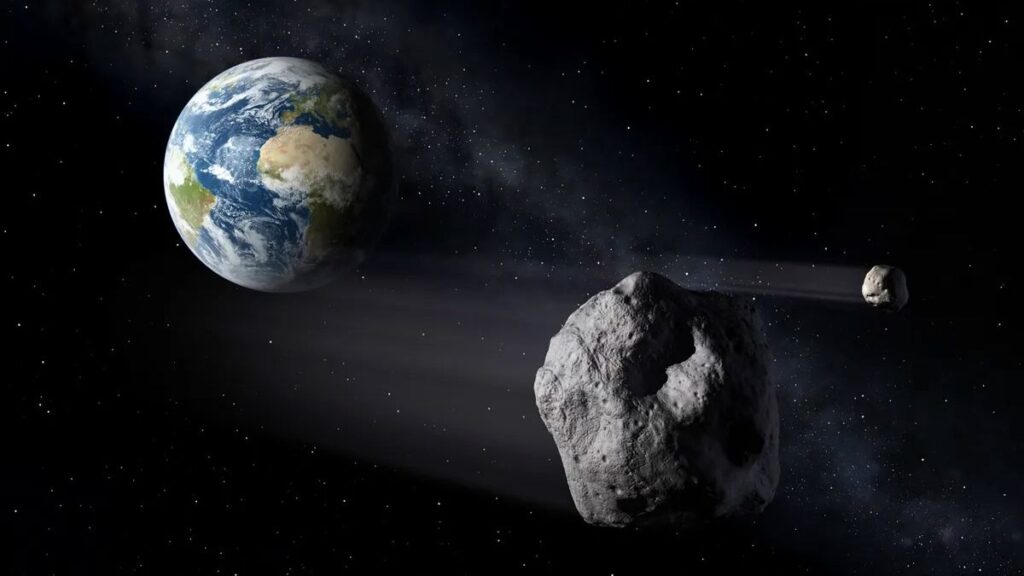
It’s a cosmic roll of the dice. A major asteroid strike could cause widespread devastation and profoundly impact life on Earth, so thwarting an incoming object could be a matter of life or death.
Luckily, we have a little bit of practice at this. On Sept. 26, 2022, NASA’s Double Asteroid Redirection Test (DART) slammed into Dimorphos, a moonlet that orbits a larger asteroid called Didymos. DART was the first-ever mission dedicated to trial-run one method of asteroid deflection by changing an object’s motion in space through a kinetic impact.
You may like

Danica Remy with three former NASA astronauts: From left, Steve Smith, Remy, Apollo 9’s Rusty Schweickart and Ed Lu, who is B612 Asteroid Institute’s executive director. (Image credit: Christopher Michel)
Enter the heads-up and off-world reality of the nonprofit B612 Foundation, which takes its name from Antoine de Saint-Exupéry’s 1943 novella “The Little Prince.” (The prince lives on an asteroid called B-612.)
Since 2002, the Silicon Valley-based organization has engaged in research, education and promoting the protection of Earth from asteroid impacts, and also advancing knowledge about the solar system’s evolution and expanding economic development in space.
Danica Remy is president of B612 and a co-founder of Asteroid Day, an international day of action and education about asteroids held every year on June 30.
“The idea [behind Asteroid Day] was that the public needed to be educated about both the risks as well as the aspirational opportunities that asteroids present to humanity,” Remy told Space.com.

Danica Remy, president of the nonprofit B612 Foundation. (Image credit: Hugo Wagner)Public communications
Modeled after Earth Day, Asteroid Day is an important part of B612’s worldwide public communications strategy, said Remy, “a way to elevate trusted voices and spokespersons about both the risk and the opportunities that asteroids present.”
“In some ways, you still need a human network,” she added. “That’s because we actually don’t know what trust looks like in this time of internet communications and artificial intelligence generation.”
Asteroid Day was co-founded by astrophysicist and musician Brian May of the rock band Queen, along with Apollo 9 astronaut Rusty Schweickart, filmmaker Grig Richters and Remy. The day is recognized by the United Nations with hundreds of events held to sharpen public appreciation of asteroids.
You may like
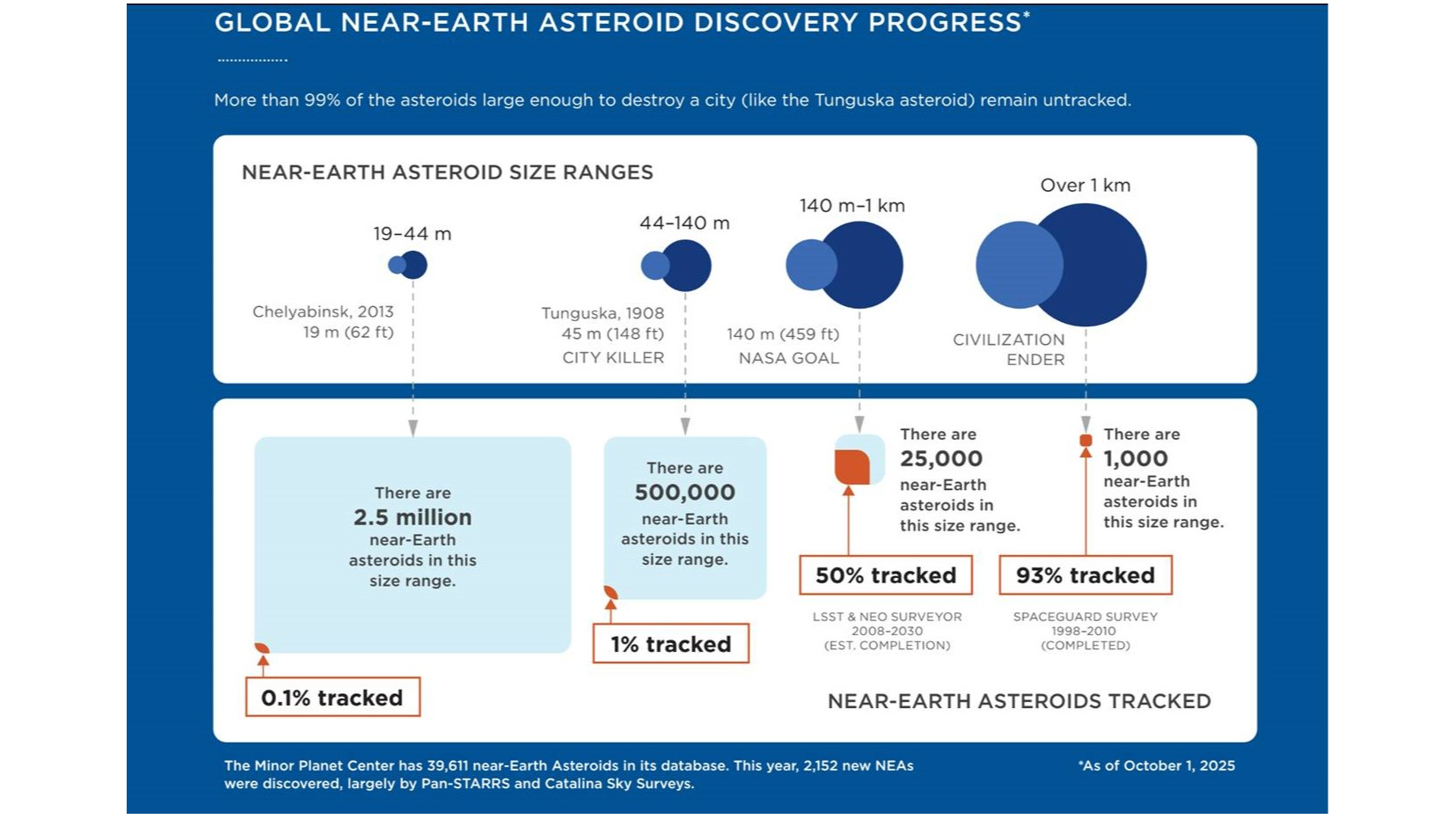
More work is needed to continue advancing discovery and tracking tools to strengthen global readiness against potential asteroid strikes. (Image credit: B612 Foundation)Multidimensional work
Schweickart co-founded B612 and led it for its first 10 years. He was also instrumental in persuading Remy to join forces with former NASA astronaut Ed Lu in leading the effort.
“I convinced her that the planetary defense challenge, while having substantial technical challenges, was far broader than that,” Schweickart told Space.com. “In fact, when the rubber hits the road regarding an impact threat, the major issues and decisions were largely non-technical.”
Remy’s efforts and talent in management, fundraising and organizational leadership have enabled the multidimensional work of B612 to grow “and become a highly productive planetary defense asset for the world,” Schweickart said.

This sky rendering is a reconstruction of the asteroid explosion over Chelyabinsk, Russia on Feb. 15, 2013. (Image credit: Sandia National Laboratories)Two real-world impacts
Asteroid Day spotlights the anniversary of the 1908 Tunguska impact in Siberia, the largest asteroid hit on Earth in recorded history. That major wallop into shattered roughly 800 square miles (2,072 square kilometers) of forest — the approximate size of a major metropolitan city today.
A more recent Earth encounter with an asteroid occurred in February 2013, over the Russian town of Chelyabinsk. An asteroid about 60 feet (18 meters) wide detonated above the city, an unexpected sky show that damaged buildings and injured a large number of people on the ground. (Asteroids don’t have a particular animus for Russia; the nation just covers a huge amount of territory, so it has a relatively high chance of being hit.)
It was a 21st century wakeup call, and also rang the bell to emphasize the range of B612 activities.
A techno-optimist
“My background is in the area of computer science,” said Remy, who spearheads the organization’s strategy and operations. She has an enviable track record of leading startups and nonprofits across diverse fields, including technology, internet services, education and philanthropy.
“I am a techno-optimist and really believe that technology can solve problems,” Remy said. But, she added, “it will make a lot of problems, too, if we don’t think well about the potential problems.”
Remy says that the asteroid challenge is a data challenge.
“We simply don’t know where the majority of them are, and we have the technology,” she said. “In order to find and track them, we need to deploy those technologies or invest in those technology solutions to accelerate the rate of asteroid discovery.”
For example, the Asteroid Institute, a program of the B612 group, is working on a way to utilize the latest advances in computing and astronomy to build “open tools” — easily accessible ways to understand, map and navigate our solar system.
The Asteroid Discovery Analysis and Mapping (ADAM) platform is a case in point. Built on Google Cloud, it combines curated datasets — 8.6 billion point sources — and cloud-based services to create the infrastructure for discovery, analysis and mission design.
Independent voices
ADAM is an open-source tool that handles impact probability, trajectory optimization and real-time discovery in one easily accessible interface, Remy said.
“The tools we are building are open source, so people can download and use the tools. They are an important part of transparency in this world of a lot of information from a lot of different places,” she said. “We think that there should be an independent voice. We think that other people around the world are capable of doing some of this analysis for themselves.”
It is important that computer and software-savvy individuals validate data about where an asteroid is and where it is traveling, making them credible sources of information, Remy said.
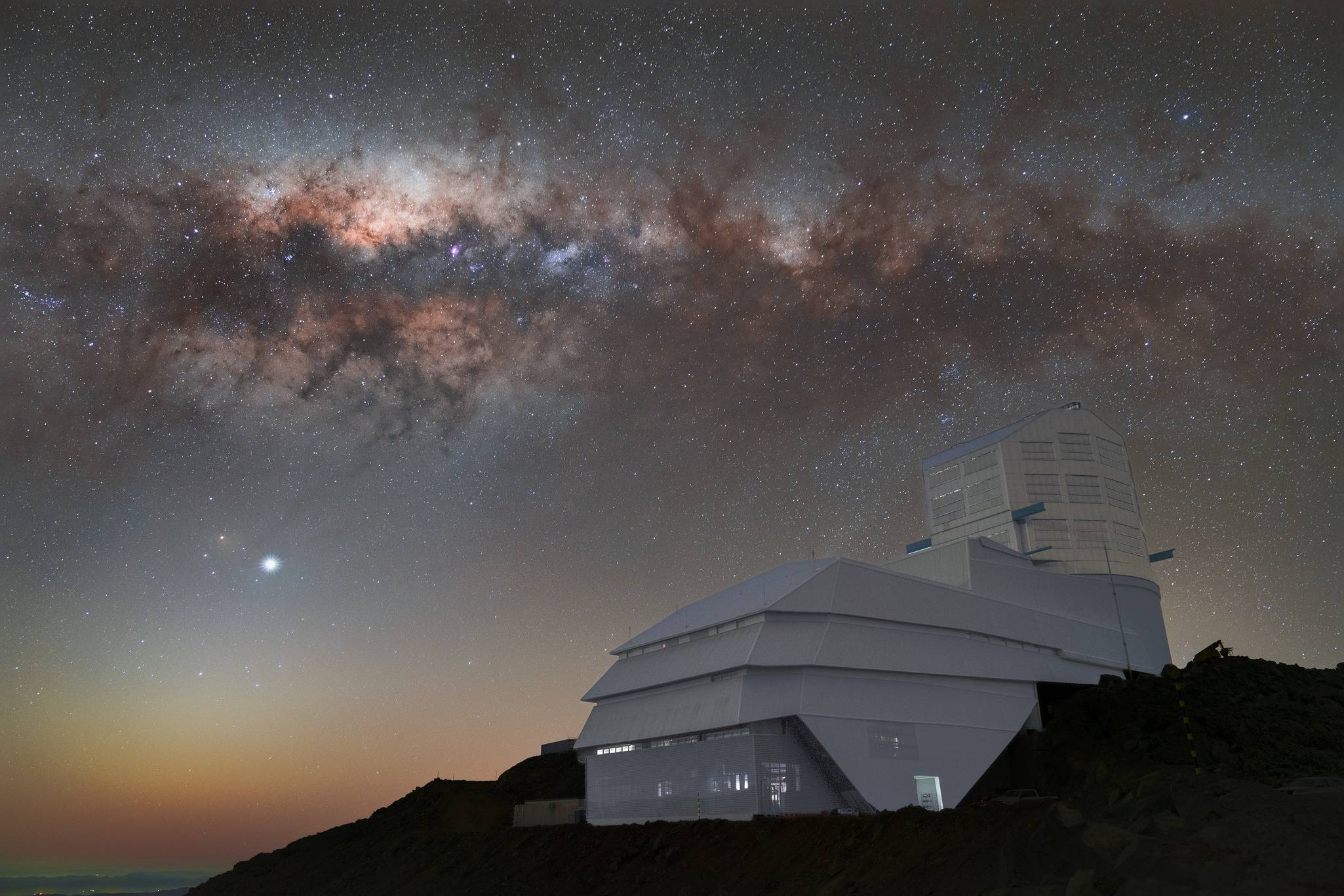
The Vera C. Rubin Observatory is a new astronomy and astrophysics facility on Cerro Pachón in Chile, designed to yield a treasure trove of discoveries, from asteroids and comets to pulsating stars and supernova explosions. (Image credit: RubinObs/NOIRLab/SLAC/DOE/NSF/AURA/H. Stockebrand)Discovery pipeline
“By making tools and information available, we think the world is better off having researchers, explorers and planetary defenders,” Remy added. “People can be enabled to begin that exploration process for themselves, independent of an agency or an academic institution.”
Lu is the executive director of the Asteroid Institute. In last year’s Institute progress report, he emphasized the ground-based Vera Rubin Observatory‘s capabilities as the most powerful facility for asteroid discovery ever built.
Lu said that scientists will use ADAM with Rubin observations to identify and assess potential threats. The Institute is eager to apply its Trackletless Heliospheric Orbit Recovery (THOR) algorithm to expand the number of asteroids Rubin will uncover, he added.
THOR was developed by Joachim Moeyens at the University of Washington and the B612 Asteroid Institute. It can discover asteroids in datasets regardless of observational cadence by linking observations across time spans. The algorithm is being integrated into ADAM’s discovery pipeline.
Democratize access to data
Remy thinks that public attention to space rocks will be heightened by the April 13, 2029 flyby of Earth by the asteroid Apophis, named after the Egyptian god of chaos.
“Apophis is a great story, and luckily, it doesn’t have our address on it,” she said. “And it’s a really exciting adventure for all of humanity.”
A growing cadre of national and international spacecraft missions will collect critical Aphosis data for current and future use. “The community is going to have access to that data. That’s why I think it’s so important that we democratize access to data, especially for science,” said Remy.
Our planetary future
Similarly, there’s another space rock lurking out there to keep an alert eye on: Asteroid 2024 YR4. Astronomers initially thought 2024 YR4 might be a troublemaker for Earth, but that prospect has dissipated. On the other hand, the asteroid may slam into Earth’s moon on Dec. 22, 2032.
Experts give 2024 YR4 a 4% chance of striking our celestial neighbor on that date. “But remember, that means there’s a 96% chance that it won’t hit,” Remy said. Still, such a hit would be “an amazing show through a telescope,” she said, perhaps causing meteor showers here on Earth.
“While the B612 DNA was in planetary defense, our future and all of our investments for the last six years have been in mapping our solar system, not only for planetary defense but also for mission planning, for visiting asteroids and for discovery,” Remy concluded. “The tools we are building are about our planetary future.”