
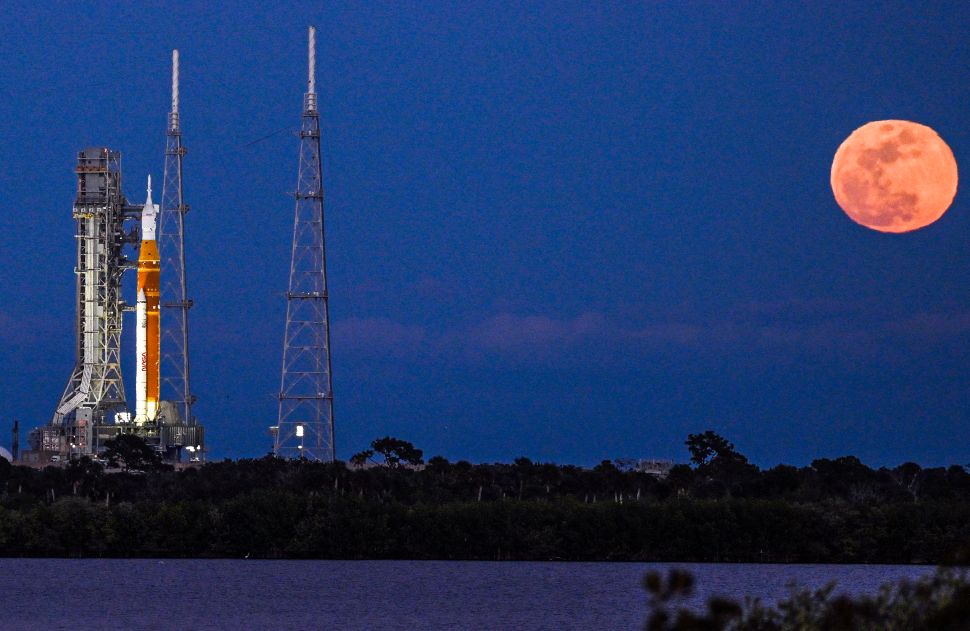
 NASA’s SLS rocket and Orion capsule stand on Launch Complex 39B ahead of Artemis II on Feb. 1, 2026. Miguel J. Rodriguez Carrillo / AFP via Getty Images
The last time the U.S. sent astronauts to the Moon was Apollo 17 in 1972. More than half a century later, NASA is preparing to do it again. Artemis II, the agency’s first crewed mission of the Artemis era, will send four astronauts on a 10-day loop around the Moon to demonstrate that its new rocket and crew capsule can carry people to lunar distance and return them safely to Earth. NASA had been targeting an early-February launch, but after a liquid-hydrogen leak during late-stage testing, the agency is now targeting launch opportunities no earlier than March, with additional windows in April if needed.
The crew—Reid Wiseman, Victor Glover, Christina Koch, and Canadian Space Agency astronaut Jeremy Hansen—will lift off from Kennedy Space Center in Florida inside NASA’s Orion capsule atop the Space Launch System, the agency’s heavy-lift Moon rocket. They’ll depart from Launch Complex 39B, one of Kennedy’s most storied pads, which previously supported Apollo 10 as well as crewed Skylab and Apollo-Soyuz missions. Next door, Launch Complex 39A—used during the Apollo era and later by the space shuttle—is now used for NASA’s regular SpaceX Crew Dragon missions to the International Space Station.
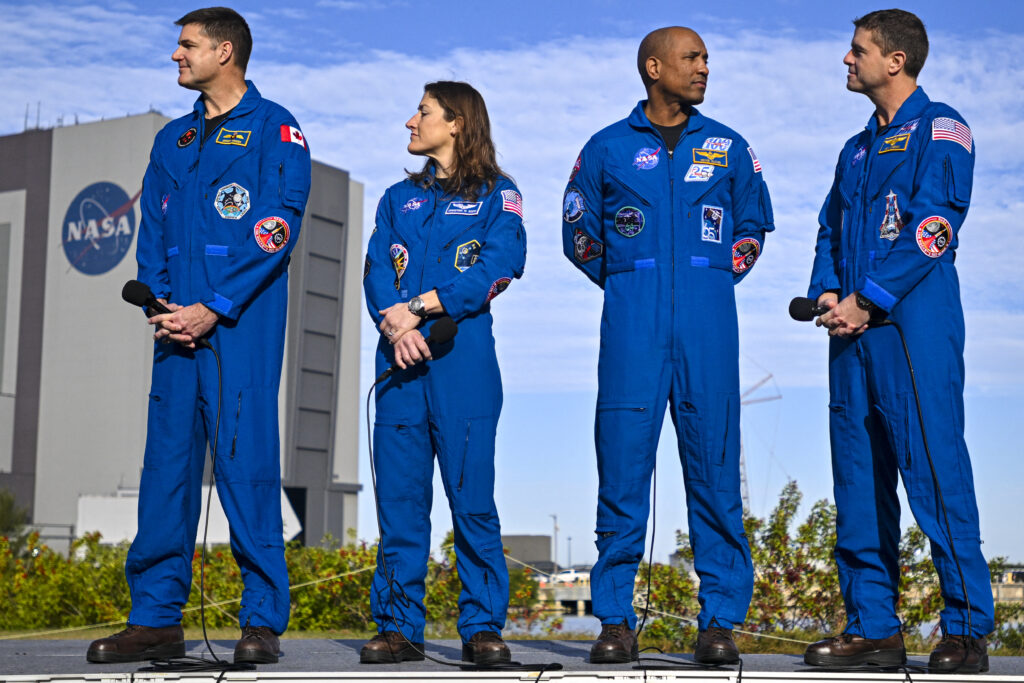
Wiseman will command the mission, with Glover as pilot and Koch and Hansen as mission specialists. All four are veteran aviators, and three have already flown in space: Wiseman previously served as a NASA astronaut and former chief of the Astronaut Office. Glover flew on SpaceX’s Crew-1 mission to the International Space Station, and Koch spent 328 days in orbit, then the longest single spaceflight by a woman. Hansen, a Royal Canadian Air Force colonel and Canadian Space Agency astronaut, is set to become the first Canadian to travel to lunar distance. With Koch and Glover aboard, Artemis II will also mark the first time a woman and a person of color fly on a lunar mission.
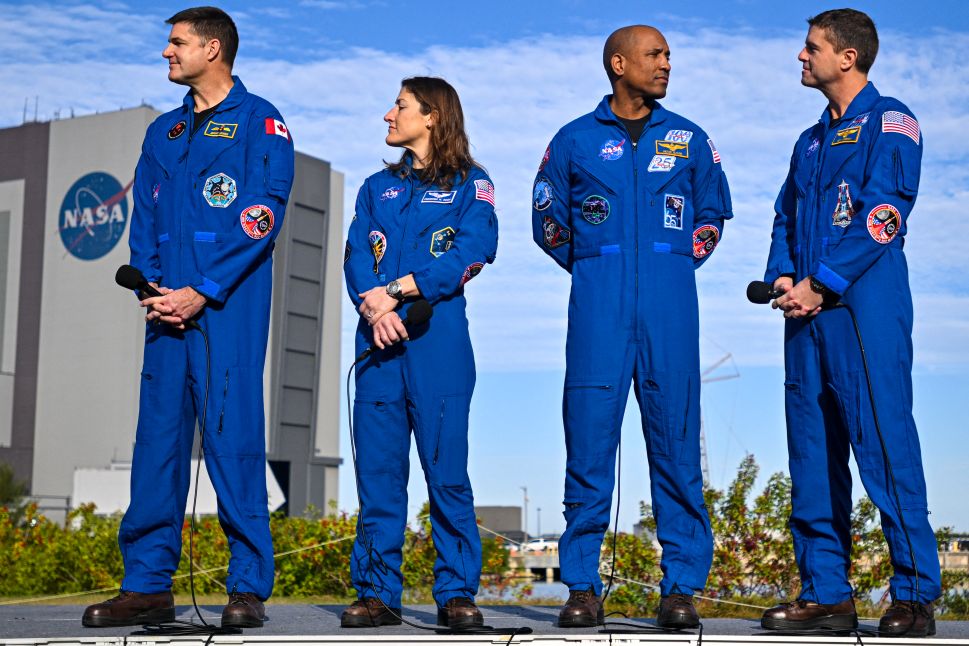 (From left to right) Artemis II astronauts Jeremy Hansen, Christina Koch, Victor Glover and Reid Wiseman watch the rollout of NASA’s Space Launch System rocket and Orion crew capsule. Miguel J. Rodriguez CARRILLO / AFP via Getty Images
The Artemis Program
Artemis—named after Apollo’s twin sister in Greek mythology as a nod to the Apollo era—is NASA’s plan to return astronauts to the Moon and lay the groundwork for more sustained deep-space exploration. The program’s modern push began during President Donald Trump’s first term. In late 2017, the White House directed NASA, then led by administrator Charles Bolden, to return humans to the Moon as a stepping stone toward longer-range missions, and the agency soon consolidated its lunar efforts under the Artemis banner. The program is now led by NASA administrator Jared Isaacman, a fintech entrepreneur and private astronaut.
Congressional funding is what keeps the multiyear program moving. NASA’s Office of Inspector General has projected total Artemis campaign costs of about $93 billion through fiscal 2025. For fiscal 2026, lawmakers approved $24.4 billion for NASA, including $7.8 billion for exploration—consisting of $2.3 billion for the Space Launch System, roughly $1.4 billion for the Orion crew capsule and about $2.0 billion for the Human Landing System program.
NASA last tested the rocket-and-capsule system during Artemis I, an uncrewed mission flown in late 2022 that demonstrated the spacecraft could travel to lunar distance and return safely. Artemis II will follow a similar trajectory, but with astronauts aboard, to prove the “human” side of the system works as intended—life support, communications and the procedures used by the crew and flight controllers from launch through recovery.
The mission’s most critical test comes at the end. Returning from the Moon requires entering Earth’s atmosphere much faster than a typical crewed mission in low Earth orbit. Orion must survive extreme heat and stress during reentry before deploying parachutes for a controlled descent and recovery.
The program is designed to advance in stages. Artemis I validated the basic flight profile without astronauts. Artemis II repeats it with a crew. Artemis III is planned as the first crewed lunar landing of the Artemis era and is currently targeted for no earlier than 2028. Artemis IV and V are intended to support longer stays and additional infrastructure, with increasing commercial involvement as missions grow more complex.
The largest rocket ever made
All of those plans hinge on the rocket at the center of the program: the Space Launch System. SLS is NASA’s super-heavy vehicle for deep-space missions. In its current “Block 1” configuration, it stands about 322 feet tall, produces roughly 8.8 million pounds of thrust at liftoff—about 15 percent greater than the Saturn V used during Apollo—and can send about 27 metric tons to the Moon.
SLS is built for infrequent but powerful deep-space flights, placing it in a different category from rockets designed for regular trips to Earth orbit. SpaceX’s newer Starship system is designed to be larger on paper. Starship stands about 397 feet tall, is intended to generate roughly 17 million pounds of thrust at liftoff, and is being developed with a target payload of up to about 150 metric tons to orbit in a fully reusable configuration. It’s still in development and testing.
Before Artemis II can fly, NASA must complete final launch processing and confidence checks on the fully integrated vehicle. In early February, the agency conducted a full propellant-loading test—an end-to-end fueling run used to validate ground systems and countdown procedures. A liquid-hydrogen leak, however, cut the attempt short before teams could complete the full sequence. NASA said it is repairing and retesting the affected hardware and reviewing data from the test as it works toward a launch opportunity no earlier than March.
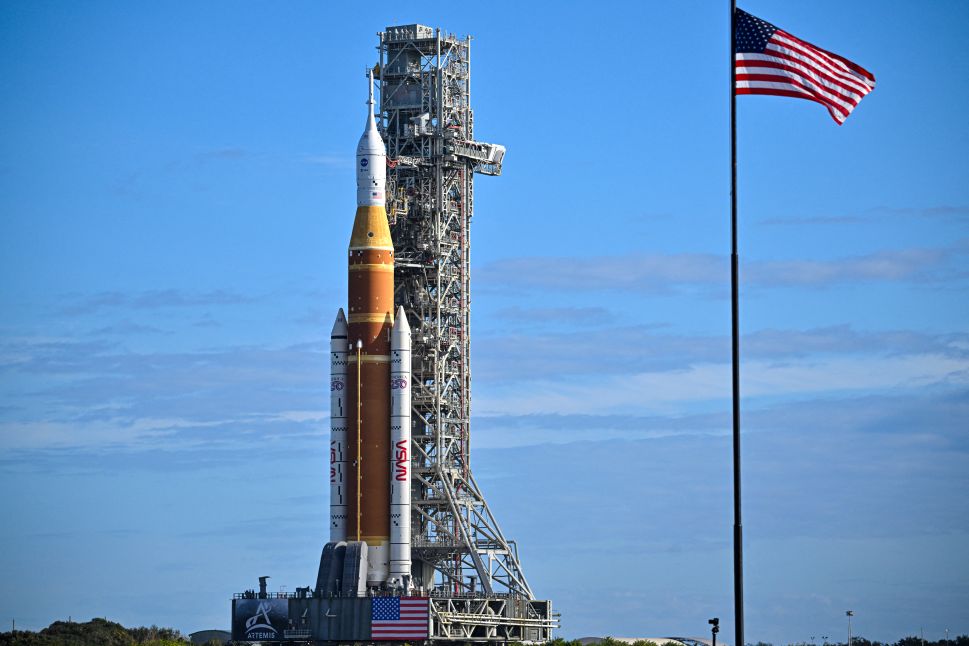 The SLS rocket and Orion crew capsule stand on Launch Complex 39B at Kennedy Space Center in Florida ahead of the Artemis II mission. Miguel J. Rodriguez Carrillo / AFP via Getty Images
Landing on the Moon
For the final descent to the Moon’s surface, NASA is relying on commercial providers rather than building its own lander. The agency selected SpaceX in 2021 for the first Human Landing System contract, valued at $2.89 billion, and added Blue Origin in 2023 under a $3.4 billion contract for Artemis V. NASA said the second award was meant to introduce competition and provide a backup option for a capability it is not developing in-house.
Both landers are still in development. NASA has said SpaceX must complete major demonstrations—such as proving key spacecraft operations in orbit and performing an uncrewed lunar landing—before astronauts can depend on the system. Blue Origin, for its part, has said it is prioritizing its lunar program and has paused New Shepard space-tourism flights to focus resources, with a robotic “Blue Moon” demonstration mission planned as part of that effort.
The Artemis program is unfolding amid renewed lunar ambitions elsewhere. China has said it aims to land astronauts on the Moon by 2030, and recent robotic missions—including India’s Chandrayaan-3 landing in 2023—have underscored how crowded and competitive lunar exploration has become.