
NASA has published a striking image captured by the Hubble Telescope. It shows a protoplanetary nebula known as the Egg Nebula.
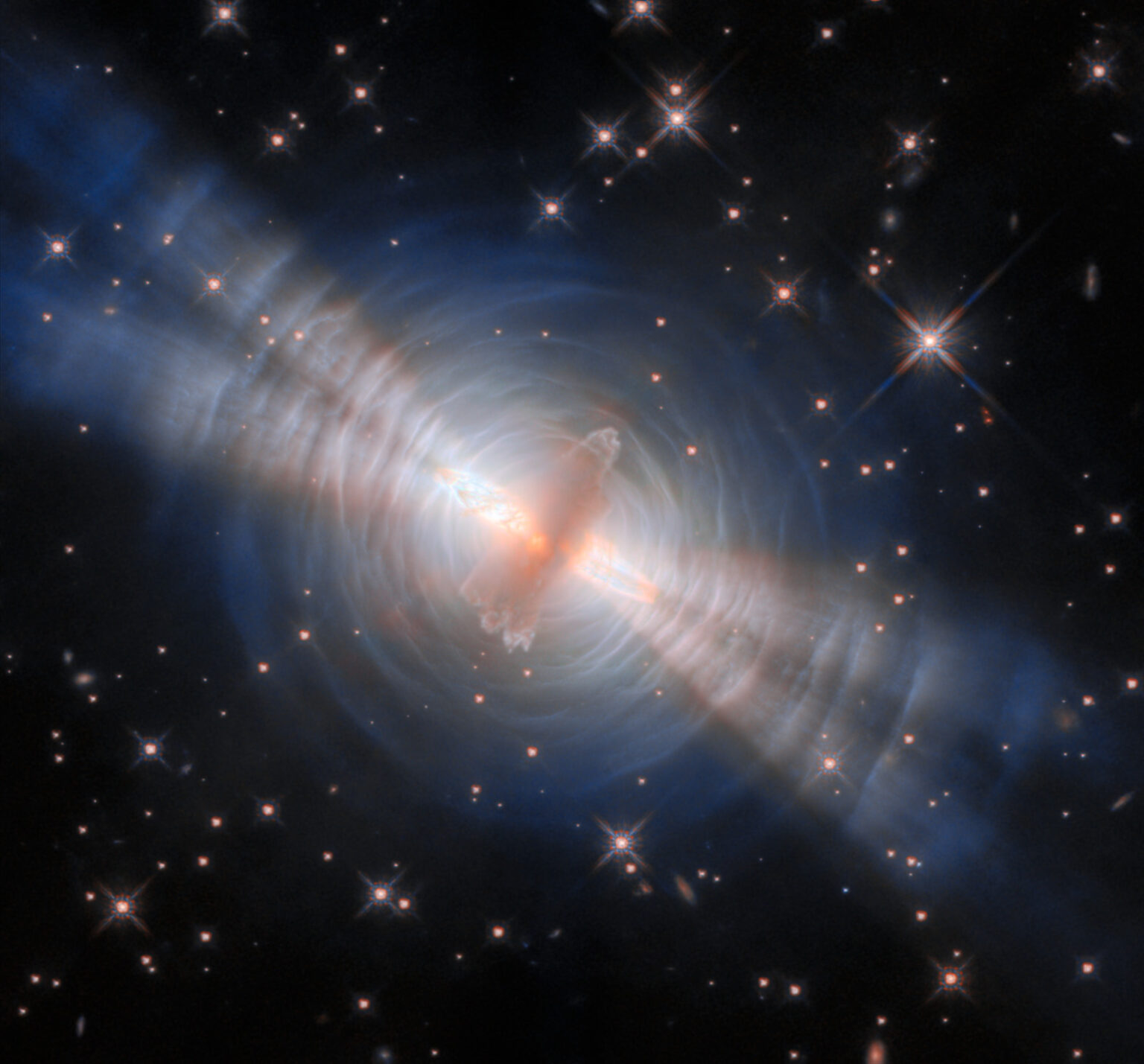 The Egg Nebula. Source: NASA, ESA, Bruce Balick (University of Washington)
The Egg Nebula is located a thousand light-years from Earth in the constellation Cygnus. At its center lies a star that, like an egg yolk, is hidden from us by a dense, opaque cloud of dust. But thanks to the power of the Hubble telescope, astronomers were able to see intricate details hinting at the processes taking place at its center.
This object is interesting because it is the youngest protoplanetary nebula closest to us. This is the name given to the penultimate stage in the life cycle of sun-like stars. Located in the center of the nebula, the Egg has already begun to shed its shell. But the temperature of its core is not yet high enough to ionize the surrounding matter and cause it to glow with its own light. At this early stage, the nebula glows, reflecting the light of the central star, which penetrates through the polar “eye” in the surrounding dust. This light comes from a dust disk ejected from the surface of the star just a few hundred years ago.
The double rays of a dying star illuminate fast-moving polar lobes that pierce a slower, older series of concentric arcs. Their shapes and motions indicate gravitational interactions with one or more hidden companion stars, all of which are buried deep within a thick disk of stellar dust.
The symmetrical patterns captured by Hubble are too orderly to be the result of a powerful explosion, such as a supernova. Instead, the arc, lobes, and central dust cloud are likely the result of a coordinated series of poorly understood scattering events in the carbon-enriched core of a dying star.
This transitional stage lasts only a few thousand years. Subsequently, the exposed core of the star will heat up enough to ionize the surrounding gas, creating a luminous shell known as a planetary nebula. However, this stage will not last long. In a few tens of thousands of years, the core will cool down and begin to contract, turning into a white dwarf. The nebula itself will cease to be visible, and its matter will disperse throughout space and eventually become part of new star systems.
Earlier, we reported on how Hubble photographed protostars in the Orion constellation.
According to NASA