
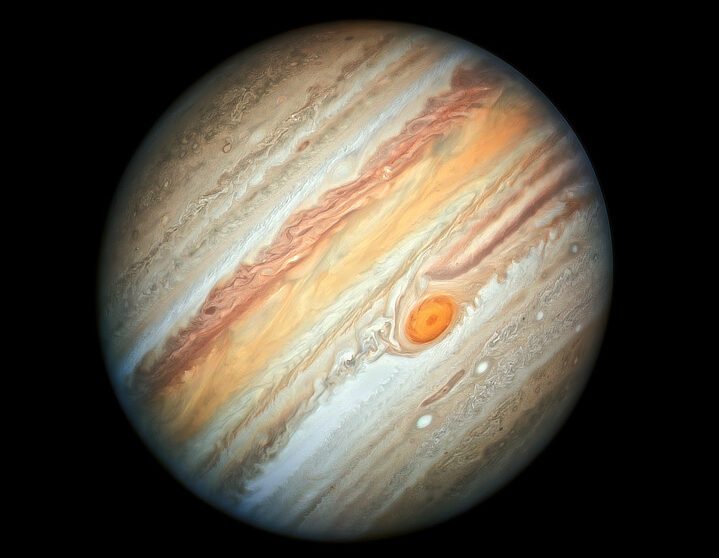
Jupiter is the biggest planet in our Solar System. It’s so big, in fact, that every other planet of the Solar System could fit inside Jupiter.
Jupiter is a gas giant, which means it’s mostly made of gases like hydrogen and helium surrounding a small, central core.
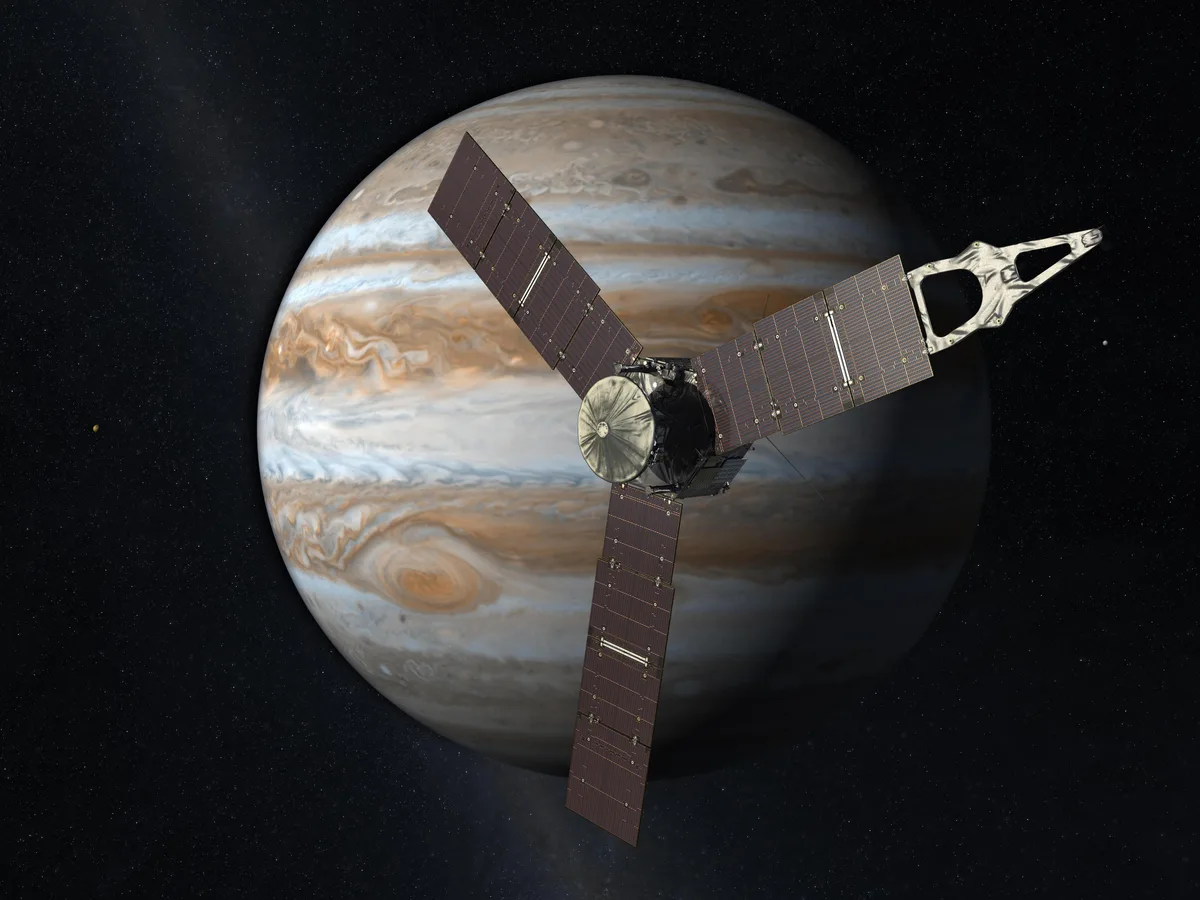
On 4 July 2016, NASA’s Juno spacecraft arrived at Jupiter, and it’s been orbiting the gas giant ever since.
Juno has given us amazing images of Jupiter’s poles, it’s Great Red Spot – an Earth-sized storm that’s been raging for centuries – and has unlocked some of the biggest mysteries about the planet.
 Credit: NASA
Now, NASA says Juno data has revealed that Jupiter is slightly smaller and flatter – or more ‘squashed’ – than previously thought.
Scientists looked at data captured during 13 of Juno’s flybys of Jupiter and determined the gas giant is 8km (5 miles) narrower at the equator and 24km (15 miles) flatter at the poles.
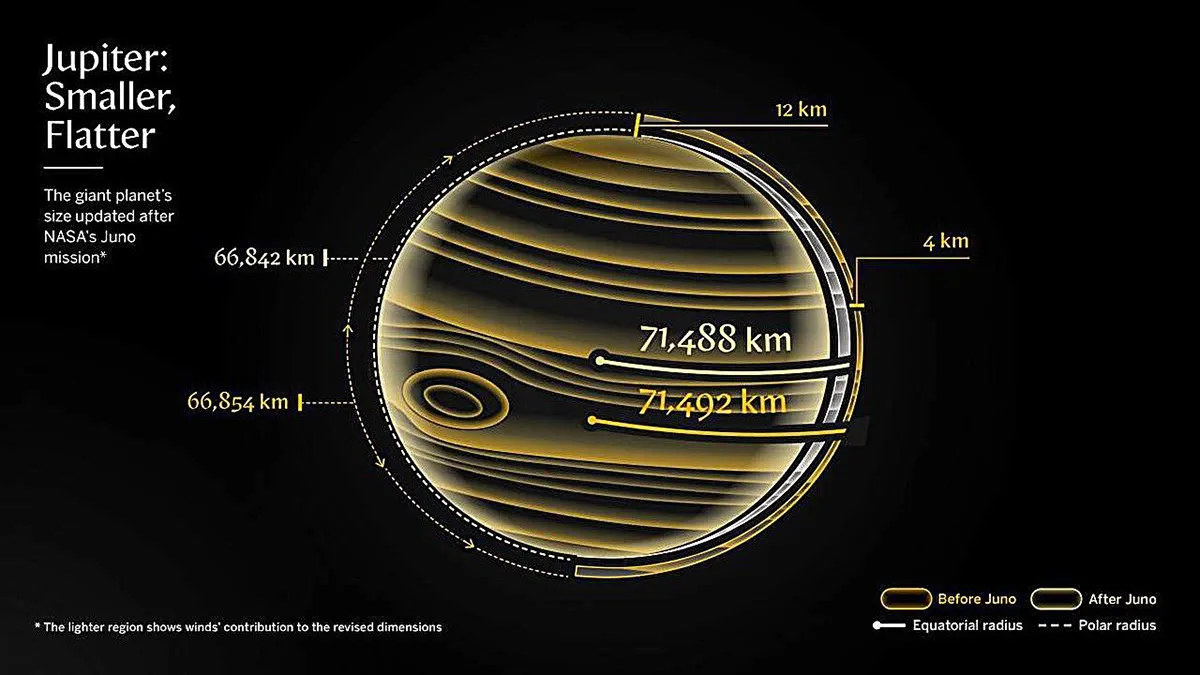 An infographic revealing data from NASA’s Juno spacecraft that shows Jupiter is slightly smaller and more squashed than thought. Credit: Weizmann Institute of Science
The technique used to gather the data is called ‘radio occultation’, which enables scientists to effectivley see through Jupiter’s dense, stormy atmosphere.
It works by the Juno spacecraft beaming radio signals back to Earth, but these radio signals pass through the upper layer of Jupiter’s atmosphere first.
This causes the signals to bend and warp, but also to arrive at NASA’s Deep Space Network on Earth slightly later than they would otherwise.
The change in frequency caused by the bending effects of Jupiter’s atmosphere enables astronomers to calculate the temperature, pressure and electron density at different depths.
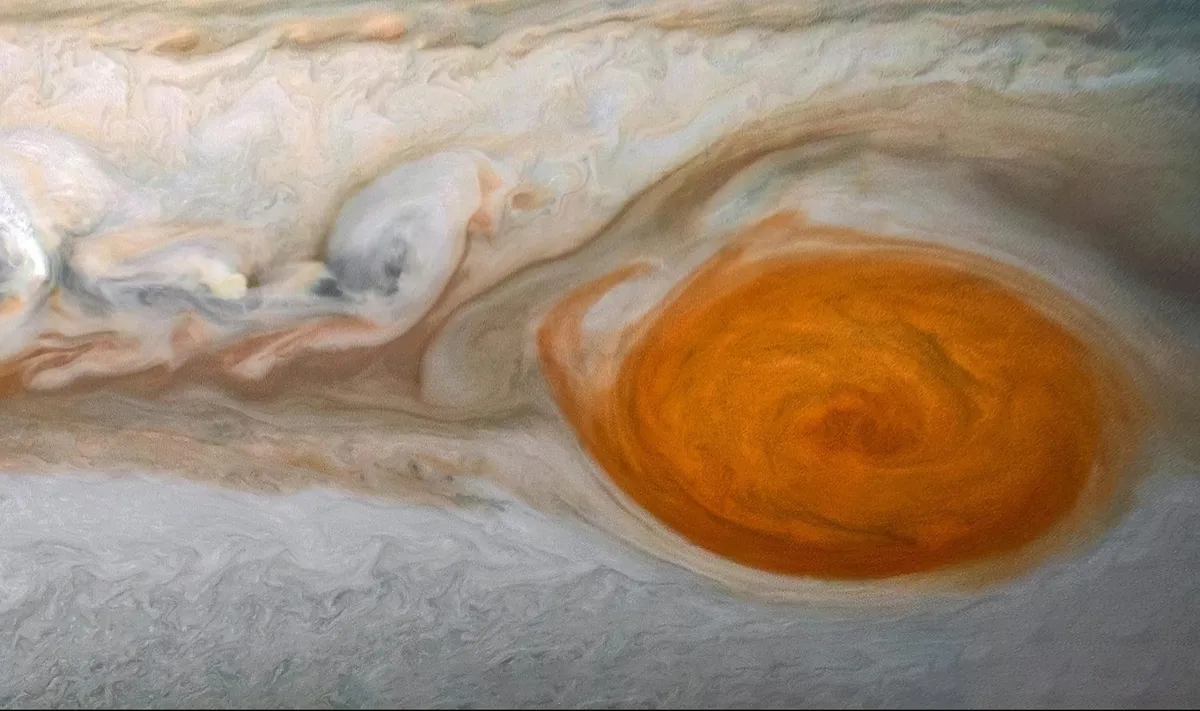 A view of Jupiter’s Great Red Spot captured by the Juno spacecraft and processed by citizen scientist Kevin M Gill. Image data: NASA/JPL-Caltech/SwRI/MSSS
While the discovery has enabled planetary scientists to learn something new about our Solar System, NASA says the study could enable better understanding of giant planets orbiting distant stars, known as exoplanets.
Astronomers use something called the transit method to discover and learn more about exoplanets.
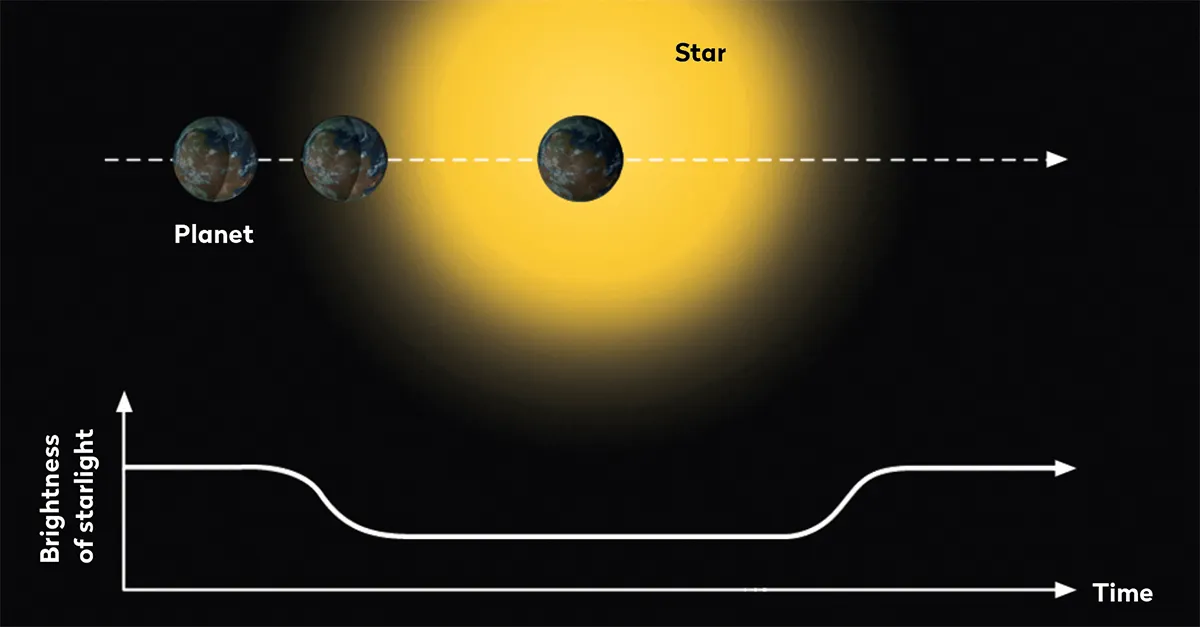 The transit method of detecting exoplanets sees astronomers measure dips in starlight as a planet passes in front of its host star.
It involves observing an exoplanet passing in front of its host star, from our perspective on Earth, and using that information to work out the exoplanet’s size, composition and even chemistry.
Scientists say this Jupiter study could work as an analogue, helping them better interpret data acquired from exoplanets passing in front of their star.
Read the full study via Nature Astronomy.