
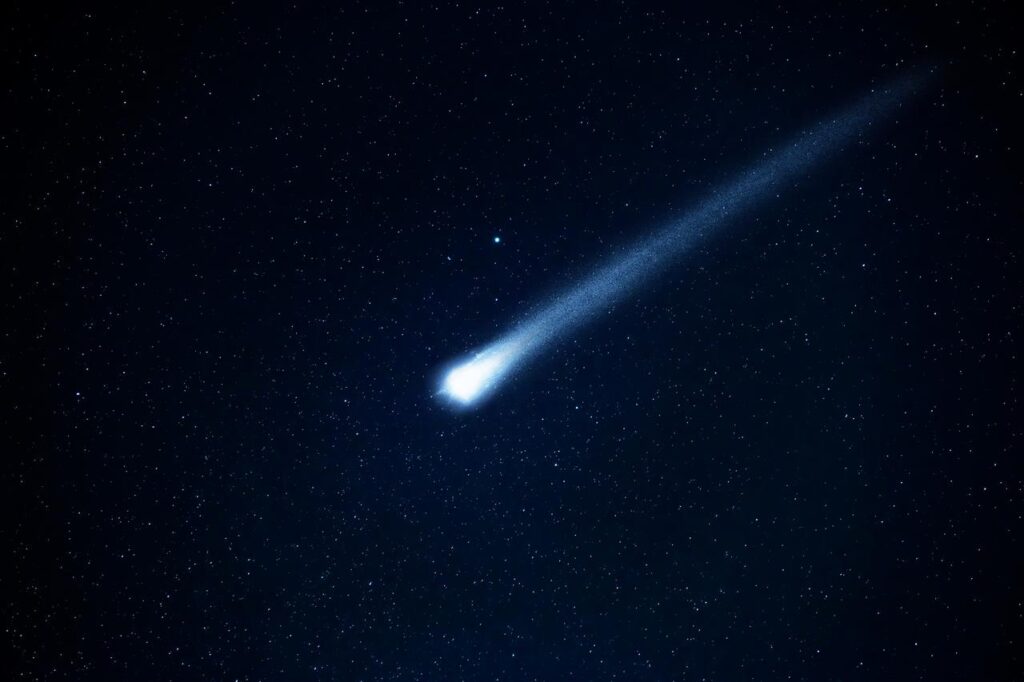
Astronomers have identified a newly discovered sungrazing comet that could become bright enough to see with the naked eye this spring, possibly even during the day, if it survives a close pass by the sun.
The comet, named C/2026 A1 (MAPS), belongs to the Kreutz family of sungrazing comets, a group known for dramatic flybys that sometimes produce some of the brightest objects in the sky.
French astronomer Alain Maury and his team first spotted the comet on Jan. 13 using a remotely operated telescope at an observatory in Chile’s Atacama Desert. The discovery came 82 days before the comet is set to reach its closest point to the sun, known as perihelion.
“We have discovered a bit more than 300 new Earth-crossing asteroids and 8 comets since we started in 2021, and each time it’s a good surge of adrenaline,” Maury told Discover. “But this one is notable because its orbit is quite special; it will come very close (too close?) to the sun and is part of a large family of comets.”
Why do these comets fly so close to the sun
Sungrazing comets travel unusually close to the sun.
Members of the Kreutz group follow paths that bring them within about 850,000 miles of the sun. C/2026 A1 will pass even closer.
The comet will fly within about 125,000 miles of the sun’s surface in April, according to Discover.
Live Science reports that it will reach perihelion on April 4, when it will come within roughly 500,000 miles of the sun’s center and whip around it at over 2 million miles per hour.
At such distances, the comet faces intense radiation, extreme heat, and powerful tidal forces. Ed Bloomer, senior astronomy manager at the Royal Observatory Greenwich, explained the risk.
“The close approach of the sungrazers exposes them to intense radiation from the sun and powerful tidal dynamics,” Bloomer told Discover. “The comet itself is basically a snowball (that’s simplifying things a bit), so many sungrazers are utterly destroyed by evaporation.”
Many sungrazers break apart before or during their closest approach. Researchers say the survival of C/2026 A1 will depend on its size and composition.
“It’s hard to predict the outcome: some sungrazers do survive their journey close to the sun, but it depends on the size and makeup of the cometary material itself,” Bloomer said. “The fate of so many sungrazers suggests the chances of survival this time are relatively slim… but there’s a chance!”
Could the comet be visible in daylight?
If the comet survives perihelion, scientists say it could brighten significantly in early April as solar radiation releases large amounts of gas and dust.
Some researchers speculate that C/2026 A1 could become several times brighter than the full moon, which would make it visible to the naked eye in daylight.
However, experts stress that it is too early to predict its maximum brightness with certainty.
Past Kreutz comets have produced remarkable displays.
The Great Comet of 1882 became visible in daylight, and Comet Ikeya-Seki shone brighter than the full moon in 1965. Comet Lovejoy, another member of the family, survived a close solar encounter in 2011 despite being partially torn apart.
Observers in the Southern Hemisphere will likely have the best view of C/2026 A1. People in the Northern Hemisphere may see it low above the southwestern horizon just before sunset if it remains intact.
Even if the comet disintegrates, astronomers expect it to be visible from late March through telescopes or stargazing binoculars.
Later in April, another comet, C/2025 R3 (PanSTARRS), will also approach perihelion on April 20 and could become visible to the naked eye, raising the prospect of a notable month for skywatchers.
For now, astronomers say patience is key.
According to Maury, “We have a French expression saying ‘il ne faut pas tirer de plan sur la comète,’ which you say when you can’t plan the future.”
“So far, we just have to wait and cross our fingers.”

February 11, 2026 04:42 AM GMT+03:00