
WASHINGTON — Executives at United Launch Alliance said the departure of longtime chief executive Tory Bruno has had an impact on the company, but insisted it has not altered ULA’s ability to deliver on its central task: increasing the launch rate of its new Vulcan rocket after years of delays.
Speaking with reporters Feb. 10, interim chief executive John Elbon acknowledged the disruption that follows the exit of a leader who had run the company for more than a decade. Bruno led ULA for 12 years and was closely associated with the development of Vulcan Centaur to replace the company’s legacy Atlas and Delta rockets.
“Although leadership is certainly important, ULA’s strength is really in its 3,000 people that design the rockets, build the rockets in Decatur [Alabama] and launch the rockets at the Cape and Vandenberg,” Elbon said.
Elbon, a former Boeing executive, said he had planned to retire from ULA before being asked to serve as interim CEO. A formal search for a permanent chief executive is now underway, he said. ULA is jointly owned by Boeing and Lockheed Martin.
The company’s near-term challenge is translating Vulcan’s entry into service into a predictable launch cadence. The rocket has flown three times since its debut in January 2024, including two missions required to certify the vehicle for national security launches.
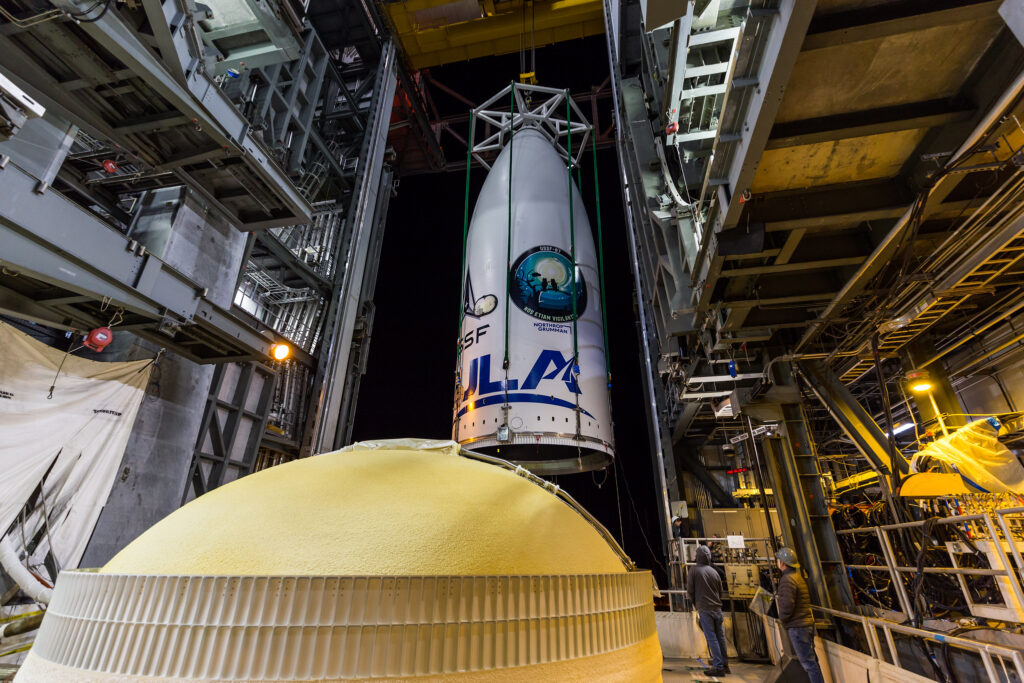
Vulcan’s fourth launch, the USSF-87 mission for the U.S. Space Force, is scheduled for Feb. 12.
Elbon said ULA’s top priority is achieving a “reliable and sustainable increased launch rate.” That goal has proven difficult as the company sharply reduced its projected launches for 2025 to fewer than 10 missions, less than half of its earlier target of 20. The shortfall reflects a slower-than-expected transition from Atlas V to Vulcan following a second-flight anomaly, as well as the complexity of bringing a new launch system into routine operations.
The slowdown prompted the U.S. Space Force to reassign three GPS satellite launches originally slated for ULA to SpaceX, underscoring the pressure on ULA to demonstrate consistent performance. Elbon said the company currently holds a backlog of about 80 missions across military and commercial customers.
Targeting 18 to 22 launches
Chief operating officer Mark Peller said ULA is aiming for between 18 and 22 launches in 2026, including four Atlas missions and 16 to 18 Vulcan flights.
To support higher flight rates, Peller said the company has completed major infrastructure upgrades at its East Coast launch site at Cape Canaveral, including a second mobile launch platform for Vulcan and a second integration facility. The parallel processing capability is intended to support an increase in both national security launches and commercial missions, including flights for the Amazon LEO constellation, which has purchased the remainder of ULA’s Atlas inventory.
On the West Coast, ULA is nearing completion of Vulcan’s launch complex at Vandenberg Space Force Base in California. The first Vulcan launch from that site is expected in the second quarter of 2026 oand will be a national security mission for the Space Force’s Space Development Agency, Peller said.
“I think there’s high confidence in our ability to be able to execute the missions that the Space Force is asking us to deliver on this year,” Peller said. He added that some schedule pressures are tied to Space Force constraints as it works to “deconflict resources” across multiple launch providers and both coasts.
Elbon declined to outline any broader strategic shifts under consideration following Bruno’s departure. “Tori, to some degree, was the face of ULA,” he said, “but our strength is really in the engineering expertise and the production expertise and the launch expertise.”
Asked about reports of frustration within the Pentagon over ULA’s launch pace, Elbon said the company’s relationship with government customers remains intact. “We had some anomalies … and we worked through those with them,” he said. “I think they understood what we were doing to address them, and so now it’s getting down to the business of launching.”
Without commenting on continued speculation that ULA could be put up for sale, “I will tell you that both Boeing and Lockheed are very supportive of ULA,” he said. “They’re excited about the future. There’s a lot of growth in space.” As the company moves into its next phase, he added, “we’ll be sorting out the specific path forward.”
Related