
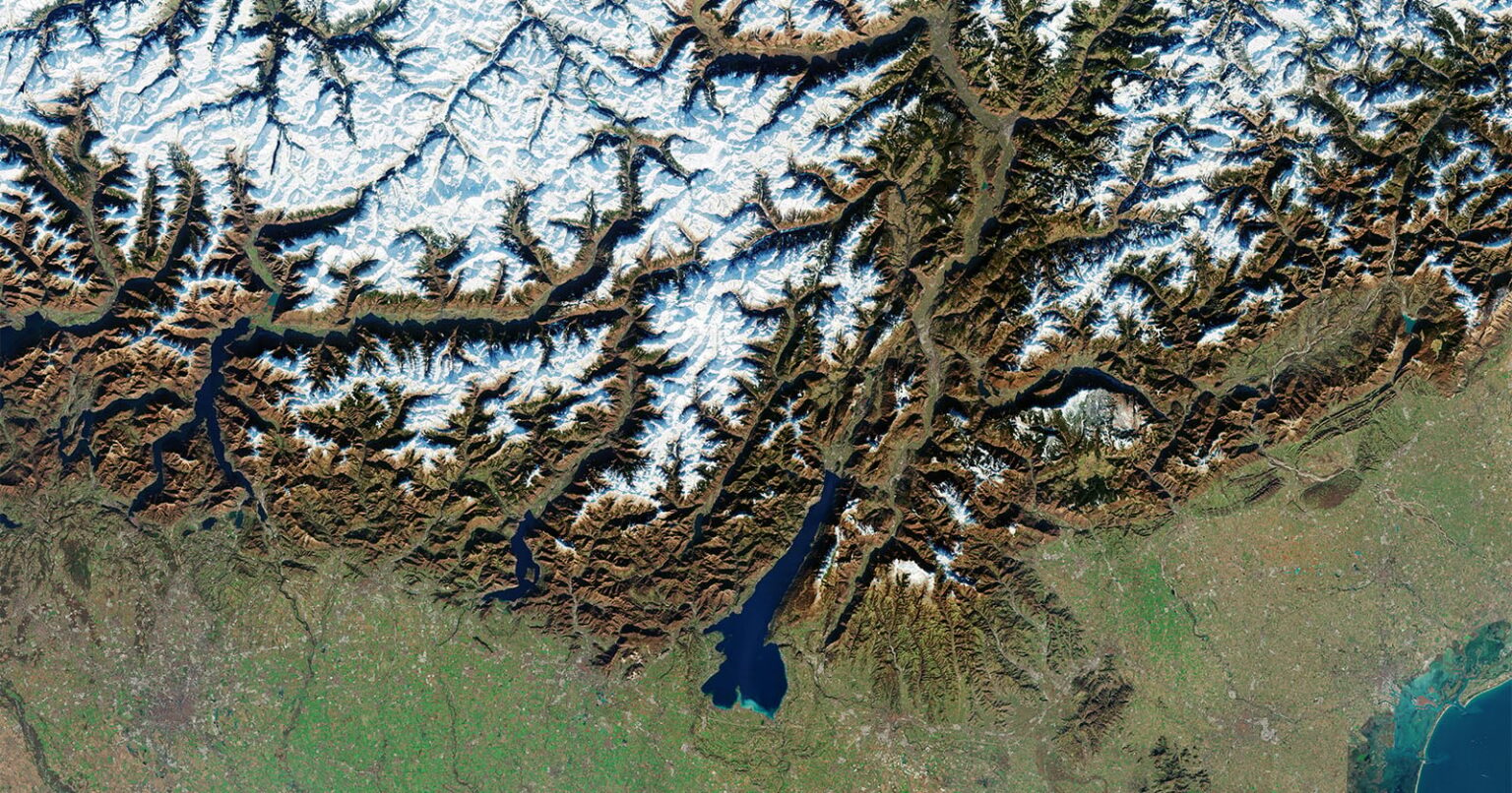
With the Winter Olympics in full swing and hundreds of millions of people worldwide tuning into all the sporting action from Italy, the European Space Agency (ESA) delivered a very special look at different Winter Olympic venues using its Copernicus Sentinel-2 mission satellite.
The 2026 Winter Olympics, officially known as the XXV Winter Olympic Games, are taking place in Milan and Cortina d’Ampezzo in northern Italy, with venues spread across several cities and towns, including Milan and Cortina, as well as Bormio, Livigno, Anterselva, Predazzo, Tesero, and Verona.
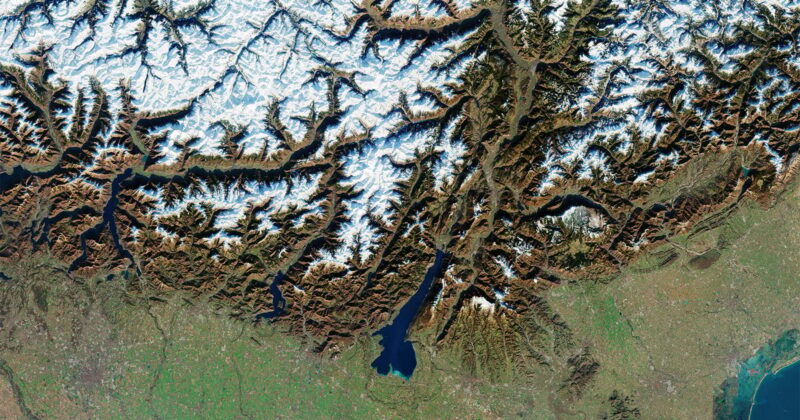
 ‘With the 2026 Winter Olympics officially opening today, the Copernicus Sentinel-2 mission brings us a striking view of northern Italy, highlighting several key Olympic venues… Also known as the Milano Cortina Games, this year’s Olympics are geographically widespread, with events taking place simultaneously in different regions and venues across northern Italy, including Milan, Bormio, Livigno, Anterselva, Cortina d’Ampezzo, Predazzo, Tesero and Verona.’ | Click here for an interactive, high-resolution version of this image.
In the ESA’s satellite shot, shared by Space, viewers can get a better sense of just how far apart some of the different venues are and the remarkably rugged landscape of the world-famous Dolomites. Cortina d’Ampezzo, often called the “pearl of the Dolomites,” is a beautiful winter resort town that also hosted the 1956 Winter Olympics.
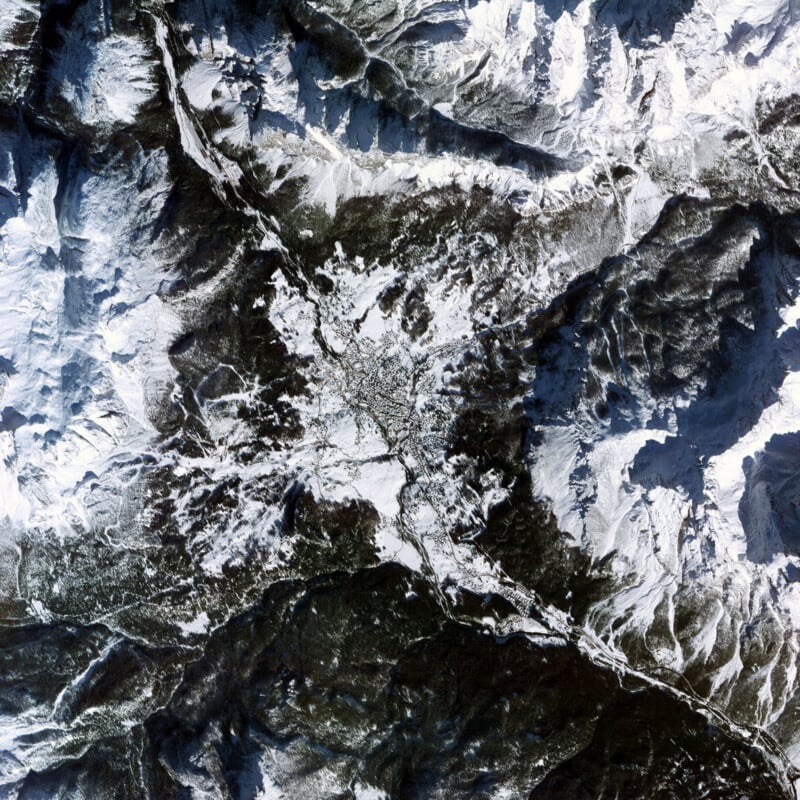 This image of Cortina d’Ampezzo was captured by a different satellite, IRIDE’s Hawk for Earth Observation (HEO)
This year’s opening ceremony was held at San Siro Stadium in Milan, located below the Alps. Milan is Italy’s second most populous city, behind Rome, and is home to numerous arena and stadium events in the XXV Winter Olympic Games, including the exciting ice hockey tournament.
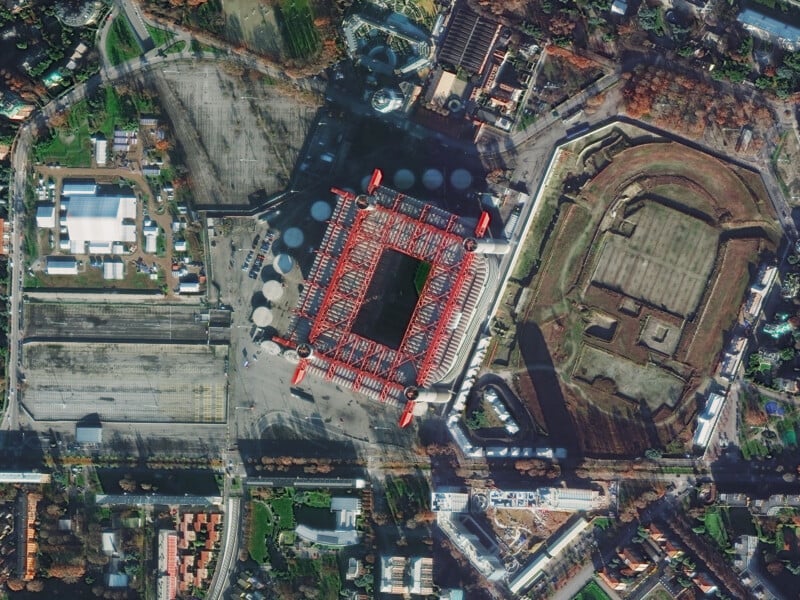 Yet another different ESA satellite, WorldView-3, captured this aerial photo of San Siro Stadium in Milan, Italy
To the east of Lake Garda, which sits at the base of the mountain range, is Verona, where the closing ceremony will be held. This same arena in Verona will also host the opening ceremony for the Paralympic Winter Games on March 6.
The Sentinel-2 satellites have a mean orbital altitude of 786 kilometers (488 miles) and perform just over 14 revolutions of the Earth every day.
Although the Winter Olympics in Milan-Cortina have been underway for less than a week so far, they have already delivered some notable moments. An Associated Press (AP) photographer captured a series of dramatic, powerful shots of American skier Lindsey Vonn’s horrific crash during the downhill skiing event. Viewers at home have been able to watch fast-paced events with new camera angles thanks to heavy use of FPV drones for broadcasts, although the drone’s buzzing noise has proved very polarizing. The drones have also been quite an annoyance for professional photographers on site.
Image credits: European Space Agency (ESA).