
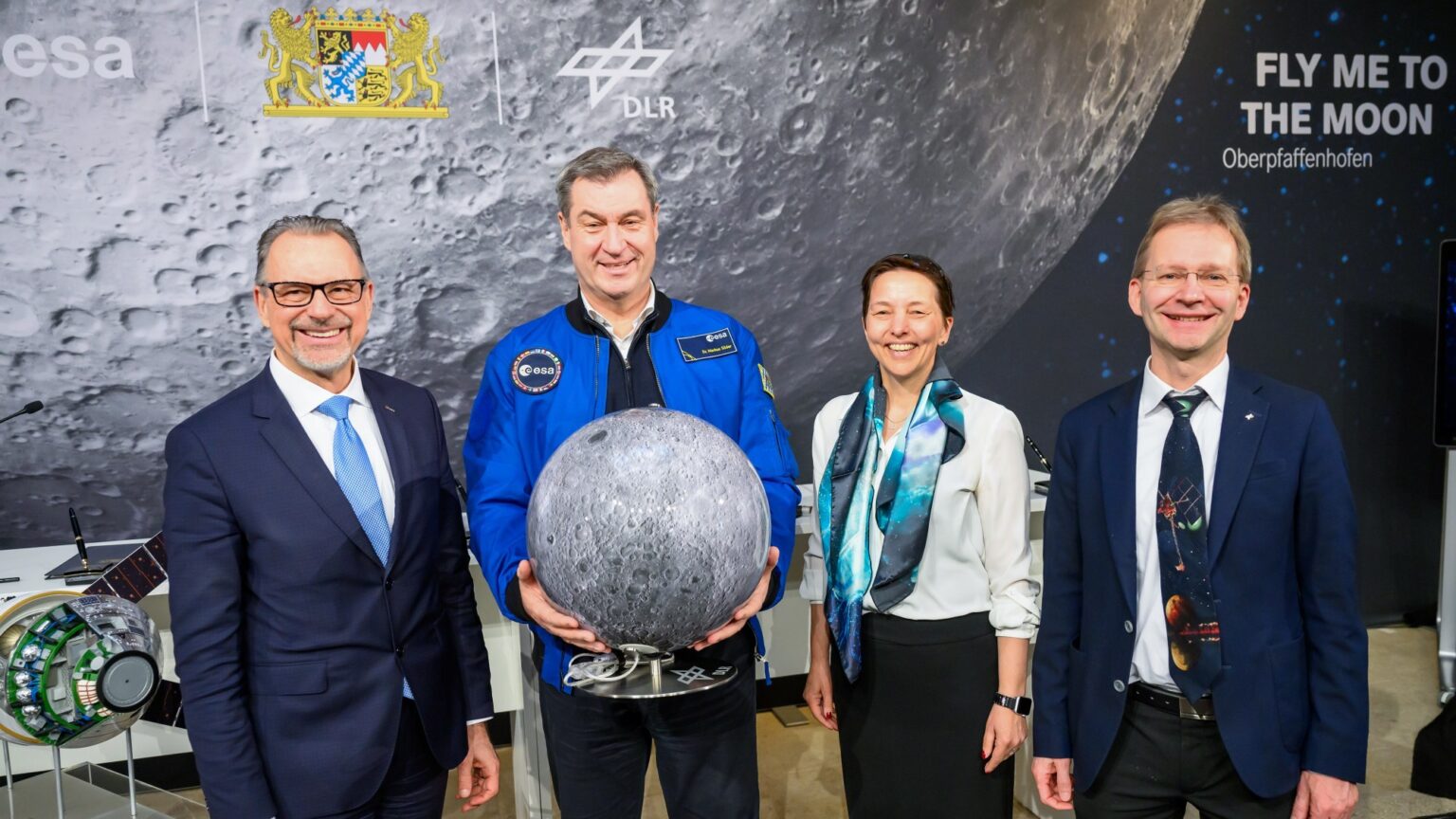
MILAN — Bavarian Minister-President Markus Söder announced Feb. 4 that the German Aerospace Center (DLR) will receive 58 million euros ($69 million) to build a Human Exploration Control Center to support future robotic and human exploration missions. The total cost of the facility is 78 million euros and in addition to the Bavarian funding, DLR will invest 20 million euros from its institutional budget.
The investment adds to Germany’s broader effort to position itself as a potential European leader in lunar exploration.
The center will be a DLR-led facility located at the agency’s site in Oberpfaffenhofen, near Munich, as part of the German Space Operations Center (GSOC). DLR will own the facility, while the European Space Agency will act as a client for operational services. The center will support European operations for the Gateway program, replicating the approach GSOC already applies to operating the ISS Columbus module by ESA, which includes, among others, operations such as coordinating scientific experiments, monitoring and operating life support systems and providing communication channels between the ISS and the ground control stations. Dorothee Bär, Germany’s Federal Minister for Research, Technology and Space, framed the project in strategic terms. “Expanding our national expertise in spaceflight operations is a significant German contribution to Europe’s sovereignty in space,” she said.
The project includes the construction of a new building designed to accommodate about 200 staff members that is expected to be completed by 2030, a DLR spokesperson told SpaceNews.
Beyond infrastructure, GSOC teams are developing new operational and deployment concepts for future moon and Mars missions after Gateway. The DLR spokesperson confirmed that the agency is already working on an enhanced vision for an “HECC Plus version, which will be implemented within the 2030 timeline and is already part of the allocated budget, and includes a multi-mission control center with high-security control and server rooms. This will allow us to serve customers beyond ESA as well.”
National strategies within Europe’s lunar ambitions
Funding a new HECC for lunar exploration aligns with the priorities Germany laid out at the most recent ESA ministerial. There, Germany emerged as the largest contributor to the agency’s human and robotic exploration program, pledging 885 million euros for the next three years. The portion of that funding specifically allocated to lunar exploration has not yet been disclosed and is expected to be clarified in the first quarter of 2026. The new funding nevertheless reinforces Germany’s position as the most advanced European actor in developing a long-term approach to human lunar and Mars exploration.
Germany and France, ESA’s two largest contributors overall, have pursued different strategies. France allocated 342 million euros to exploration at the latest ministerial, of which only 45 million euros was dedicated to lunar activities.
Gilles Rabin, CEO of Hic et Nunc and former space attaché at the French Embassy in Germany, told SpaceNews that the divergence reflects deeper national priorities.
“For Germany, it is not a question of revenue or policy. It’s not only about making money, but about saying that going to the moon is important for humanity and for Germany. It’s not a question of new space or old space — they want to develop an inspirational project,” he said.
Within Germany, Rabin added, industrial alignment with this political vision will be a key variable. “There are two particularly influential figures shaping Germany’s exploration policy right now. On one side, you have Marco Fuchs, CEO of space systems developer OHB and son of OHB founder Manfred Fuchs, whose ambition was to go to the moon. On the other, you have Markus Söder, who is strongly focused on lunar exploration and wants Bavaria to play a larger role in it.”
“France, on the other hand,” Rabin said, “is about launchers. France is Ariane 6 and autonomous access to space. Exploration is not the objective. It can be a way to develop new launchers, but the primary goal is to secure European launch capability.”
Italy, which committed 834 million euros at the latest ministerial to human and robotic exploration — including 274 million euros for lunar activities — is the third-largest contributor to ESA’s exploration budget and appears more closely aligned with Germany’s approach. Still, Rabin noted a distinction between aligning industrial capabilities with international partners and developing a coherent national strategy.
“Thales Alenia Space is a major player and operates a very important lunar facility in Turin,” Rabin said. “But the question is about strategy. Do they want to develop lunar exploration not just in terms of industrial tasks, but as a matter of Italian policy?”
Taken together, the three countries illustrate diverging European approaches to exploration: Germany treating the moon as a long-term strategic and inspirational objective, France prioritizing launch autonomy over exploration itself and Italy positioned between the two — industrially capable, but still defining the political role it wants lunar exploration to play.
For Rabin, there’s one question for Rome: “Do they want to be part of the game, or not?”
Editor’s Note (Feb. 10, 2026): This article originally misspelled the name of Gilles Rabin. SpaceNews regrets the error.
Related